When I was doing research for my book, Keepers of the Sheep: Knitting in Morocco’s High Atlas and Beyond, I came across a beautiful pair of leg warmers in the book Berber Costumes of Morocco by Frieda Sorber and Marie-Rose Rabaté. The complex tessellating pattern was intriguing and reminded me of the patterns decorating objects I had seen while living in Niger. The knitter in me wanted to know how the leg warmers had been made, but I was also curious about the knitters themselves and the history and contexts in which the leg warmers had been made and used. Since I was living in Morocco, I immediately set out to find knitters in the Middle Atlas who might be able to help me.
Unfortunately, my trips to the Middle Atlas, where I talked with artisans and residents, were fruitless. No one seemed to know how the leg warmers were made, and some didn’t even know about them. It seemed that this knitting tradition had declined with changes in fashion and eventually disappeared when the last knitters passed sometime in the first half of the 20th century CE. Nevertheless, there could still be people out there who were raised with this knitting tradition and still have memories of it. I just never managed to meet them.
Being too curious for my own good, I couldn’t just let go of these leg warmers. Over the course of a year, I developed a hypothesis for how the leg warmers might have been knit based on many hours of experimental knitting informed by photos of leg warmers (example – inventory no. 71.1996.22.2.1-2) in the Musée du Quai Branly collection in Paris and a photo (inventory no. PP0227604) from their archive depicting a man in the Middle Atlas knitting what are likely leg warmers (use the inventory numbers and search bar on the Musée du Quai Branly collections page).
The best way to produce the tessellating pattern proved to be intarsia-in-the-round, which was confirmed by the photo of the man knitting in the Musée du Quai Branly archive as well as photos of the inside of leg warmers at the same museum. Having never knit intarsia before, much less in-the-round, it took me many months to figure out just how to do one line of diamonds in the pattern – never mind trying to get the diamond pattern to repeat over and over again. And so, I developed the gauntlet glove pattern available in the book I wrote, which only requires one line of diamonds.
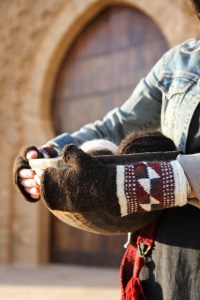
While I was pleased with having figured out the single row of diamonds, my brain was not satisfied. I really wanted to be able to make the diamond pattern repeat over and over again, as it does in the leg warmers, without creating gaps in my knitting. But, life has a way of distracting you. This project was put on the back burner as COVID-19 hit the world and I was swept up with relocating from Morocco to the USA and then Armenia. Once in Armenia, I hit the ground running doing research for a new book about knitting in Armenia (working title, Knitting at the Crossroads: A Journey with Knitting in Armenia).
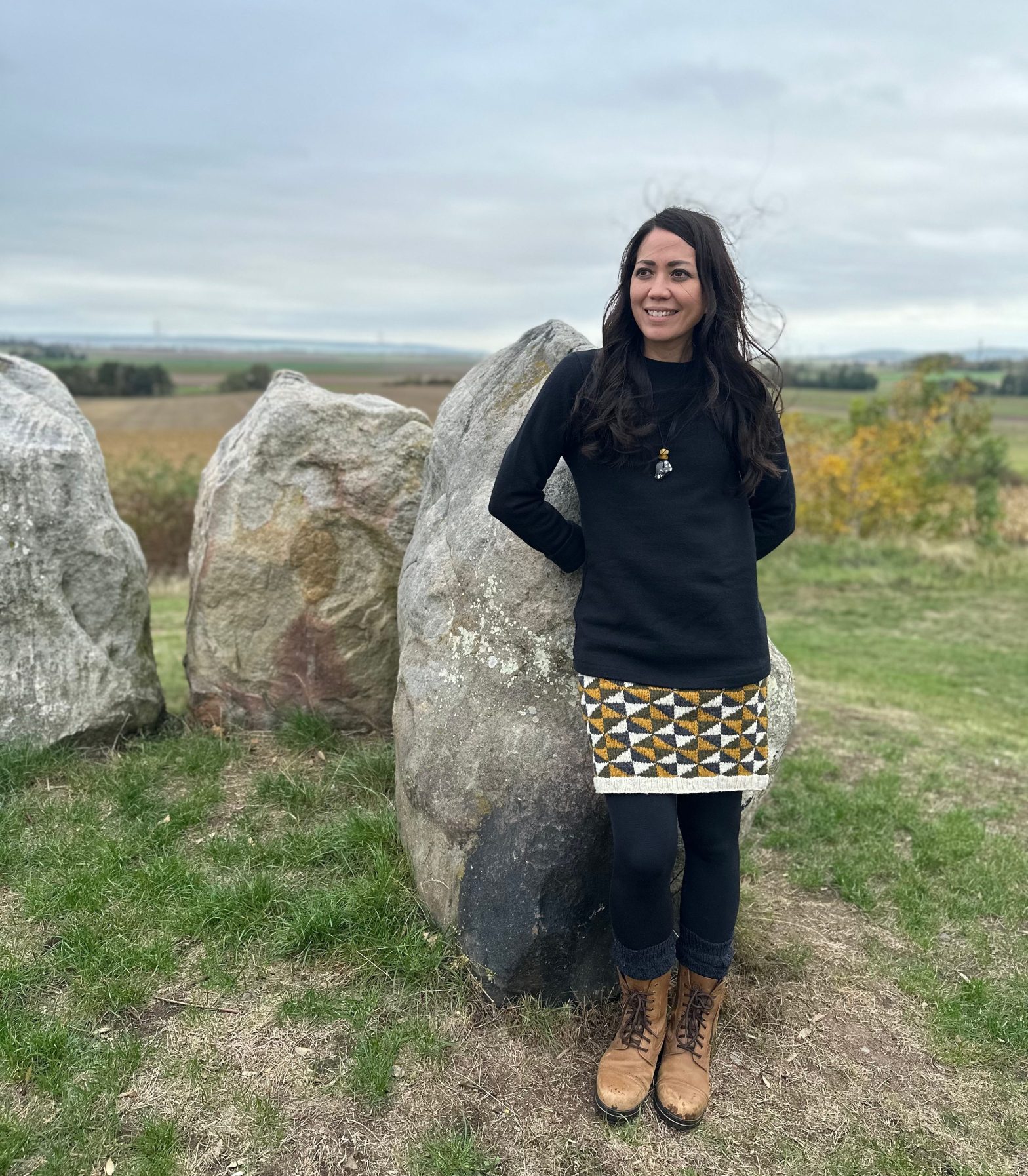
Fast forward to last year (2025), and I finally could no longer ignore the itch to revisit Middle Atlas intarsia-in-the-round. I didn’t feel like knitting leg warmers because I knew that I likely wouldn’t finish the second one given my busy schedule and long list of work for my Armenia book. I dislike putting time and effort into something that winds up unfinished and unusable, so I decided to knit a skirt. I reasoned that a tube skirt is similar in shape to a leg warmer and, although it would require more bobbins, I would have a ready-to-wear garment at the end of it and no need to knit a second one (famous last words).
After introducing the bobbins, I was slightly horrified by my decision to apply this technique to anything wider than my leg. My knitting was a mass of yarn that looked as if it would seize up into a giant tangle the minute I moved it. What was I thinking? I would never be able to wrestle this into a completed garment. However, that itch to figure it out was now a full blown flaming rash, so I plodded onwards. I knew that it should work since I had successfully created the gauntlet pattern. I just needed to calm down and be methodical. And so, it began. The first row of diamonds came out as expected, but the second row took several tries to figure out. There were definitely moments when I questioned my sanity, but I eventually figured out how to transition to the second row and the third row. By this point, I had a clear idea of the order of operations. The knitting became easier and easier. Dare I say, it almost became as relaxing as knitting a simple garter stitch scarf? Before I knew it, the skirt was done.
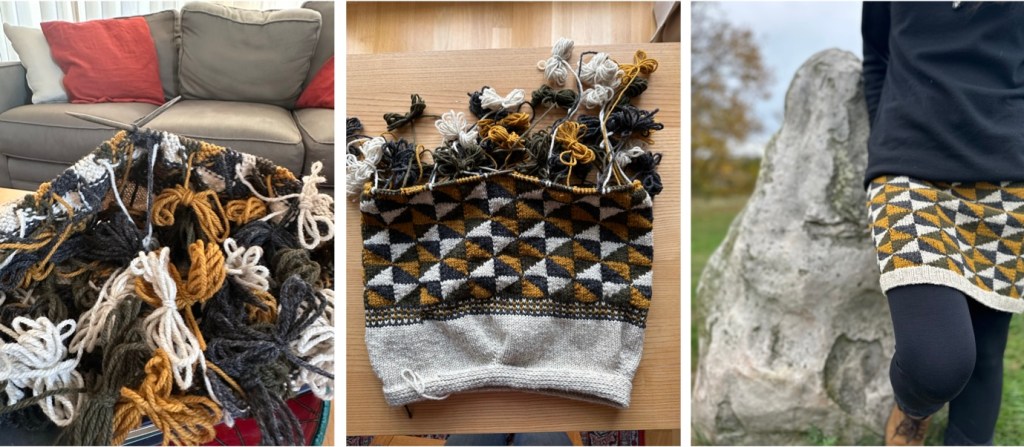
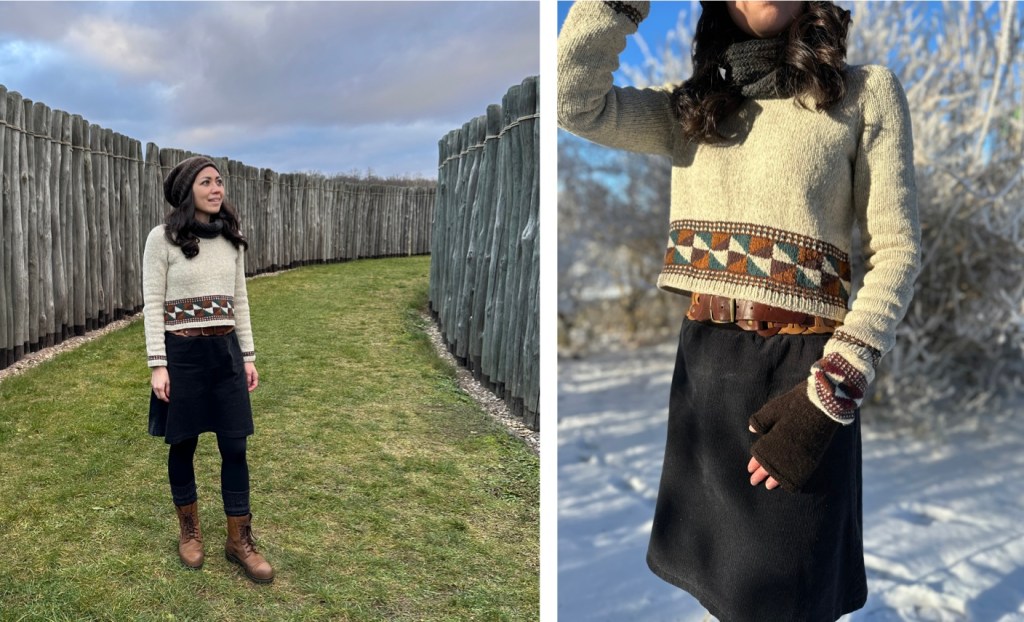
As soon as I bound off my stitches, I wanted to keep working with the motif. I had grand ideas to design a sweater, but I just didn’t have the time, and my reserve of patience was in sore need of refilling. So, I decided to add the motif to the Molly Cocoknits sweater. I really love Julie’s method of knitting sweaters. I am petite-ish, but my shoulders are broad and straight for my frame, which often makes for ill-fitting necklines. However, with the Cocoknits method, I have been able to produce sweaters that fit my shoulders well. Anyway, I opted to shorten the Molly and only increased to a number of stitches that would accommodate the motif and my middle. Although I had thought about doing an all-over design, I chose to do only a line of diamonds at the hem. This left me with lots of leftover yarn so, of course, I immediately cast on for a second skirt (because I needed to test what I had learned to make sure I had really learned it, right?).
Between the first and second skirt, I began developing a written pattern for the skirt and a step-by-step instructional guide for how to do intarsia-in-the-round for this particular motif. Readers of my first book will know that I strive to find a happy medium between oral tradition and written patterns. My grandmother, who taught me to knit when I was 5 years old, does not use written patterns. She might look at the pictures in knitting pattern books for the ideas, but she never follows the instructions. Instead, she knits a gauge swatch and uses calculations and her own experience with knitting to create the sweater she wants. Although I had strayed very far from this style of knitting, and had even become a fairly militant gauge swatch knitter who followed written patterns to the letter, my work with shepherd-knitters in the High Atlas mountains of Morocco re-introduced me to the beauty and freedom of an oral knitting tradition. It blew my mind and did wonders for building my self-confidence as a knitter. I wanted to capture that same feeling in my pattern.
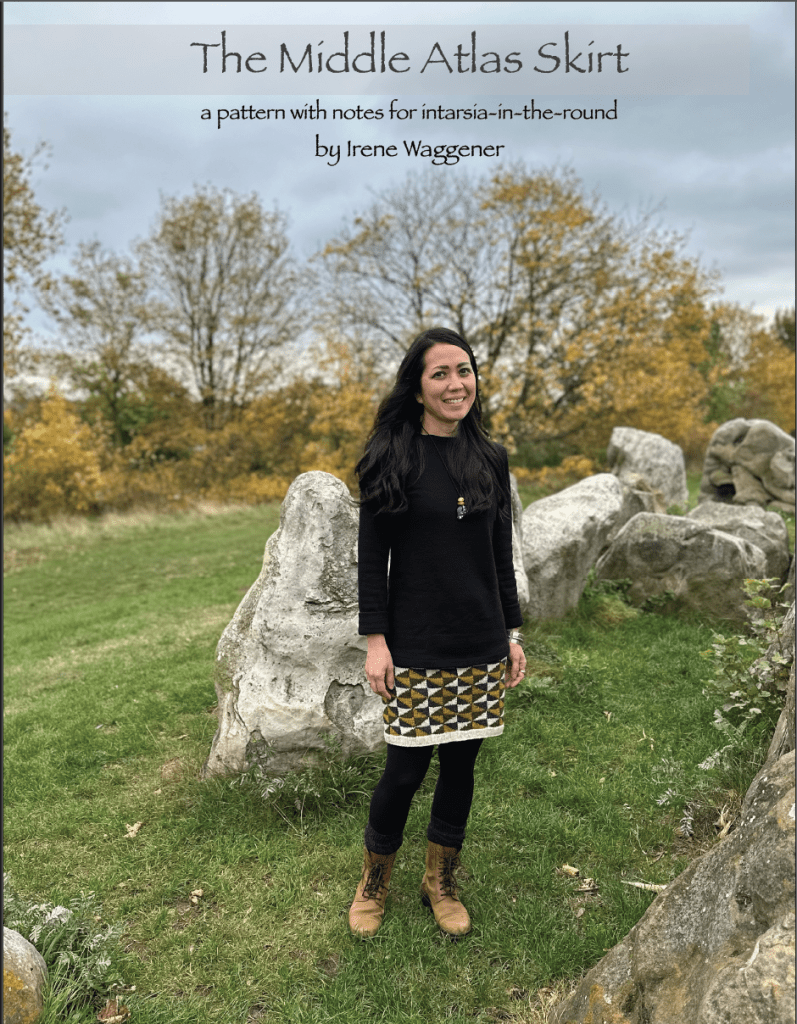
And so, the Middle Atlas Skirt pattern with notes for intarsia-in-the-round was born. Unlike most conventional knitting patterns that require you to get gauge and tell you exactly how many stitches to cast on, increase, etc., this pattern only requires one gauge swatch (using whatever needles and yarn you have on hand) and your waist and hip measurements. A table walks you step-by-step through the calculations necessary to produce a skirt that will fit your body shape. Once those numbers are determined, they are added to the pattern, which has blanks for your specific numbers. While some might groan at the thought of doing math, I have tried my best to walk you through it with clear and simple directions and formatting. The amount of time it takes to knit your swatch, measure your body, and figure out your numbers takes as much time as knitting gauge swatches for a conventional pattern – possibly less if you are like me and waste hours, if not days, trying to get gauge with dozens of little squares of knitting. The beauty of this style of knitting is that you can use any size needles and yarn (although it works best with yarns in the DK and worsted weights). Moreover, since the intarsia-in-the-round motif does not use much of any one color, it is great for yarn stash busting.
If you are interested in giving this skirt and intarsia-in-the-round a try, you can find my pattern on Ravelry (I am working on adding it to my Etsy page and will update here once that’s done). I am always happy to see what you do with my work, so please do tag me on Instagram (@waggens_ho) or send me an email (see the ‘Contact’ button at the top of this web site). As a self-funded, independent researcher, pattern sales help me cover the costs associated with my work. If you do purchase the pattern, thank you very much for investing in my research! If you don’t want to purchase the pattern but would still like to support my writing, please consider sending me a tip via Ko-fi. Thanks!
Up next – Why is understanding Middle Atlas intarsia-in-the-round important?
 106 Meters from the Road