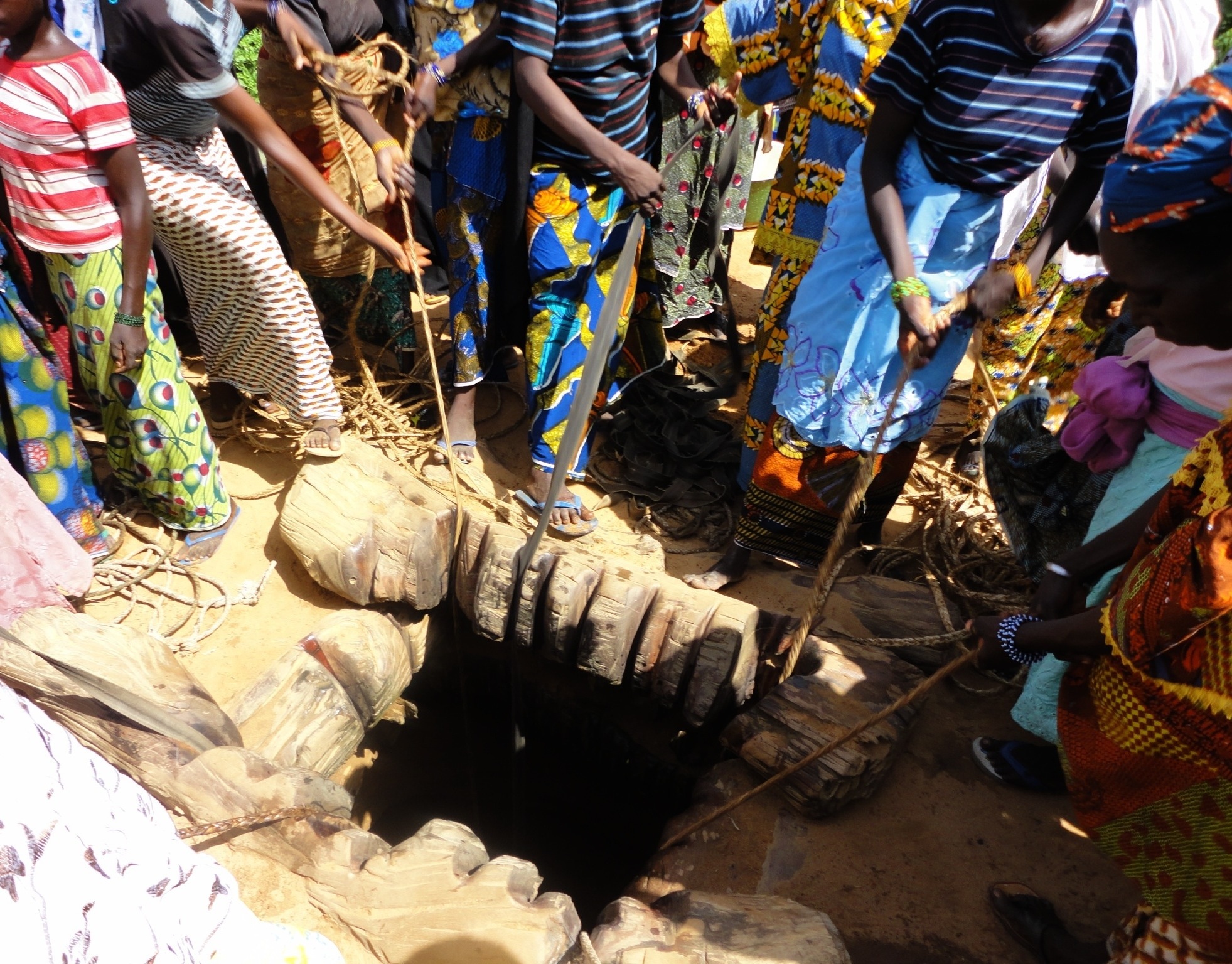
Even though we did not speak the same language, the village women made it clear that they wanted me to experience hauling the water bucket from the bottom of the 118 meter well. I stepped up to the edge of the gaping hole surrounded by four hefty wooden logs. Each one was deeply grooved in parallel lines by the daily passage of ropes. I was terrified that I would fall in. I took hold of the thick rope with both hands and pulled, digging my feet into the dirt, trying not to look down. The great resistance of the water-filled bucket deep down at the bottom of the well traveled up the rope. I could feel the women behind me as they grabbed the rope just behind my hands. There were three of us in a line, bending forward and leaning back in unison as we inched the heavy bucket closer to the surface. It seemed it would take forever. Finally, with sweat seeping through my shirt, we pulled the large pouch made of tire rubber to the surface. Cloudy water sloshed onto our dusty feet and instantaneously disappeared into the hard packed earth.
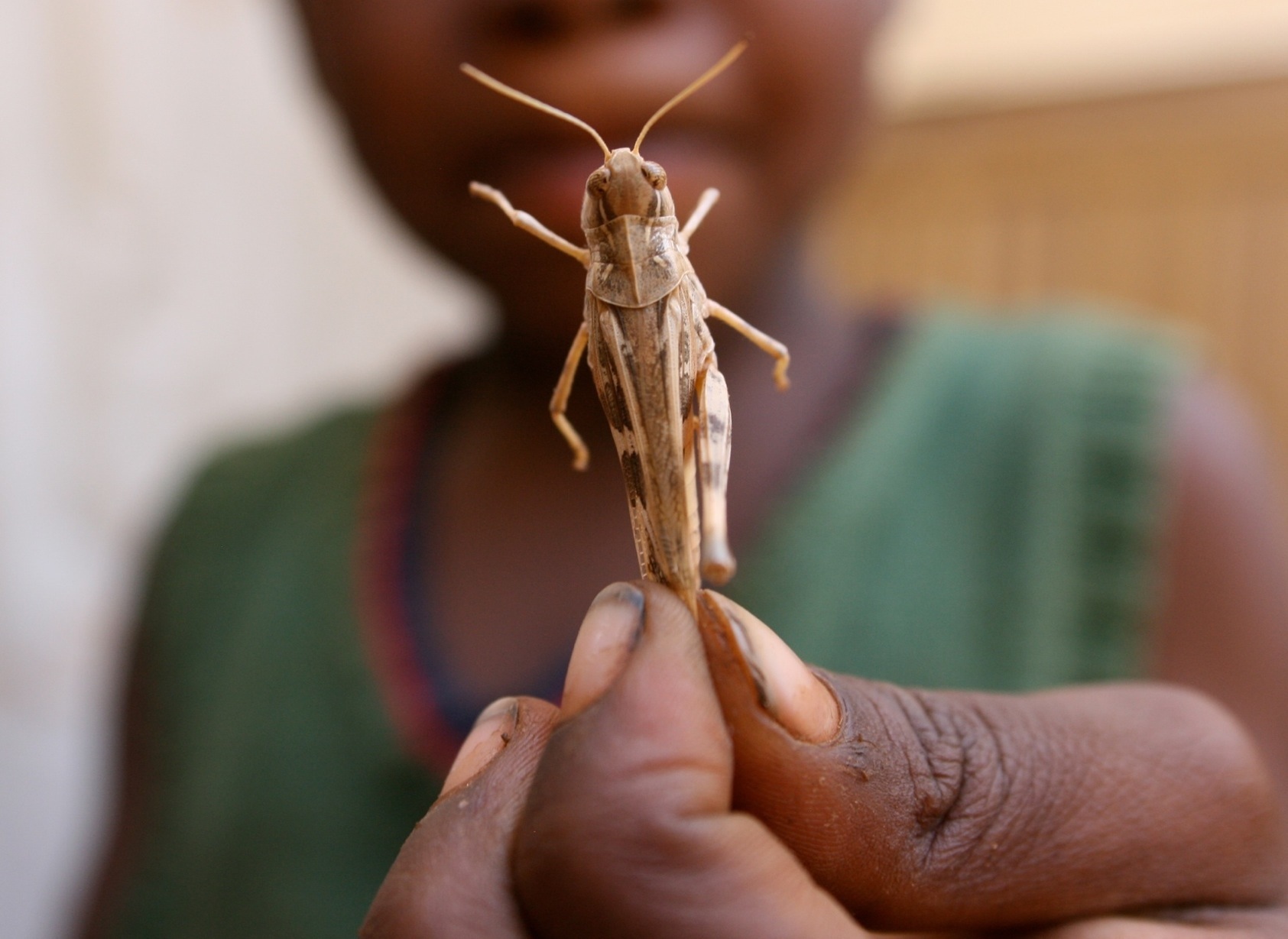
Niger is full of grasshoppers. My friend’s son enjoys catching them just to show he can. Some villagers outside of Niamey gather the insects in the early morning when the grasshoppers can’t move too quickly. At home, they boil them, dry them in the sun, and then bring them to Niamey’s Katako market. Sautéed grasshopper with West African spices is a popular snack. Read more about it at amoveablekitchen.blogspot.com.
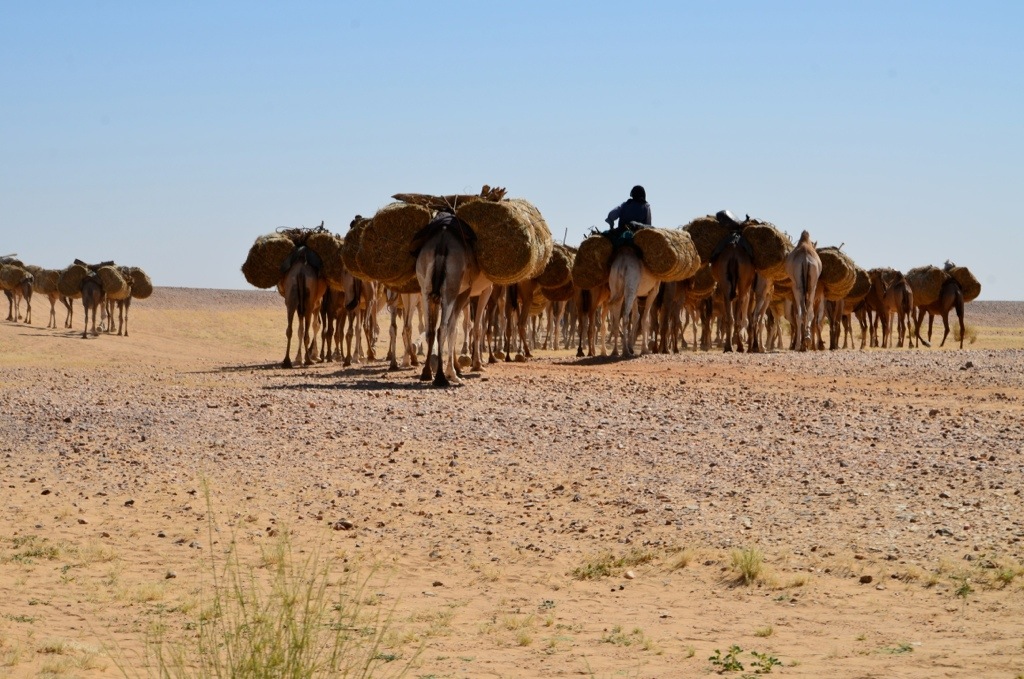
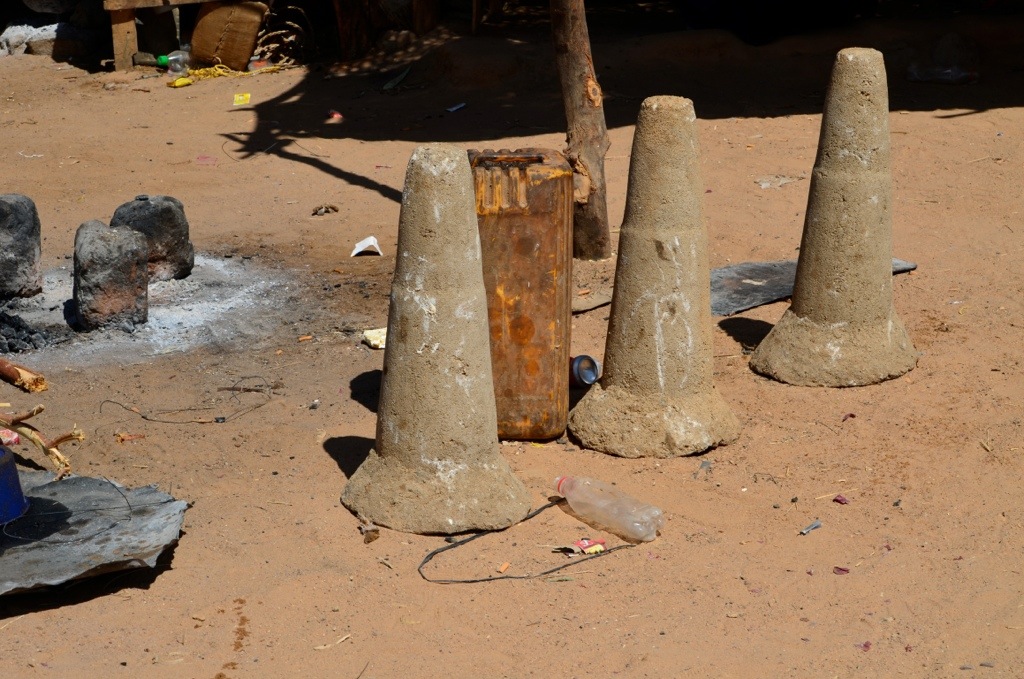
While driving east out of Agadez one November day, we came across some Tuareg traders setting out on their annual trek across the Sahara to the small town of Fachi. A small handful of men undertake the arduous 29 day journey with camel herds reaching into the hundreds. Loaded on the backs of the camels are provisions for the men and their animals as well as fresh produce and firewood to trade for the large cylinders of salt they bring back to Agadez (pictured below). You can find these same salt cylinders in Niamey’s markets as well. According to Issouf Ag Maha in his book, Touraeg du XXIeme Siecle, the journey is considered a right of passage for young Tuareg men. Navigating through a bleak environment with few landmarks and no sources of food and water for nearly two months is not taken lightly.
I will never forget sleeping under a desert sky full of crystalline stars. As I lay on my blanket arranged on the sand, the only sound I heard was an occasional breath of wind. The vastness of the empty space made me feel incredibly small. The silence amplified the size of the Earth and the universe to which we belong. Getting there, I thought we would lose our SUVs to the satiny sand, but they made it thanks to some expert driving. There are no roads once you get out there – even the dirt tracks carved by previous vehicles do not exist. You feel really and truly alone.
At the annual Cure Salée in July, the Tuareg and Wodaabe gather at In-Gall near Agadez for a month of camel racing and speed dating before the nomadic groups splinter off again into the dusty expanses of the Sahara and Sahel. One evening, the Tuareg gathered for the “dating wheel” in an empty expanse near their pitched tents. Women, decked out in their finest, sat atop donkeys loaded down with decorative leather household items in maroon, teal, and midnight blue. Turbaned men wheeled their towering camels this way and that to show off the elegant swish of long leather tassels hanging from the animals’ humps. When it was time, the women steered their donkeys into a circle and began parading them in a counter clockwise direction. The men on camels quickly formed a ring around the women and maneuvered their camels in a clockwise direction. They continued in this way for a while, giving both men and women a chance to check each other out before approaching their love interests after the event.
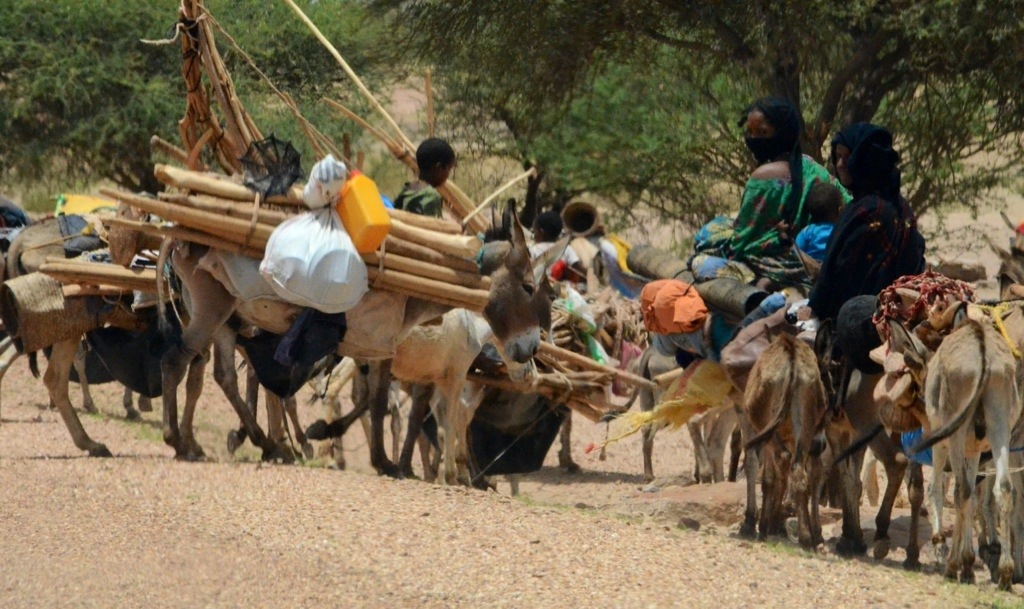
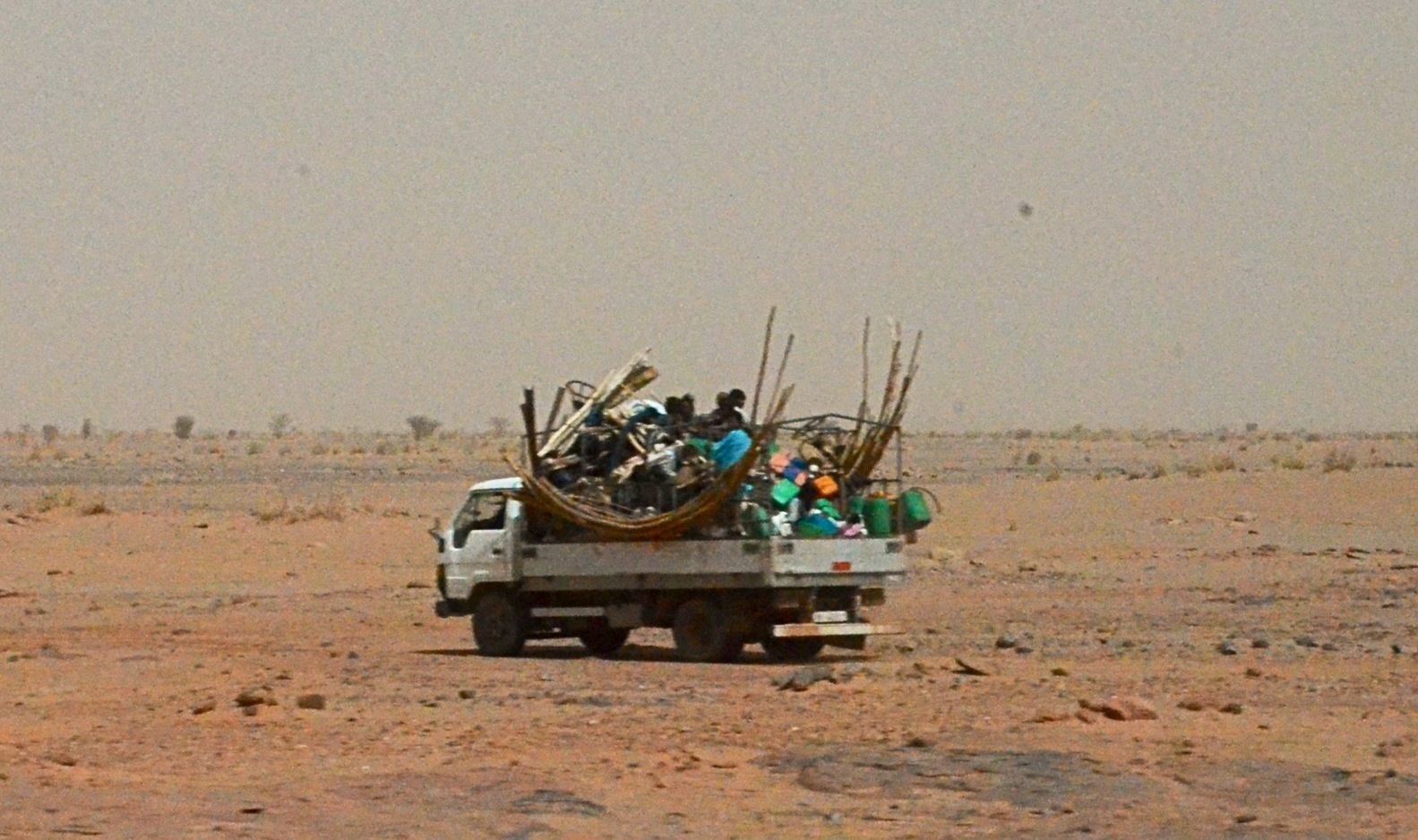
Traveling near Agadez in July brings you across many caravans of people moving their cattle, sheep, goat, and camel herds across the greening desert. The herders take advantage of the shallow lakes produced by the seasonal rains that fall from April to August. Both people and animals congregate around the watering holes to quench their thirst and cool off before moving on to stubbly pasturelands. Many herders move their household the old-fashioned way – on the backs of camels or donkeys. But, increasingly, you see traditional loading methods on the backs of Toyota trucks as well…
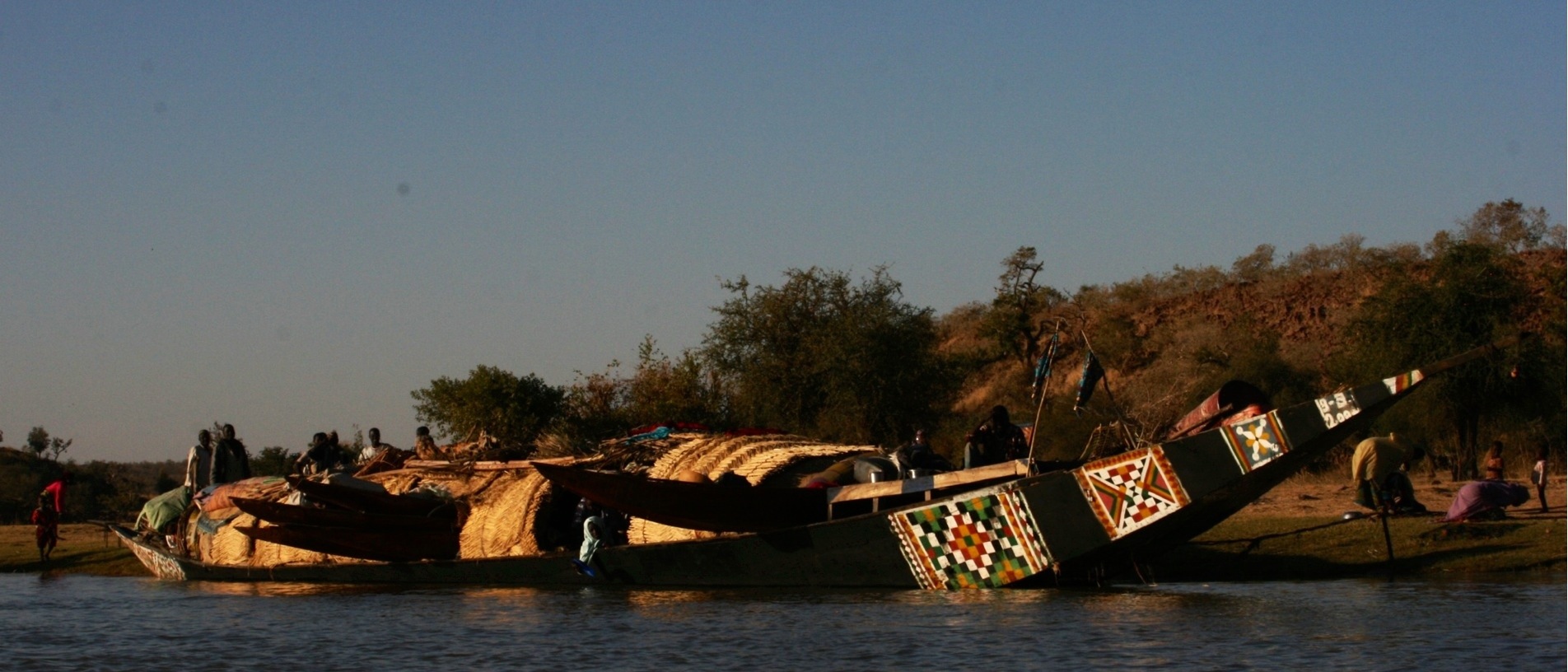
As our narrow pirogue slipped through the Niger River, I looked out across the calm water reflecting the rosy hue of the evening sky. In the distance, four large pirogues glided silently towards us. Unlike our open passenger boat, these ones were piled high with sacks, buckets, goats, chickens, and one even had a motorcycle on it. They also had smaller pirogues stacked one on top of the other across their decks. Shelter for the boats’ inhabitants was provided by straw mats stretched in arcs across parts of the deck. Colorful pieces of cloth fluttered from the entryways of the shelters. While the four boats pulled up to shore, more boats came gliding into view. There were eleven of them altogether. Men, women, and children jumped on land and set to work immediately preparing cooking fires. Dusk was clearly upon us and the first evening stars were beginning to appear on the darkening horizon.
These were river nomads, people from Mali who travel down the Niger River through Niger and into Nigeria where they trade agricultural products for manufactured goods like petrol, household wares, and other urban commodities before traveling back up the river to Mali.
The Shiriken, or camel festival, takes place every Spring in Akoubounou, Niger – a small town near Abalak in the western part of the country. Tuaregs from the region gather for horse and camel racing, tende music and dancing, Tuareg blues under the stars, and people watching. Community leaders established the festival as a way to keep Tuareg traditions alive as many young people have moved to the city and no longer follow the nomadic, camel-centric lifestyle of their forebears.
Entering the minaret, you crouch on all fours to pass through a small doorway. Grains of sand stick to your hands and bare feet as you crawl up the unevenly spaced dry mud stairs. It is pitch black. As you twist your way up the tight turns, bats take flight, skimming your shoulders and the top of your head. The guano underfoot smells sharp and stings the inside of your nose. Approaching the middle of the tower, you gradually regain your full upright position. It is more spacious, and sunlight cuts through small, square windows. A few more turns and the tower narrows again, forcing you to stoop. Suddenly, a breath of sweet air causes you to lift your head again. Warm sunlight and a view of Agadez’s flat-roofed buildings stretch out below you. Beyond the mud buildings, the expanse of the desert.
The mosque’s imam says that climbing the tower represents the stages of life. In the beginning, you crawl like a baby. In the middle, you walk upright like an adult. And right before you reach the top (paradise), you stoop like an elderly person.
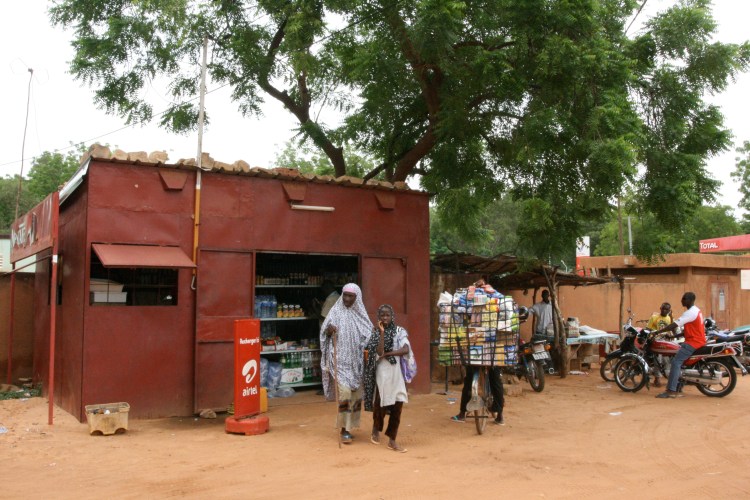
Above: Djibo Boureima with his son, Boubacar Djibo Boureima, inside his new shop. Below: Ambulatory vendor on a bike in front of Mr. Boureima’s shop.
I step into the shop made of metal sheets welded together. A clean-shaven man with a wide smile waves at me from his fortress of shelves piled high with candy bars, biscuits, cookies, 50 CFA bags of peanuts, and water bottles.
Tinny music from a small T.V. perched atop a refrigerator by the door fills the air. To my left, shelves are stacked with neon-colored household cleaning products, baby wipes, laundry detergent, and notebooks. The man switches on the bare fluorescent light bulb above our heads so I can see better.
And then the power cuts off – a common occurrence in Niamey, where the electric company struggles to keep up with demand. A few moments later, it clicks back on, filling the store with the bulb’s greenish glow and mechanical hum.
There are many shops like these all over Niamey, and it’s easy to fly past them in your car with the windows rolled up, the A/C blasting. But thanks to Djibo Boureima’s location facing the American Cultural Center (ACC), I often find myself walking into his shop.
Over the past two years, I have seen his business evolve from a simple wooden structure to the shop I’m in today. He has added a few more shelves and increased the number of items he sells. Last week, I decided to go beyond Ina kwana (Good morning) and Ina aiki (How’s work?) to ask him about the key to his success.
Sitting on a wooden bench, an interpreter between us, we have our first real conversation amidst the buzz of ACC English Language Program students coming to buy biscuits and sodas after class.
“Building this business has not been easy,” he says in a matter of fact tone. “When I was in my early twenties, I could walk all over town with my table of products balanced on my head going from neighborhood to neighborhood and not sell a single thing.” This certainly would not have been easy in a climate where temperatures regularly surpass 110F.
“It was pure luck that one day I stumbled upon the ACC. At that time, it was located in the Grand Marché, where the pharmacy is today. I noticed that there were always people there just hanging out, waiting for classes to start or for their kids to come out of classes. So, I stopped carrying my table all over town and set it up in front of the ACC instead. I didn’t have to walk anymore. My customers came to me!”
And, they keep coming. In the middle of our conversation, Mr. Boureima has to attend to several customers who come in looking for laundry detergent, chocolate cookies, and cell phone minutes. “Mr. Boureima is very well-known because we know we can trust him,” says one customer. “If there’s something I want, I just ask him and he finds it for me. Some people drive all the way across town just to buy things that they know only he has.” The customer continues as Mr. Boureima hands him his change, “and if I don’t have enough today, he’ll let me pay my bill at the end of the month!” Of course, this only works for his regulars.
His customers gone, Mr. Boureima continues, “When the ACC moved to this spot, I was the only vendor who followed. For several months, I set up my table full of candy bars, peanuts, cigarettes, and other things under this tree, in this very spot, where I could see the door, over there. The director at that time noticed I was the only vendor who had moved with the Center. He asked me to build a permanent shop. And, so I did.”
A white van pulls up in front of the open door and the driver waves at Mr. Boureima. They exchange a few phrases in Zarma and the man drives off. “That’s the water wholesaler,” he explains to me. “He drives by every now and again to see if I need more bottled water to sell. In fact, that’s how I get my sodas and cell phone minute cards, too. Once I had my storefront, the wholesalers wanted to do business with me.”
A young boy, roughly ten years old in age, enters the shop and takes a seat by the cash box. He quickly jumps up again and attends to a young customer who wants to buy some sweets. Boubacar Boureima is Mr. Boureima’s son who is now taking English classes at the ACC.
It is the steady stream of students who have made it possible for Mr. Boureima to go from being a street vendor carrying his wares in search of customers to the owner of two stores. Mr. Boureima’s ability to spot a market and cater to its needs is the key to his success.




 106 Meters from the Road