What is the earliest evidence for knitting? This is a question whose answer will evolve over time as interest in knitting research grows and brings more material to light. Many books that cover this topic (including my own – Keepers of the Sheep: Knitting in Morocco’s High Atlas and Beyond) follow in the footsteps of Richard Rutt, who has written one of the most comprehensive books on the history of hand-knitting to-date. While this book is essential reading for anyone interested in this topic, several decades have passed since its publication. Advances have been made in fields both directly and indirectly related to knitting, which could help us bring more nuance to our understanding of the subject. This nuance, in turn, will help to point us down new avenues of inquiry. As with anything having to do with the sciences, it’s important to re-evaluate the initial work carried out by the pioneers of early knitting research and to consider how those findings may be confirmed, refined, or updated.
In his book, A History of Hand Knitting, Rutt states that the “earliest pieces of true hand knitting now known to us come from Islamic Egypt” (p.32). These pieces include a number of blue and white stockings knit in cotton from the toe up. The dating of these artifacts is often based on contemporary finds rather than chemical analysis, which means that the dates provided are conjectural. Rutt shares that museum authorities approximate the 1200s to 1500s for dating these stockings (p.35). These socks and other knit fragments are generally associated with the Fatimid (909-1171 CE), Ayyubid (1171-1250/60), and Mamluk (1250-1517) periods of Egyptian history. During these periods, Egypt was a cosmopolitan center of trade that attracted diverse people from around the Mediterranean, West Asia, and beyond – a topic I am focusing on in this project.
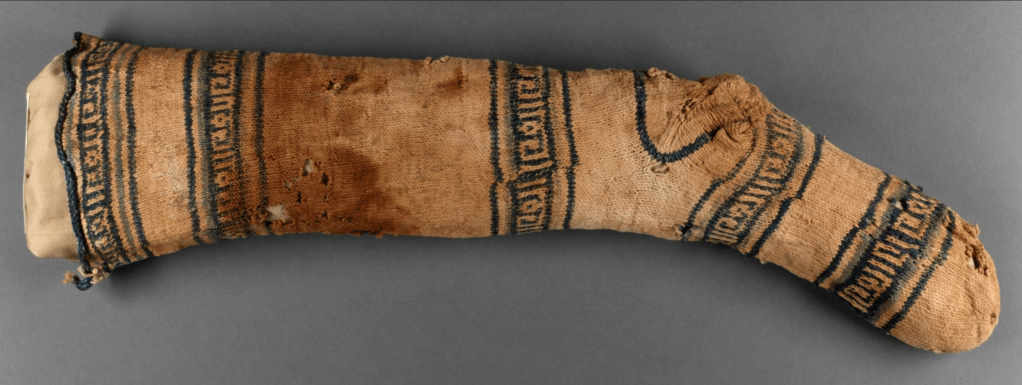
The Metropolitan Museum of Art, New York – object number 27.170.95
(https://www.metmuseum.org/art/collection/search/448138?=&imgno=3&tabname=object-information)
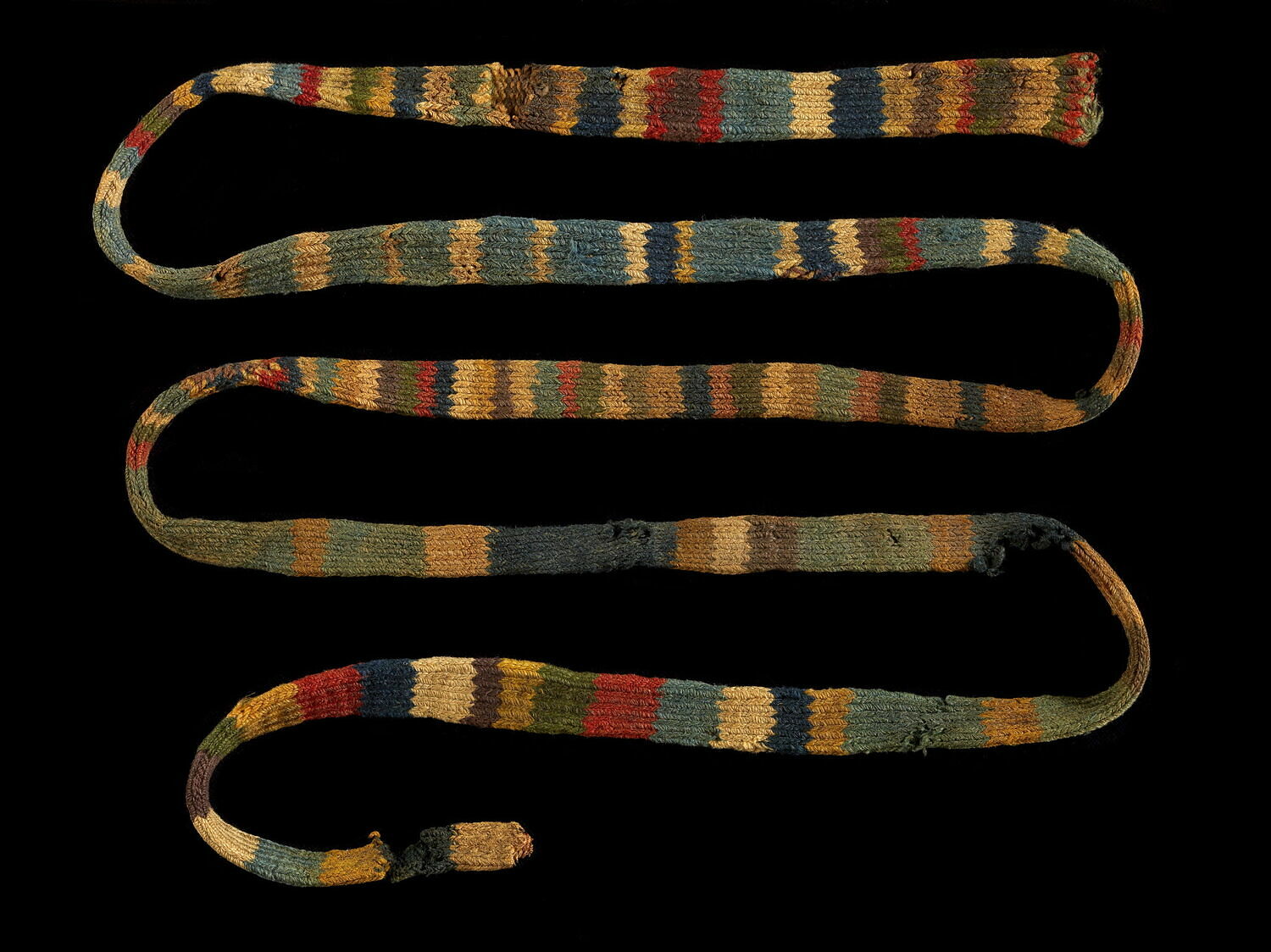
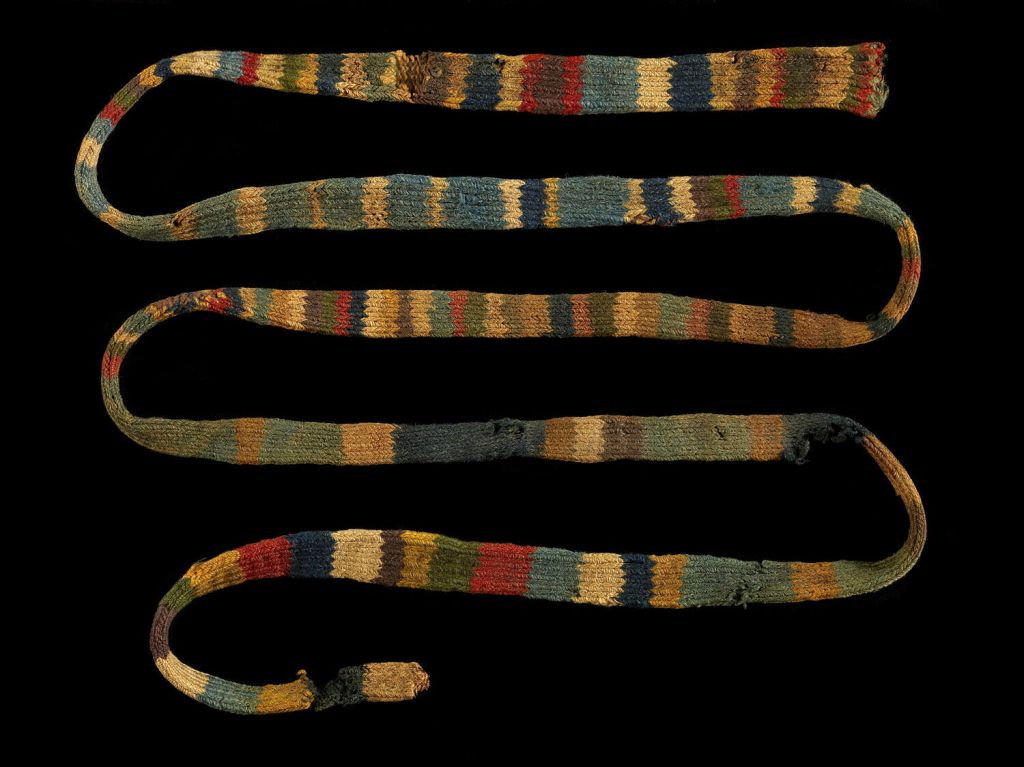
Not included in Rutt’s book are tube belts that appear to have been made by knitting – possibly with a knitting frame or knitting needles. Rutt was likely unaware of these objects because very little – or nothing at all – had been published about these pieces when he was writing his book. One of these belts (inventory number AF 6027), which is at the Louvre in Paris, France, has been chemically dated to 420-600 CE. Not only does the chemical dating provide a firm date range, it also makes this belt the oldest known example of knitting. Unfortunately, the exact provenance of this knitted tube is unknown, but it is believed to have come from Egypt.
A fragment of a similar belt (object number 15/2010) is at the Museum für Byzantische Kunst in Berlin, Germany. Unlike the Louvre belt, it is a solid reddish color; but otherwise, it appears to be similar in structure and appearance to the Louvre belt. The Berlin belt came from Arsinoe/Crokodilopolis, Egypt and is believed to date to the 4th-11th centuries CE; however, it has not been chemically dated like the one at the Louvre. Its dating is based on comparable knitted tube belts from Fustat and Qasr Ibrim (also in Egypt) that were found in 11th century CE stratigraphic layers.
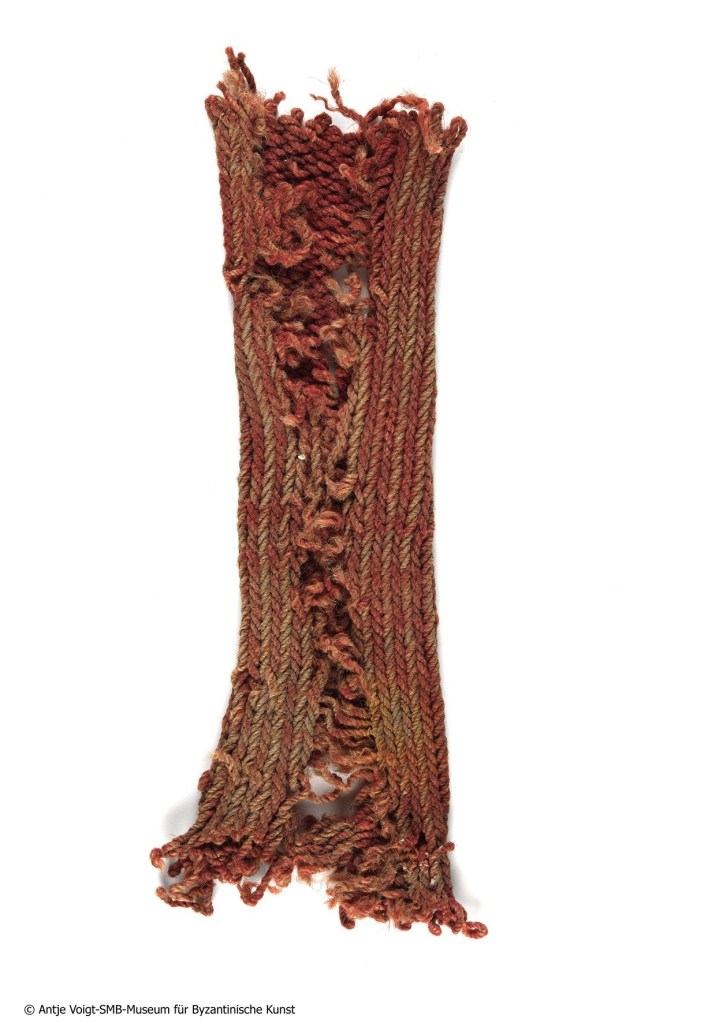
Credit: Staatliche Museen zu Berlin, Skulpturensammlung und Museum für Byzantinische Kunst / Antje Voigt
CC BY-SA 4.0
According to Gudrun Böttcher, who analyzed the Berlin belt fragment, the stitches were each lifted over two consecutive rows of yarn and was likely done on a knitting board or frame with nails (Finneiser, Linscheid, and Pehlivanian, pp.90-91). This type of knitting, referred to as compound knitting, can also be done on needles, as illustrated by Marianne Erikson in her book, Textiles in Egypt: 200-1500 A.D. in Swedish Museum Collections (p.234-235). To-date, no knitting tools have been found to confirm or deny knitting with needles or a frame, and the structure of the fabric does not readily indicate the tools used to make it.
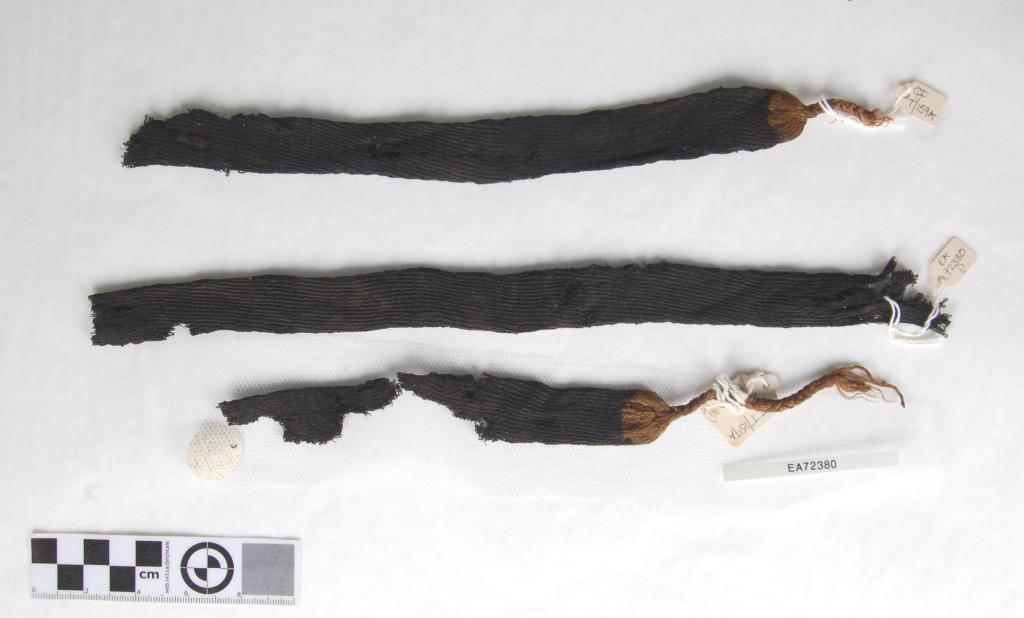
The use of these knitted tubes as belts is based on finds dating to the 8th-10th centuries CE from Nag el-Sheima and Old Dongola in Nubia. At these sites, knitted tubes were found in graves where the deceased wore them as belts (Finneiser, Linscheid, and Pehlivanian, p.91). This information is intriguing when considered alongside the ethnographic material provided in Alfred Bel and Prosper Ricard’s pamphlet, Le travail de la laine à Tlemcen, in which they describe women knitting tubular belts with five hooked needles in Tlemcen, Algeria in the early 20th century (pp.243-244).
© The Trustees of the British Museum.
Shared under a Creative Commons Attribution-NonCommercial-ShareAlike 4.0 International (CC BY-NC-SA 4.0) licence.
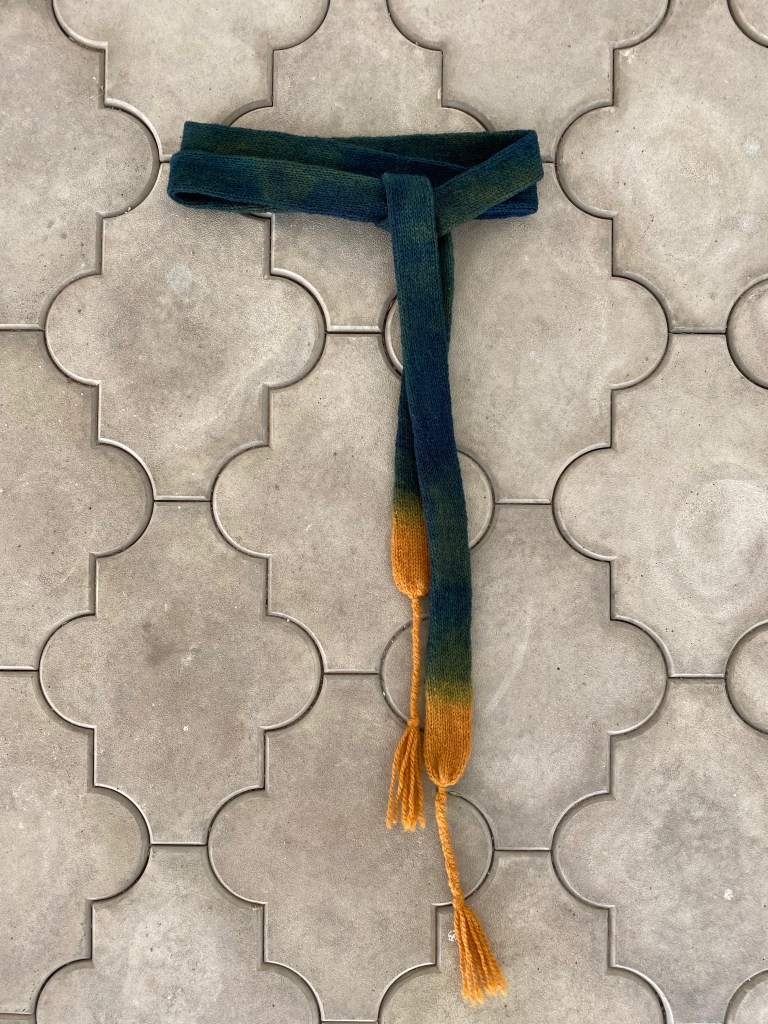
For my book, Keepers of the Sheep: Knitting in Morocco’s High Atlas and Beyond, as well as an article for Piecework magazine, I recreated these belts, known as tekka manqusa, based on Bel and Ricard’s descriptions (Waggener, pp.134-137). The resulting belts (shown below) look similar to the earlier knitted tube belts found in Egypt and Nubia. However, the early 20th century Algerian belt differs in that it was made using a simple knit stitch (as described by Bel and Ricard) rather than the compound knit stitch described by Böttcher.
While I do not have information on exactly how the belts from the Nubian graves were used, Bel and Ricard note that in Algeria the belts were used to hold up pants (p.243). Based on my experience recreating the belts, I can attest that they are stretchy just like our modern elastic waistbands and would have been a comfortable way to secure one’s pants. While difficult to prove without an unbroken chain of evidence, I believe it is reasonable to speculate that the knitted Algerian belts are related to the knitted Egyptian and Nubian belts. As I discuss in my book, the entirety of northern Africa was (and still is) connected by a network of overland trade routes, some of which have been in use for hundreds if not thousands of years (pp.110-112). It is very likely that knitted tube belts and the techniques for making them spread throughout the region stretching from Egypt to Morocco.

In comparison to the highly decorated knitted socks from medieval Egypt, these knitted tube belts are rather plain. This might be one reason they were not attention-grabbing in the 19th and first half of the 20th centuries when they were unearthed. With thousands of objects to catalog and analyze, it’s understandable that certain pieces might take precedence over others. However, these humble pieces of knitting could reveal much about the history of knitting. They certainly provide evidence for the “simple knitting” that likely would have pre-dated the intricately patterned knitted pieces of the medieval period.
Intriguingly, there is an even more humble piece of knitting at the Ashmolean museum in Oxford (accession number AN1941.1170). As far as I am aware, it has not been included in any book on knitting history, which is unsurprising given its very unremarkable appearance. It is an undyed, wool fragment in what appears to be garter stitch (alternating rows of knit and purl stitches created by knitting back and forth). One side has what looks like a selvedge edge made by slipping the first stitch when knitting flat. According to the museum, this piece is associated with Egypt’s Byzantine period, giving it a date range of 395-641 CE, which places it in competition with the Louvre belt for oldest known piece of knitting. However, I do not know if it has been chemically analyzed, and its exact provenance appears to be unknown. Nevertheless, this unassuming knit fragment raises questions – the most prominent one being: was it indeed knit flat? An unresolved issue for knitting history is whether flat knitting or knitting-in-the-round came first. Richard Rutt hypothesizes that circular knitting was probably first (p.23), and the tubular belts argue strongly for this. But, if the Ashmolean piece really was knit flat and came from the same time period as the Louvre belt, then flat knitting was known early on in the history of the craft and we really aren’t any closer to answering the which came first question.
While many knitting books often note the lack of evidence for early knitting and tend to cite the same examples, there are probably more pieces – like the humble fragments mentioned here – sitting in museum collections around the world. I suspect that as knitting gains acceptance as a field of research, we will begin to hear more about a diversity of knitting evidence that has been waiting patiently in museum drawers.
References
Bel, A. and Ricard, P. (1913) Le travail de la laine à Tlemcen. Alger: Typographie Adolphe Jourdan.
Erikson, M. (1997) Textiles in Egypt, 200-1500 A.D. in Swedish Museum Collections. Göteborg: Röhsska Museet.
Finneiser, K., Linscheid, P., Pehlivanian, M. (2010) Georg Schweinfurth: Pionier der Textilarchäologie und Afrikaforscher. Berlin: Skulpturensammlung und Museum für Byzantinische Kunst.
Rutt, R. (1987) A History of Hand Knitting. Loveland, CO: Interweave Press.
Waggener, I. (2020) Keepers of the Sheep: Knitting in Morocco’s High Atlas and Beyond. Houston, TX: 106 Meters from the Road.
 106 Meters from the Road