Two posts ago (here), I wrote about how I learned of tarriwin; my experience trying to find tarriwin knitters; and my hypothesis for the knitting technique used in making them. Following that post (here), I wrote about tarriwin knitting and how it might help to untangle the history of knitting. Now, I’d like to share some thoughts about photography and the important role it plays in helping to understand and recreate craft practices, like tarriwin knitting, that are on the decline or have already disappeared.
Photographic evidence
Photos are an invaluable source for historic textiles, especially knitted textiles. In the past, knitting knowledge was passed orally from person to person through demonstration and explanation. It was a widespread skill that likely did not garner much attention because it was so commonplace. Moreover, the garments made by knitting were often utilitarian and not necessarily highly visible, as in the case of leg warmers and socks in Morocco. Would you feel compelled to write or share about the mass-produced socks in your drawer today? Probably not. For this reason, knitted clothing and accessories did not often capture the attention of early artists, travel writers, or ethnographers. If they did make note of knitted items, they usually wrote just a line or two and did not provide much detailed description.
As industrially produced knitted clothing took over and lifestyles and preferences changed – affecting the transmission of craft practices – certain knitting traditions quietly slipped away in some parts of the world. When knitters pass on without teaching their skills to the next generation, we are left with only remnants from which to reconstruct the tradition. While knitted objects themselves are very important, they don’t provide much information about how they were used or worn or the contexts of that use. For this reason, depictions of those objects are crucial for bringing those objects to life. Early photographs are a gold mine for this type of information. While some photos are clearly staged, others depict people in everyday situations wearing their everyday clothes. While staged photos often lack context, they still provide documentary evidence for how an article looked and was worn. Staged and candid photos of tarriwin, coupled with what little was written about them, give us a fuller picture of the tarriwin knitting tradition in Morocco’s Middle Atlas Mountains.
There’s more to a photo than meets the eye
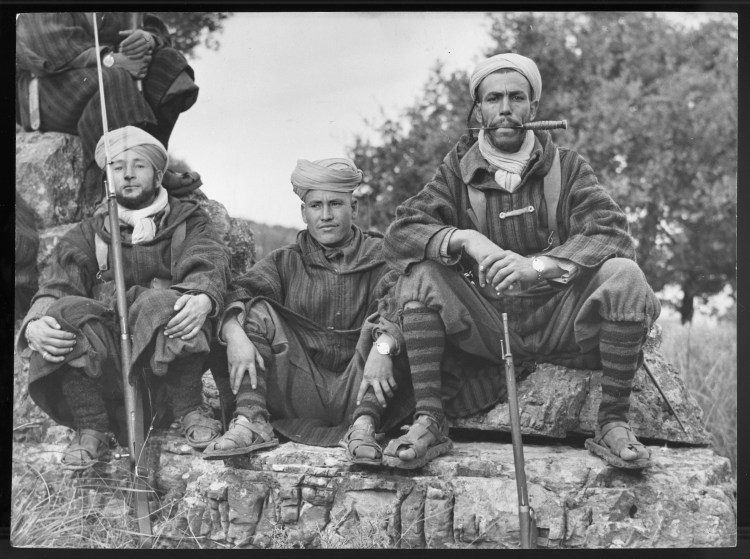
image from: https://commons.wikimedia.org/wiki/File:Goumiers_posing_with_their_weapons_in_France.jpg
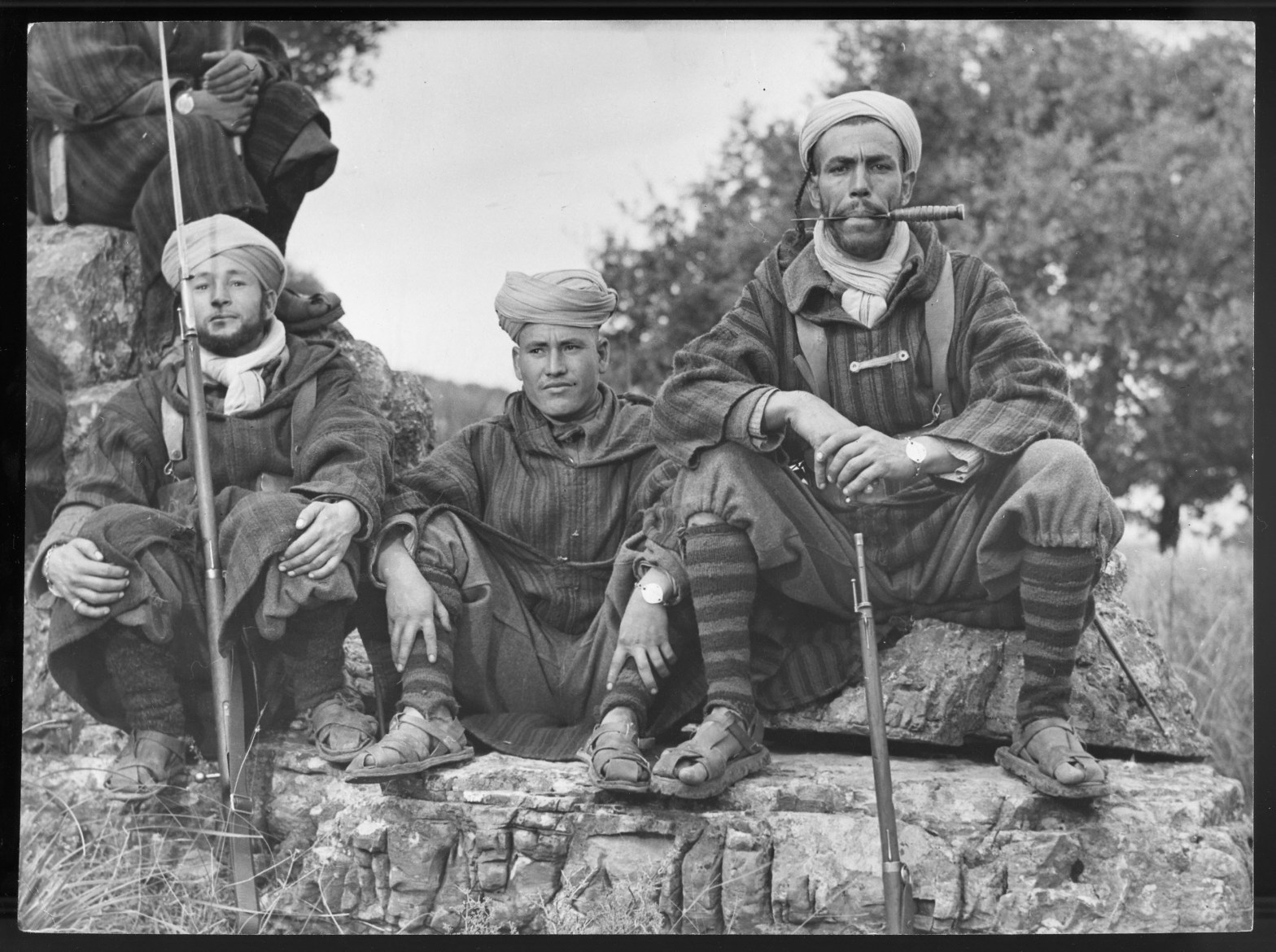
The photo above was taken by Margaret Bourke-White and published by Life Magazine in 1943. The description of the photo (here) highlights the fact that these three men are goumiers, or Moroccan soldiers, in the French army during WWII who are posing with their weapons during a training exercise. While it’s hard not to focus on the blade in the one man’s mouth, my eyes are drawn to and linger on their leg warmers. The man on the right wears solid colored leg warmers while the men sitting next to him wear striped ones. Those leg warmers were likely knit by the men who are wearing them, so an alternative title for the photo could be, “Three Moroccan Knitters.”
As I’ve mentioned in previous work, Amazigh men were often the knitters in Morocco. In the High Atlas mountains, men knit leg warmers for themselves, which they called targhiwin in their dialect of the Amazigh language. These targhiwin could be decorated with black and white patterns or stripes (see my book, Keepers of the Sheep: Knitting in Morocco’s High Atlas and Beyond). In the Middle Atlas mountains, men also knit leg warmers, which they called tarriwin in their dialect of the Amazigh language. Unlike in the High Atlas, Middle Atlas men knit tarriwin for the women in their families, as well. While leg warmers for men were more subdued – like the solid colored and striped leg warmers seen on the goumiers above – Middle Atlas tarriwin for women were often very colorful and highly decorated. The knitters used an intarsia-in-the-round technique to accomplish some of the patterns.
What photos can show us
Recently, I came across a treasure trove of tarriwin photos from the Jean Besancenot archive at the Institut du Monde Arabe in Paris, France. There are 1,770 photos in the collection, and I sifted through all of them to find tarriwin evidence (unfortunately, you can’t rely on tags to pull up every photo with knitting in it! The goumiers above are a case in point). I looked into getting permission to share some of the photos here, but the reproduction cost is higher than I can afford to pay for this self-funded blog (we’re talking hundreds of dollars for only a year’s worth of sharing). However, these photos are amazing, and I really want you to be able to enjoy them, so I am providing links to some of the best ones. I hope you click through to view them! Moreover, these photos demonstrate the kind of information that can be gleaned from a single image. Taken together with other images, this corpus of material can provide a more well-rounded understanding of a knitting tradition than just a few lines of writing.
Numéro d’inventaire: 428 – This photo shows three women and two children riding on two mules. All three women are wearing tarriwin. It’s interesting to note that the younger women are wearing the complexly decorated tarriwin that I have been writing about while the older woman is wearing plain white tarriwin. This raises some questions: Were colorful tarriwin only worn by younger women of child-bearing age? Did the solid white tarriwin worn by the older woman indicate something about her status? Or, maybe those were the only clean tarriwin she had that day? Where were these people going? Were they dressed for a special occasion, or is this their everyday attire?
Numéro d’inventaire: 321 – This photo shows a woman doing laundry in a stream or river. I believe this photo is significant because it shows that tarriwin were worn as part of everyday attire. The woman in the photo most likely did not put on her finest garments to wash clothes. Perhaps she had an even nicer pair of tarriwin for special occasions? Perhaps the tarriwin she’s wearing were a practice pair whose pattern isn’t as refined as others? Unlike some of Besancenot’s other photos, this one does not seem staged. It is very natural and candid.
Numéro d’inventaire: 415 – This photo shows men and women participating in an ahidous performance. Although it’s hard to see the tarriwin worn by two of the women, this photo demonstrates that tarriwin were part of festive attire. It also shows that not everyone wore them, as one of the women appears to have bare legs. The ahidous is a type of collective performance that marks special celebrations – such as weddings, naming ceremonies, a significant full moon, or visitors who have come from far away. It involves a line of musician-dancers who stand shoulder-to-shoulder while preforming songs – often based on oral poetry traditions- accompanied by a frame drum called the allun. For more information about the ahidous, see Cynthia J. Becker’s book, Amazigh Arts in Morocco: Women Shaping Berber Identity, chapter 3.
Numéro d’inventaire: 338 – This photo shows three different tarriwin laid out on a decorated piece of wood – possibly a door? It clearly shows the variety of patterns that were created for tarriwin. The examples on the left and right incorporate the design element that Richard Rutt noted about medieval Egyptian knitting in his book, A History of Handknitting (see this post for more details). In this design element, two stitches sit one above the other in the same wale (see the black and white checkered triangles at the top of the tarriwin and the white zig-zag motif of the tarriwin on the left). The tarriwin in the middle shows the ‘seam’ that is indicative of knitting in the round. The clarity of this photo makes it possible to count stitches, see the direction of knitting, and compare the patterns to those in other textile crafts such as weaving.
One tool in the textile researcher’s toolkit
I can’t help imagining those goumiers in the Bourke-White photo above with knitting needles in their hands working on the complex patterns of the tarriwin in Besancenot’s photos and gifting them to the women in their lives. I think most people today would consider intarsia-in-the-round to be a fairly advanced knitting technique, which means that those goumiers were likely highly skilled knitters. While we can’t definitively say that those three men knit intarsia-in-the-round tarriwin, acknowledging their possible connection to the knitting tradition depicted in the Besancenot photos compels us to consider the multi-dimensionality of Moroccan men and to confront our own stereotypes about who were and are knitters.
Collectively, these photos are invaluable for illuminating the Middle Atlas tarriwin tradition. A more detailed study of tarriwin in museum and private collections would yield valuable information about the construction techniques used in their creation. Interviews with those who remember seeing, wearing, or making tarriwin are crucial for confirming what information is available through ethnographic and travel accounts, photographs, and illustrations. While I had no luck in finding people who could answer my questions about tarriwin, it is possible that there is a great-grandfather or grandmother out there who still has memories of this beautiful and unique knitting tradition. But, time is running out to speak with them.
If you’d like to try your hand at the pinwheel tarriwin motif, see my free intarsia-in-the-round guide here and my pattern for the Middle Atlas skirt here (with step-by-step photo guide). There is a gauntlet pattern in my book, Keepers of the Sheep: Knitting in Morocco’s High Atlas and Beyond, that also uses the same technique. I have published these products to raise awareness about Moroccan knitting with the aim of increasing the consideration and inclusion of Moroccan knitting traditions in future history of knitting research.
 106 Meters from the Road

Hi, Irene,
I have a question: I see that the legwarmers worn by the goumiers have straps at the bottom. How are they kept up? With garters?
Interesting point about the value of photographs as repositories of the everyday. What will future people find fascinating and worthy of study in our photos that we hardly notice because they are so commonplace?
Have fun! Lynda
Hi, Lynda.
That’s a great question! If you look very closely at the right leg of the man on the right, there is a thin cord tied around the top of his leg warmer (you can zoom in on the picture if you click the link in the photo caption and open the photo there). When I worked with knitters in the High Atlas region, I learned that these cords are made on socks by leaving a long tail of yarn after casting off. Then, that tail is folded in half and twisted in on itself to make a sturdier/more substantial cord. People use the cords to hold up the sock (or in this case leg warmer) and also to hang them up to dry after washing.
As for your question about future photo archaeology, I wonder the same thing. There are so many things in my daily life that I don’t notice or take for granted that I’m sure others might find interesting. Fresh eyes can be useful sometimes!
Sincerely,
Irene