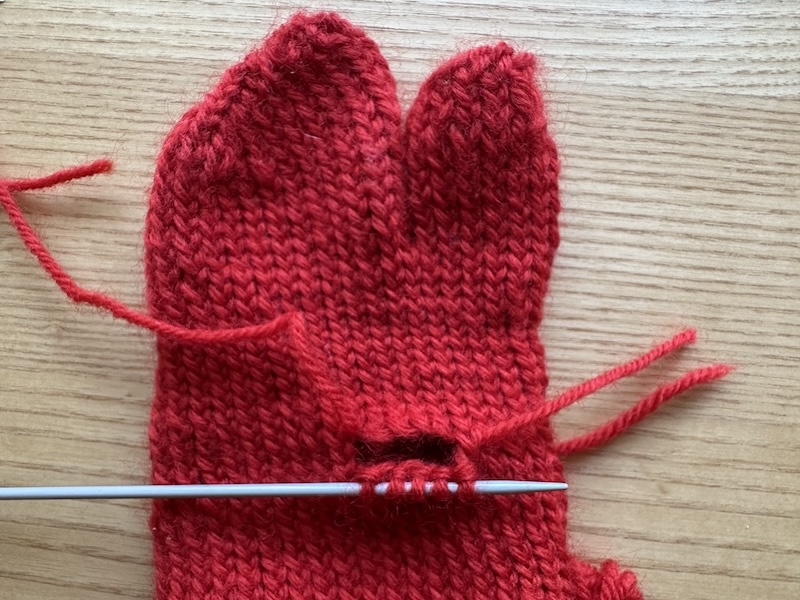
In my previous post (here) I outlined how I arrived at a theory for the development of knitting from cross-knit looped nalbinding. In short, I noticed that the structure of cross-knit looped nalbinding and crossed-stitch knitting are similar. The only difference was the direction of the loops (pointing down for nalbinding and up for knitting). Because of this, I hypothesized that nalbound fabric should behave like knitted fabric if unraveled from the starting end rather than the working end – as might happen if a hole were to develop in one’s sock. So, I tested this by making a nalbound tube and then unpicking the starting edge to see how the fabric would behave. When pulling on the yarn from the starting edge, my nalbinding unraveled in the same way knitting unravels. Observing this quality, which is particular to cross-knit looped nalbinding, could have given the makers of the iconic split-toed crimson socks from Egypt (image below) the initial idea for knitting, or what I will call ‘proto-knitting.’
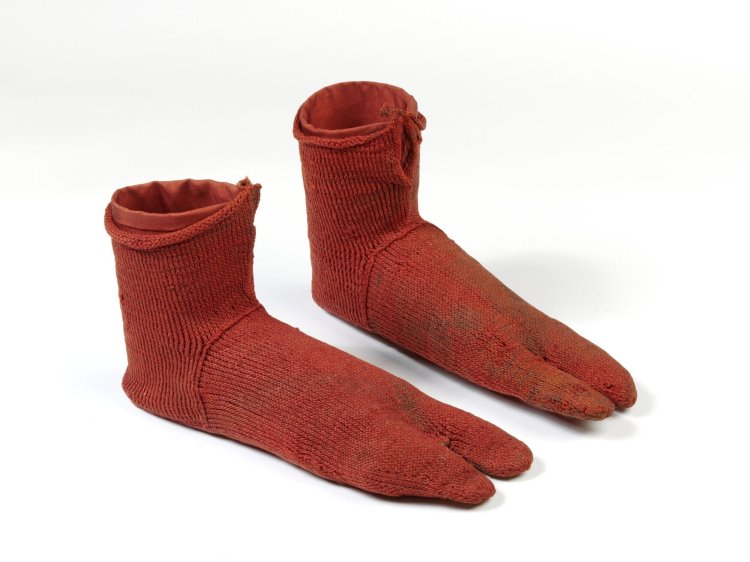
© Victoria and Albert Museum, London
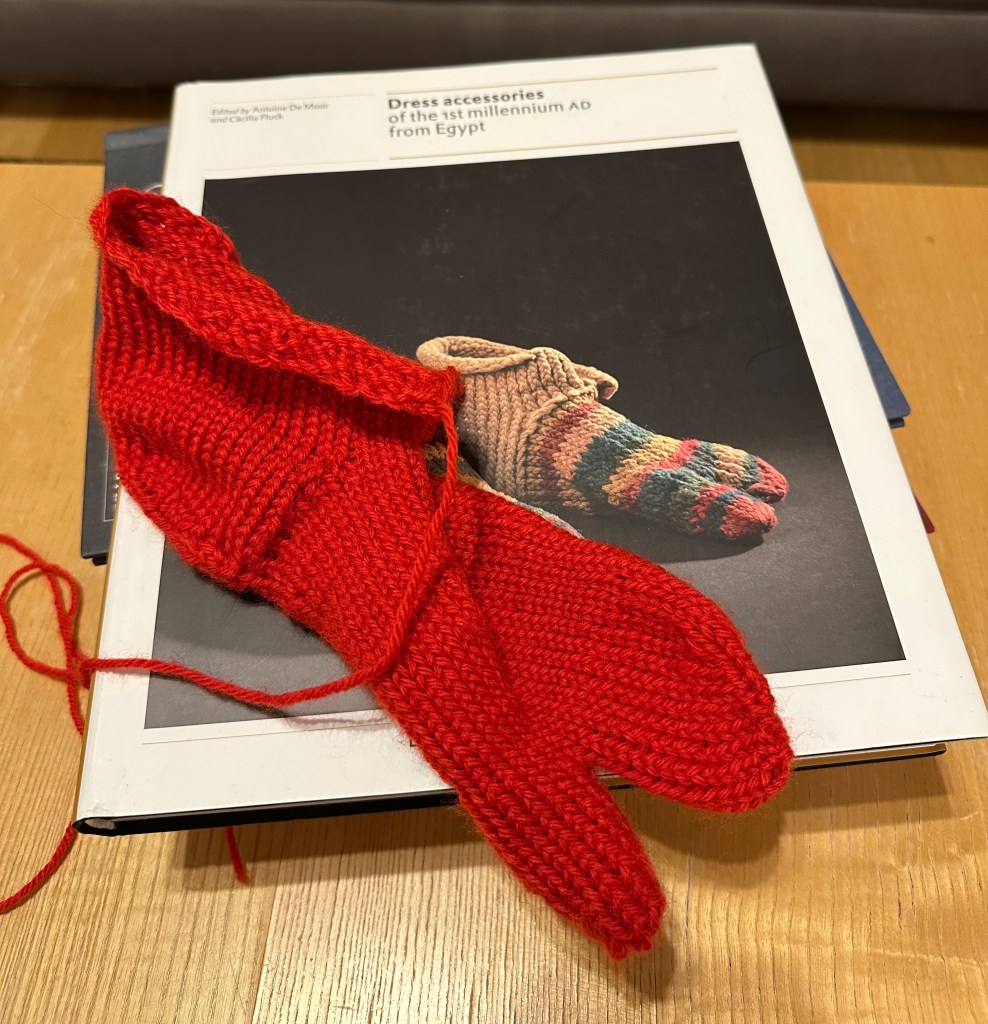
Of course, a nalbound tube made specifically with the intent of unraveling it from the starting edge is not exactly like working with a hole in a sock. Therefore, I decided to make my first ever split-toed, nalbound sock modeled after the ones from Egypt (image above) in order to see exactly how ‘proto-knitting’ might help me mend a hole. After two days, my labor of love was ready to be sacrificed. There is a considerable amount of horror and dread at the idea of taking scissors to something one has spent so much time making, but my desire to see this thing through gave me the courage.
I cut horizontally through four stitches and created a hole about an inch wide. The side of the hole closest to the toes (start of sock) was quite stable; although, it could still be unraveled if picked apart. The other side of the hole had loops that were very easy to unravel. After unraveling two rows from the side with the loops, I noticed that the now loose yarn remained connected at both sides of the hole since it was still part of the structure of the fabric. This yarn could be used to mend the hole. However, the open loops needed to be stabilized, first, so that they would not continue to unravel as I worked. It was natural for me to think of putting a stick in these loops to hold them. While this could be attributed to my experience as a knitter, I believe it also just makes mechanical sense.
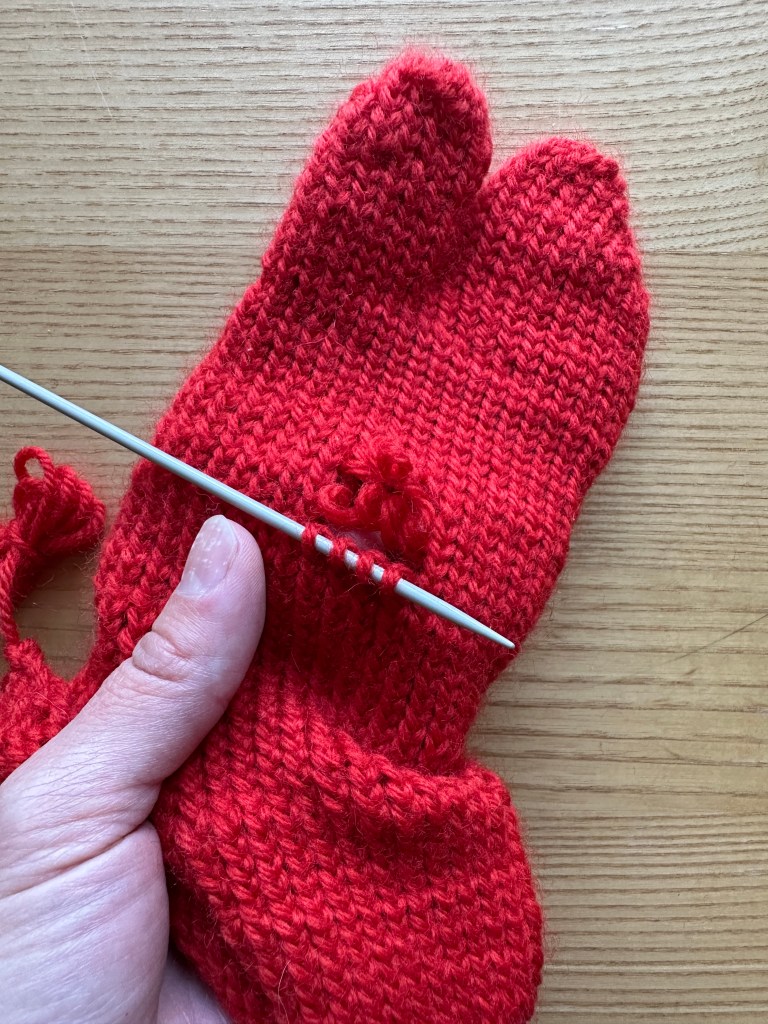
After stabilizing the open loops by putting them on a needle, I now needed another tool to help me grab the loose yarn and pull it through the loops on the needle. Using my nalbinding needle to sew new loops did not make sense since the loose yarn was still attached to either side of the hole and could therefore not be threaded through a nalbinding needle. Another straight needle, or a hooked needle, seemed the most useful for pulling the loose yarn through the small loops on the needle. I tried both methods – one row with a straight knitting needle and the other with a hooked knitting needle from Portugal. Both worked very well, but I could see the advantage of using a hooked needle as its form perfectly suited the grabbing and pulling motion required for drawing the loose yarn through the loop on the needle. Evidence for hooked knitting needles come from Iberia, North Africa, and Anatolia (Pomar, 2013; Bel and Ricard, 1913). It is tempting to suggest a possible connection between this ‘proto-knitting’ hypothesis and the use of hooked knitting needles in these regions, which have complex and long knitting traditions. However, much more research and evidence would be needed.
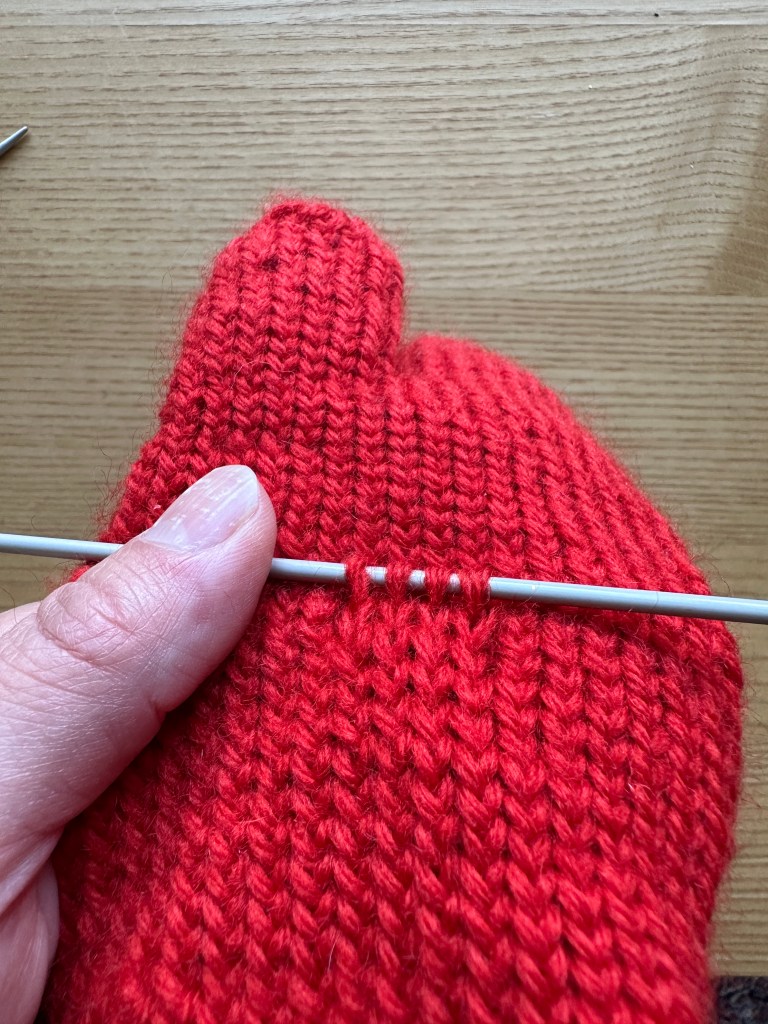
Since the loose yarn was still part of the looped structure of the fabric, there was no need to connect it to its neighboring stitch in the undamaged fabric once the loose yarn had been pulled through all of the loops on the needle. Also, it was not necessary to turn the work before starting the next row because there was no ‘working yarn’ to dictate the direction of the work. In this ‘proto-knitting’ context, all that needed to be done was pull the loose yarn back into the looped structure of the fabric. This argues for a double-pointed type of ‘proto-knitting’ needle so that the loops could be worked from either side.
In order to finally close the hole, the loops on the needle needed to be joined to the edge of the hole. The best way to do this was to sew the two together using a new piece of yarn and following the looping pattern of the fabric. This created an almost invisible seam. With more practice and skill, I think it could be possible to create a join that is almost imperceptible.
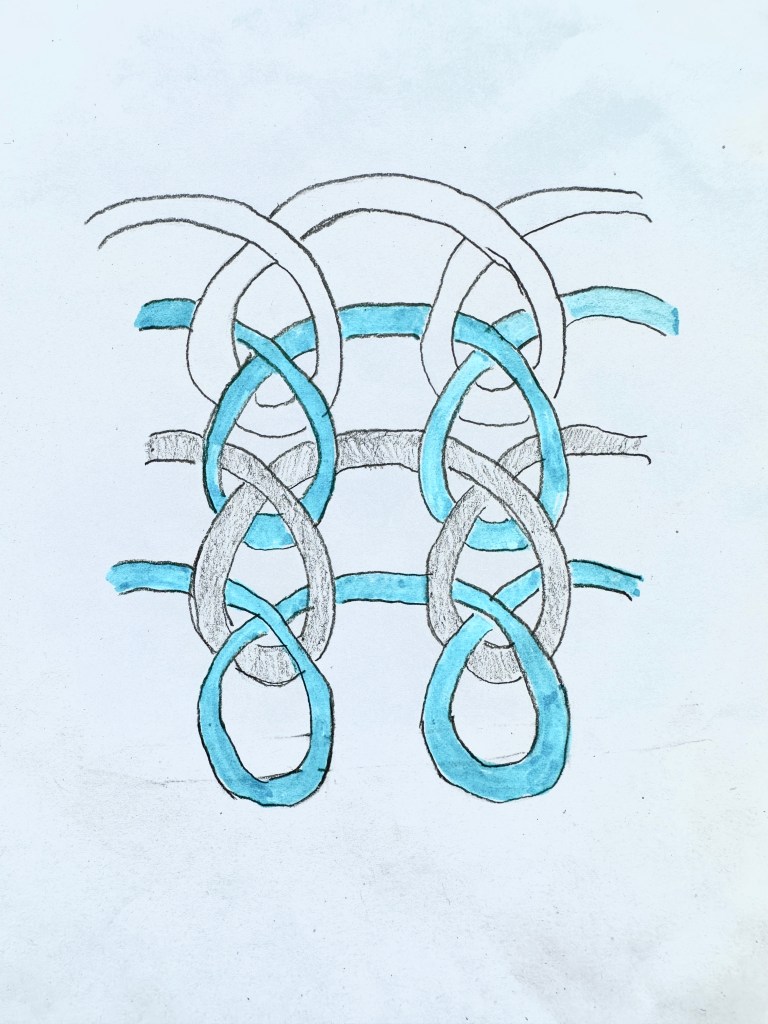
When sewing the hole closed, I found it easier to remove the loop from the needle right before the final pass of the nalbinding needle and yarn. This helped me see and understand the order of the crossings through the loop on the knitting needle; however, I suspect that with more experience I could make the final crossing with the loop still on the knitting needle.
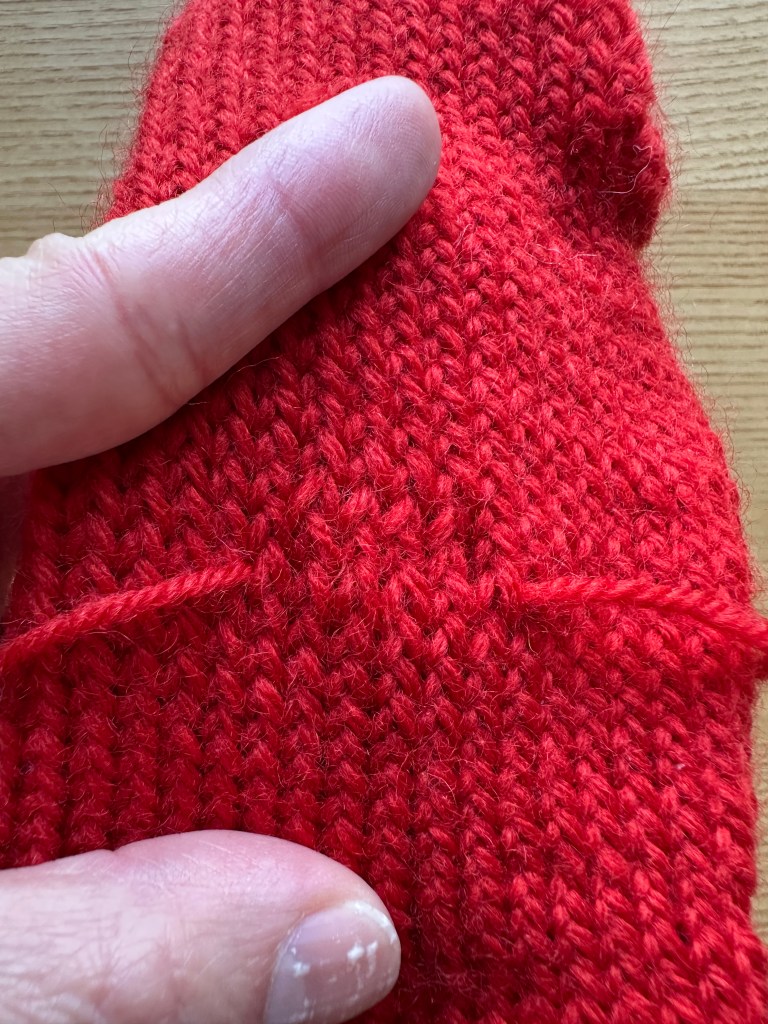
While this experiment does not prove that knitting came from nalbinding, I believe it demonstrates that the motions and ideas associated with knitting today could have evolved from mending nalbound objects. Additionally, the hole I worked with in this experiment only represents one type of mending problem. There are numerous ways a sock, or other nalbound object, could be damaged. The techniques I used here may not work in all mending contexts, or I might need to modify how I use the needles and yarn to mend different kinds of holes. Further experimentation is necessary to develop a deeper understanding of mending cross-knit looped nalbound fabrics, and a close examination of the mended fabrics is also needed to analyze the structure of the mended sections in comparison to undamaged fabric.
Lastly, and most importantly, is it possible to see evidence for this type of mending in the nalbound artifacts available to us today?
References
Pomar, R. (2013) Portuguese Knitting. Kent: Search Press.
Bel, A. and Ricard, P. (1913) Le travail de la laine à Tlemcen. Algiers: Typ. A. Jourdan, p. 243.

