Why is Moroccan Intarsia-in-the-Round Knitting Important?

Moroccan Knitting and the History of Knitting

The history of knitting has intrigued me since my early 20s when my mom gave me Nancy Bush’s book, Folk Socks: The History and Techniques of Handknitted Footwear, for my birthday. It was in the pages of Folk Socks that I first learned about knitting in northern Africa. Nancy’s medieval Egyptian sock pattern was one of the first written sock patterns I ever followed. It was a formative experience recreating an object that knitters generations before me had made. Knitting had always made me feel connected to the past and to other knitters, but making Nancy’s Mamluke Socks (pp. 76-78) made the world of medieval Egypt just that much more tangible.

Over a decade later, I was living in Morocco when I learned of an indigenous knitting tradition in the Atlas mountains. Remembering what I had read in Nancy’s book, I couldn’t help but wonder if the Moroccan tradition might be related to the medieval Egyptian tradition. After all, medieval Spain also produced very complex and beautifully knitted objects. And, what lies between Spain and Egypt? Morocco, Algeria, Tunisia, and Libya. It seems highly unlikely that knitting just skipped over most of the northern half of Africa to arrive in the Iberian peninsula (or vice versa). Living in Niger (2010-2012) had taught me about trade routes and the migration of people, ideas, and goods throughout the northern half of the African continent – not to mention the fact that people had been migrating between Iberia and the Maghreb (western North Africa) for centuries. It didn’t seem too far fetched to me that if knitting was happening in medieval Egypt and Spain, then it was probably also happening in medieval Libya, Tunisia, Algeria, and Morocco. And so, I set out to connect Moroccan knitting to medieval Egyptian knitting by working backwards in time from the ethnographic collections and writings of French colonialists in Morocco, Algeria, and Tunisia to the material evidence from medieval Egypt. You can read about this work in my book, Keepers of the Sheep: Knitting in Morocco’s High Atlas and Beyond.

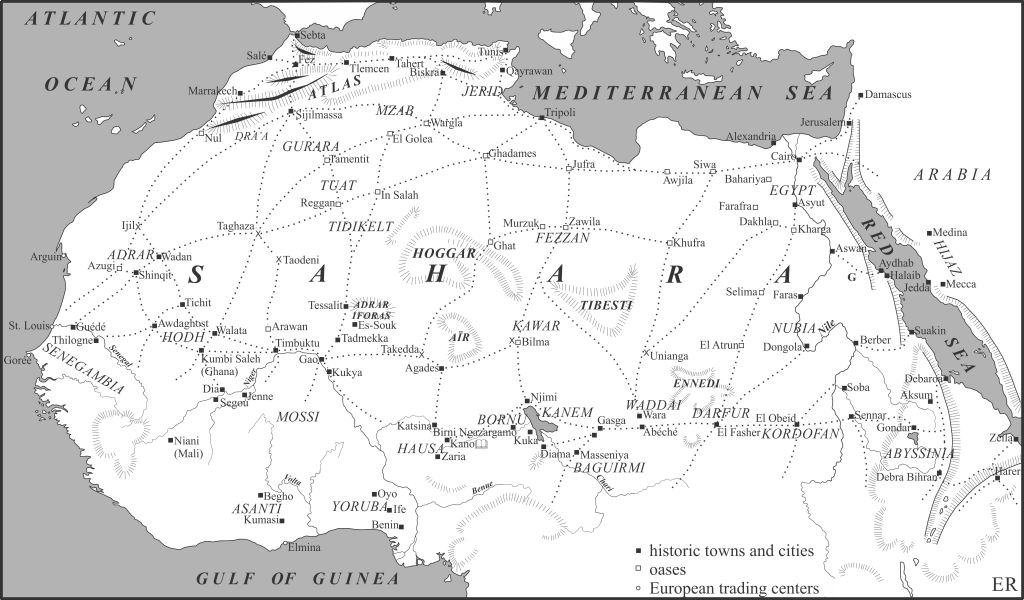
Map by Eric Ross showing historic trans-Saharan trade routes from the 8th to 19th centuries CE. Read more about his work here: https://ericrossacademic.wordpress.com/2011/01/03/trans-saharan-book-trade/

Why Moroccan Knitters Matter

The fact that there are people in Morocco who still know how to knit in the old way is special indeed. These knitters learned to knit from their elders, who learned from theirs, going back who knows how far. If their tradition is related to that of medieval Egypt and Spain, then they are a living link between the past and the present. I do not mean to imply that their knitting tradition was passed down unchanged over the centuries. Changes undoubtedly took place, since culture always evolves. But, it’s possible that some techniques and styles survived. What insight might these northern African knitters bring to the silent objects of northern Africa’s past? What can they and their knitting knowledge teach us about the history of their homelands and the connectivity between that homeland and other lands and peoples? Might these knitters and their knitting tradition contribute to piecing together a more nuanced understanding of interactions between the peoples of Africa, Europe, and beyond?

Why Heritage Knitting Techniques Matter

I believe that knitting techniques and styles can act as signatures of particular places and the people within those places. The way a person knits the toe or heel of a sock is kind of like the way a person shapes a ceramic pot or a stone tool. In archaeology, pots, tools, and the techniques for making them define cultural influences and are used to map possible migration, interaction, and exchange. Can knitting be used in the same way? Being able to map particular knitting techniques might help us ‘see’ ancient networks of interaction. However, in order to do this, we have to document what I call ‘old style,’ ‘heritage,’ or ‘indigenous’ knitting techniques (how to identify and what to call this kind of knitting is a whole other topic for debate). What I am referring to is the type of knitting people did before the dissemination of written knitting patterns, enforced colonial craft education, and YouTube.* Collaborating with those who still posses this type of knowledge and examining knitted artifacts from the past can help us better understand knitting styles and how they may (or may not) have influenced one another. The more information we have from these sources, the more reliable and clearer the picture will be.

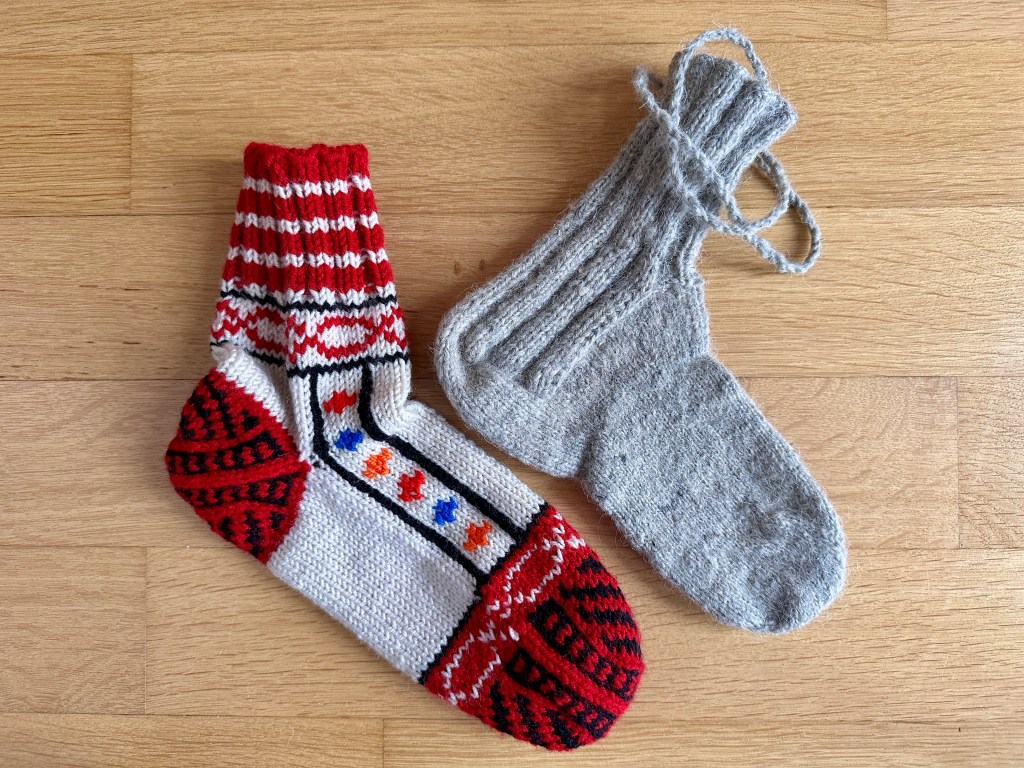
Hand knit socks from Armenia (left) and Morocco’s High Atlas mountains (right) showing differences in toe and heel structure.
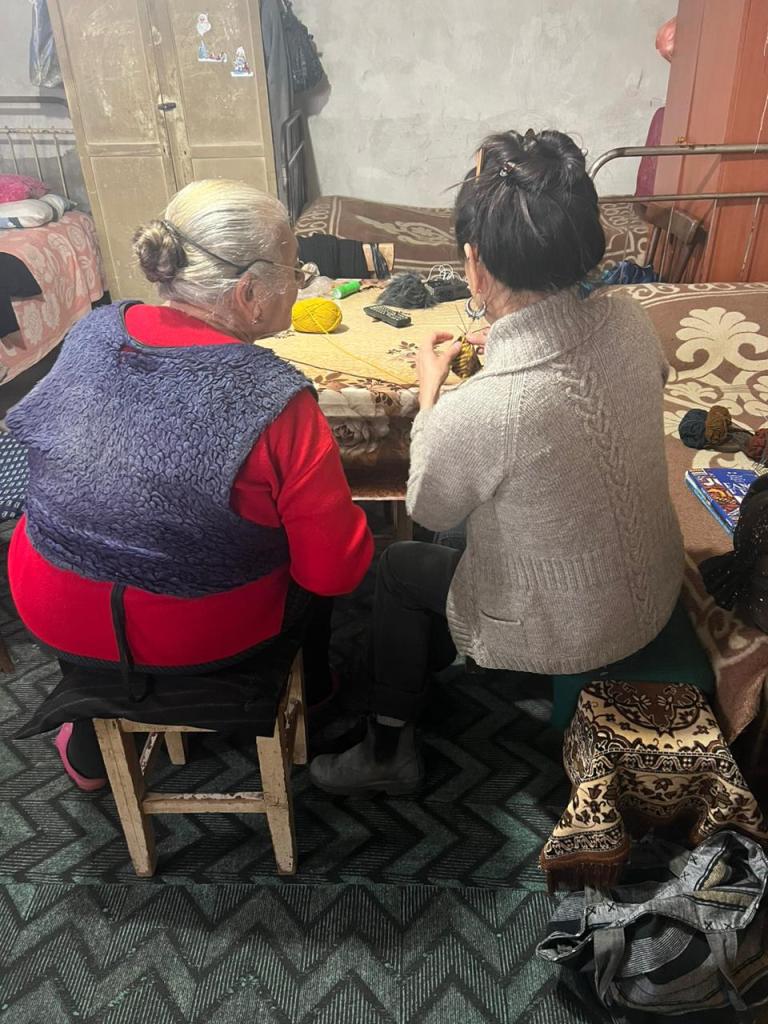
This is me learning to knit մասիկներ (masikner) – a type of slipper sock common in Armenia and other western Asian countries – from my teacher in northern Armenia.

Moroccan Knitters Today

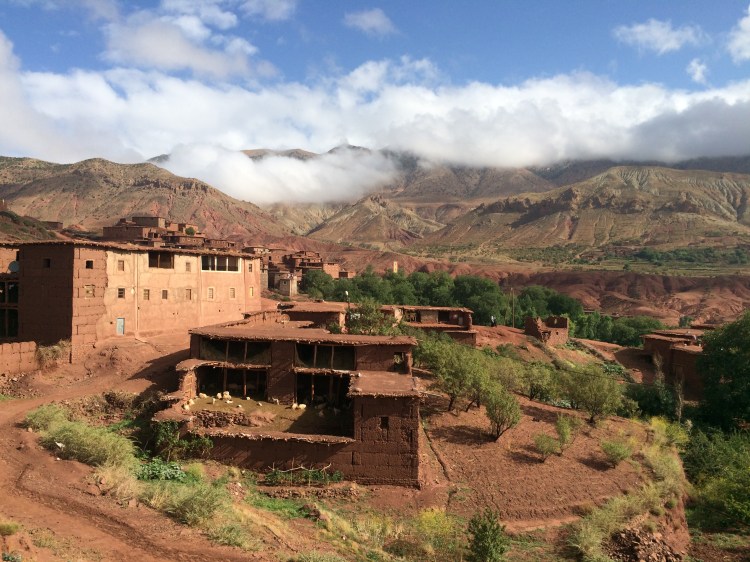
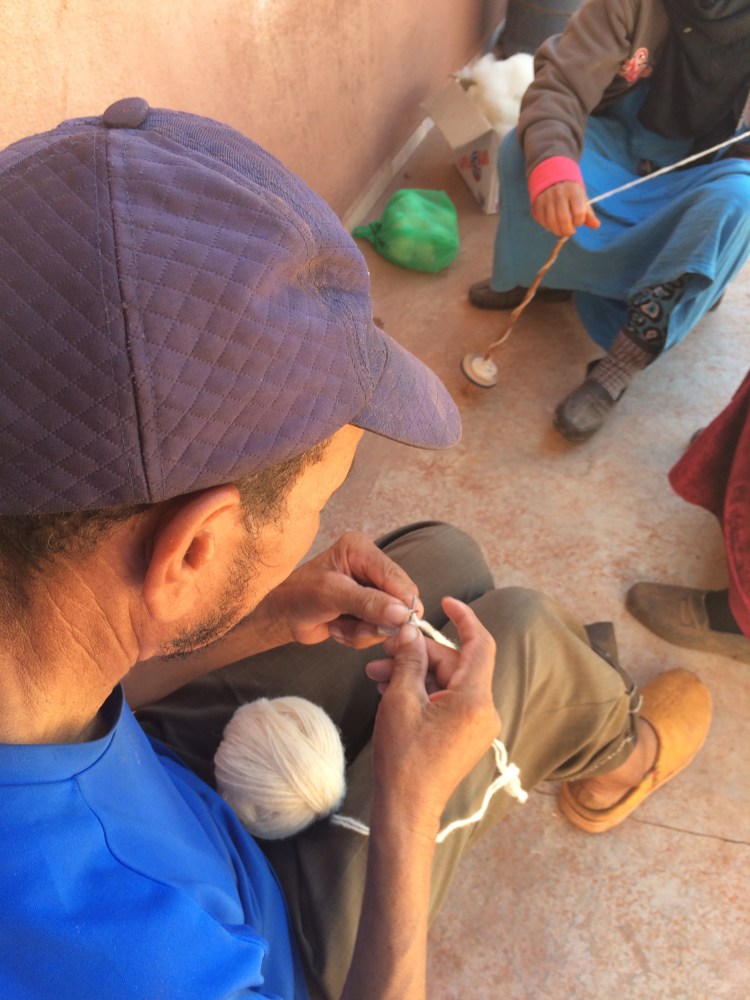
Unfortunately, the number of people who still posses these ‘old style’ skills is rapidly diminishing. Access to mass-produced products, changes in fashion, and changes in lifestyle affecting craft transmission are contributing to the rapid disappearance of indigenous knitting practices like that of Morocco. When I lived there, it took several trips from my home in Rabat to the High Atlas mountains to find people who still knit in the old way. In the end, thanks to help from artisans with the Anou, I was able to locate knitters in one particular valley of the High Atlas that had remained fairly isolated until relatively recently. All of the knitters I worked with in that valley were elderly, and they no longer produced the same range of products their forebears had made. They still knit socks, but pants, sweaters, leg warmers, hats, and mittens seemed to have fallen out of their repertoire. Some didn’t even knit anymore.

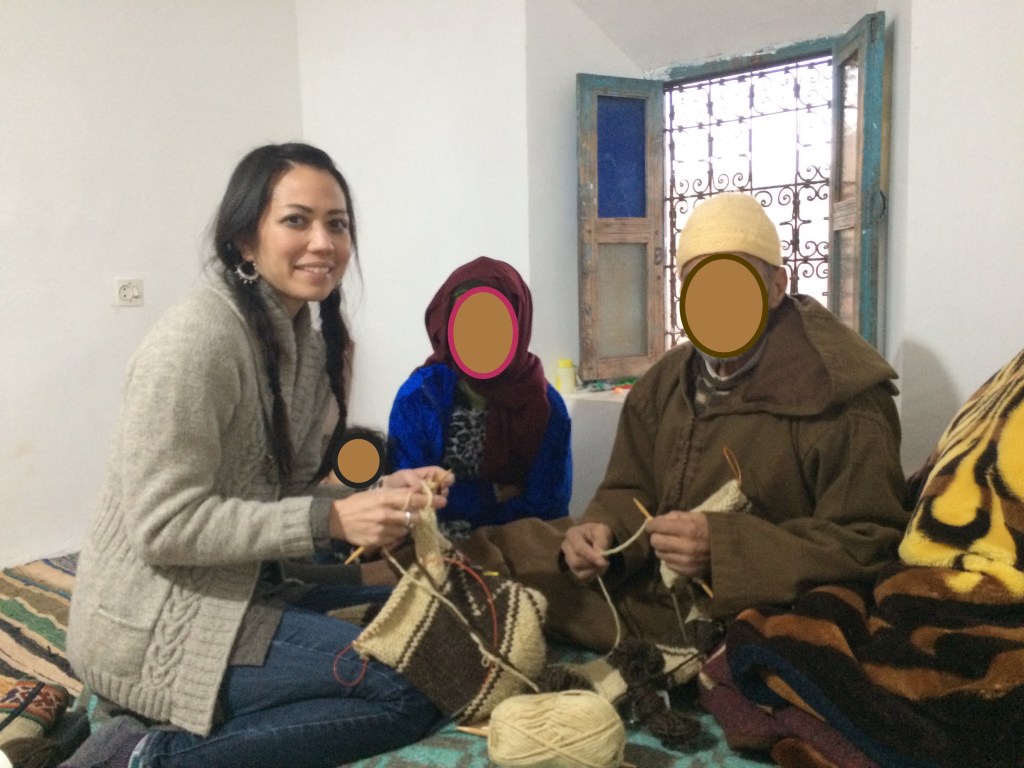
This is a photo of me (left) learning to knit High Atlas sirwal (pants). Faces are not shown to respect the request of those in the photo.
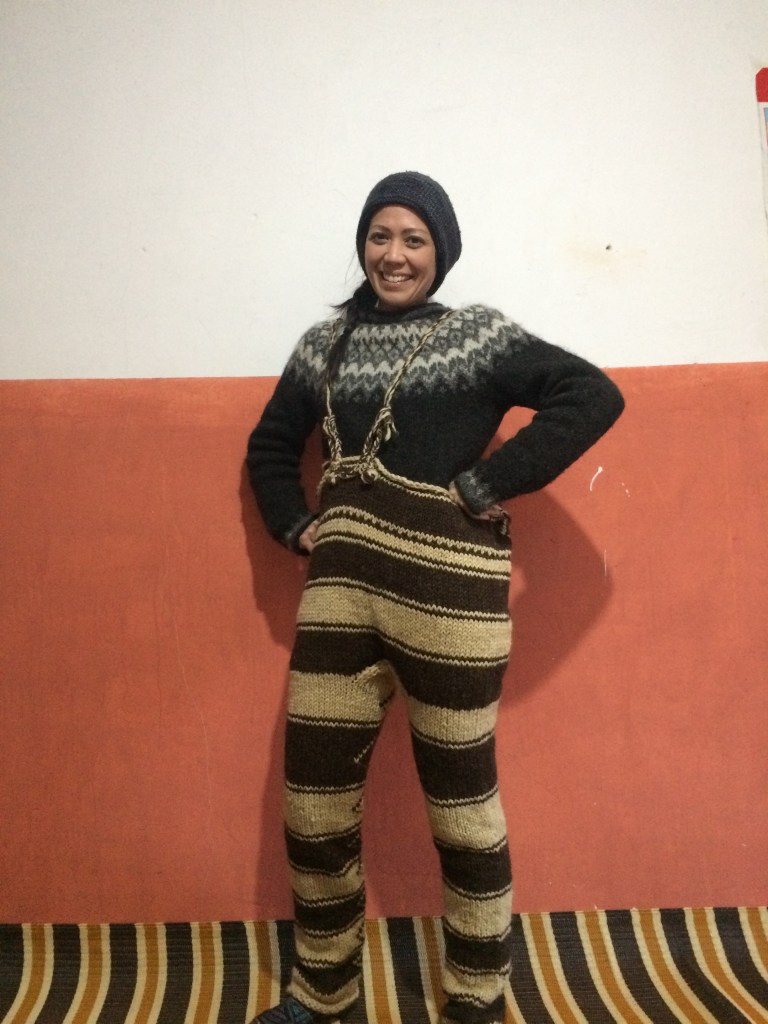
Me in my just finished sirwal. This was the first pair of sirwal my teacher (man on right in photo at left) had made since 1970.

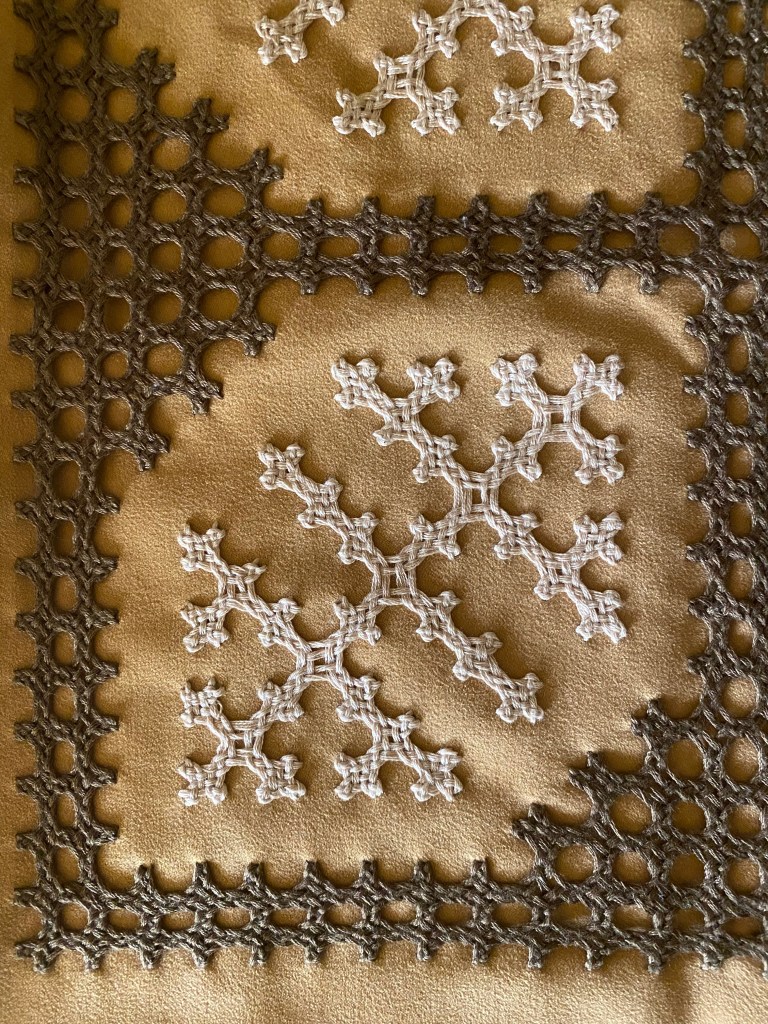
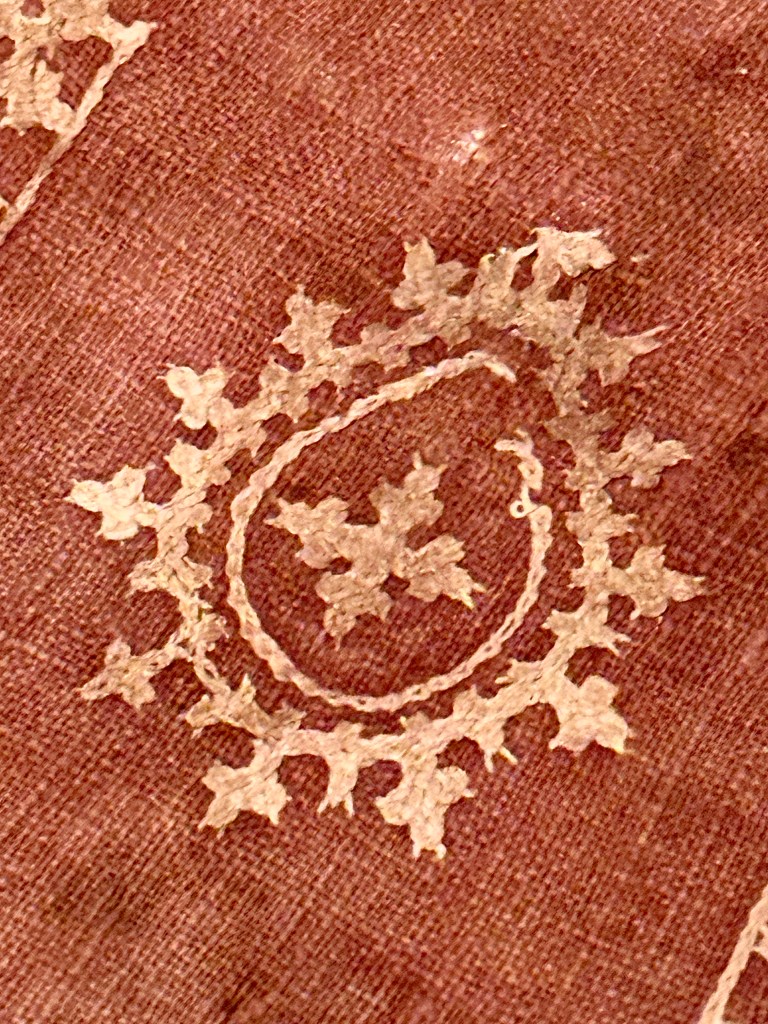
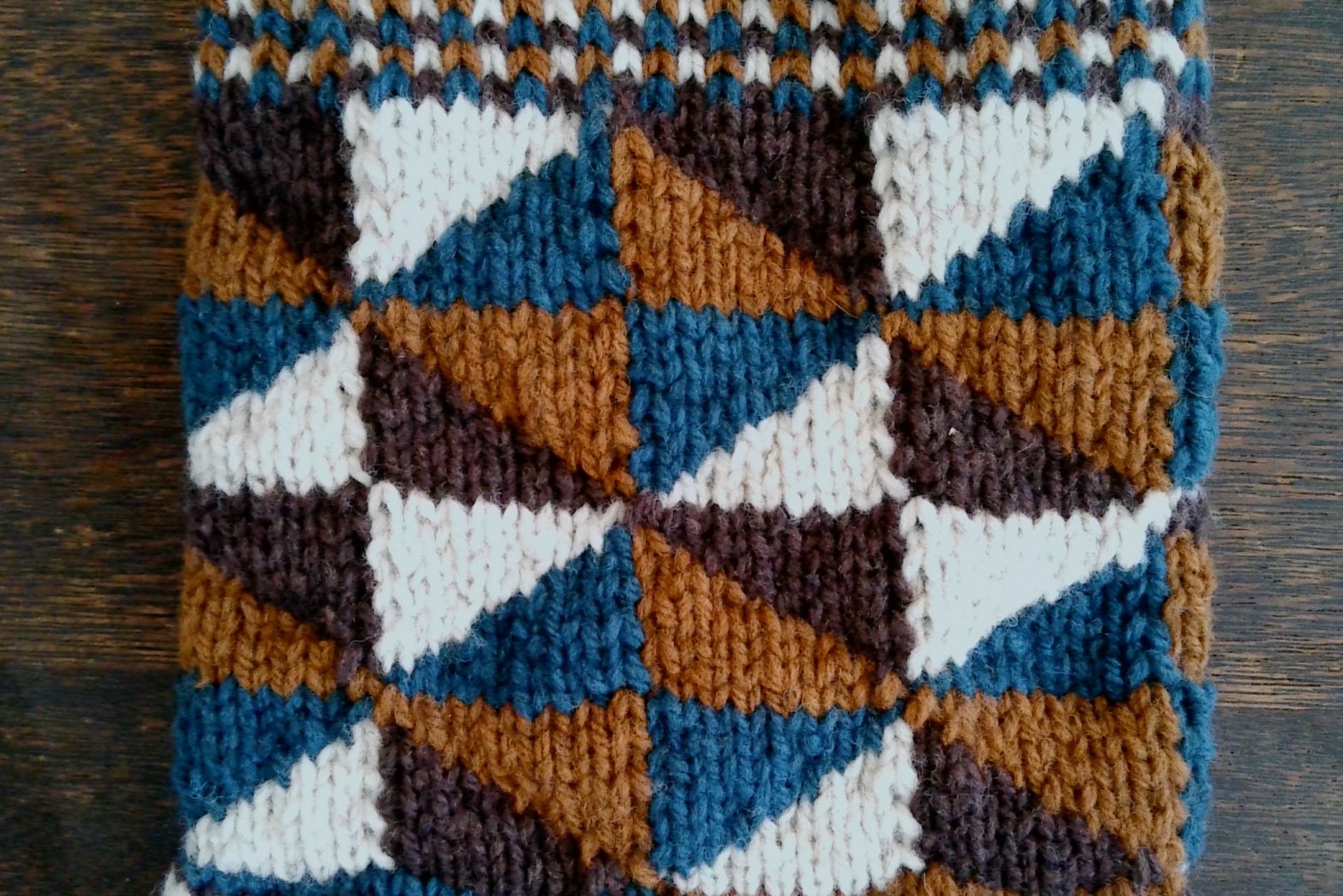
The situation in the Middle Atlas was more acute. After learning about the colorful, tessellating leg warmers Middle Atlas Amazigh men made for their brides, I tried on a number of occasions to locate ‘old style’ knitters but had no luck. In the end, I had to rely on objects at the Musée du Quai Branly in Paris and very limited anecdotes from colonial ethnographers and artists to develop a hypothesis for how the distinctive Middle Atlas leg warmers were knit. The motif used for women’s leg warmers is very important because a particular knitting technique is needed to achieve the design: intarsia-in-the-round. While intarsia is known and used in other parts of the world, the way in which it is executed in the Middle Atlas leg warmers is unique, as far as I know. This represents a major ‘signature’ that could help us better understand the development and dissemination of knitting across northern Africa.

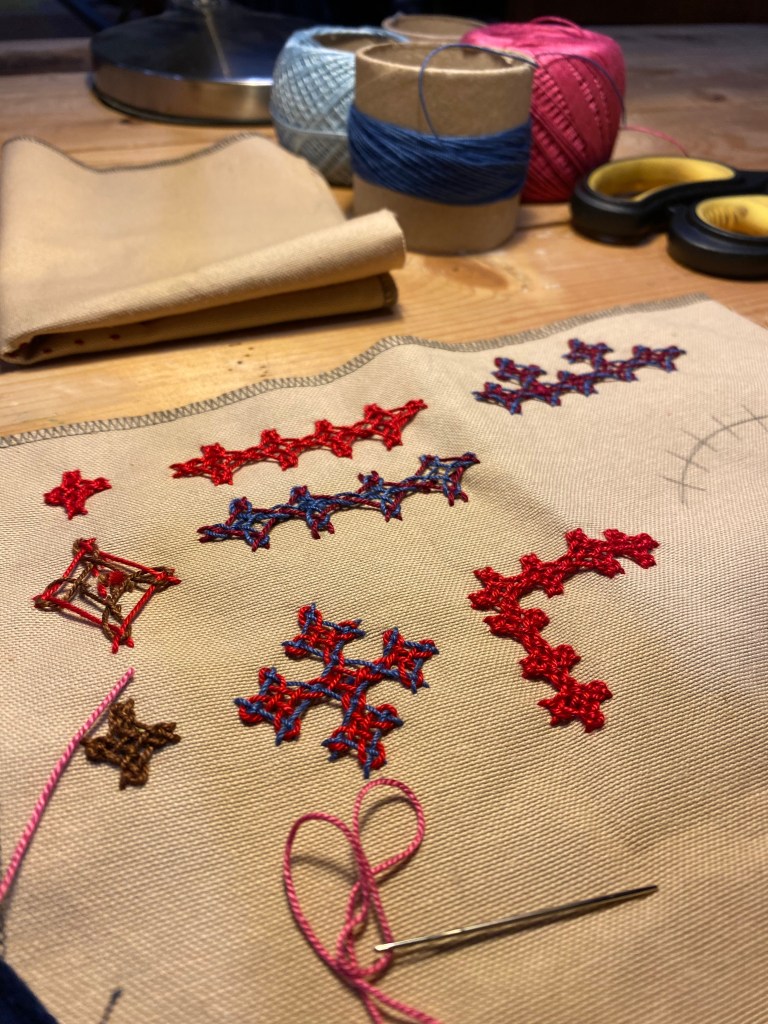
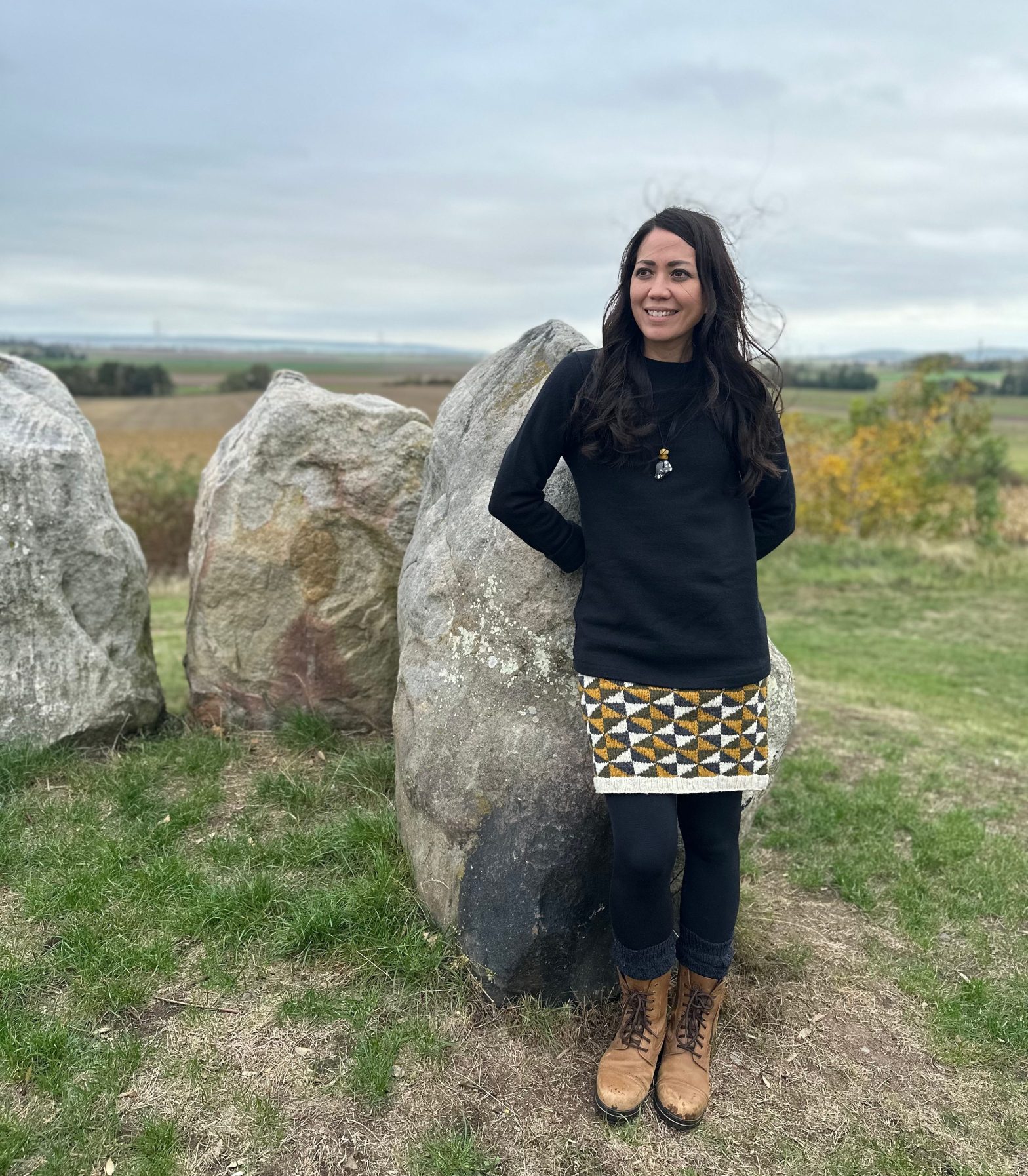
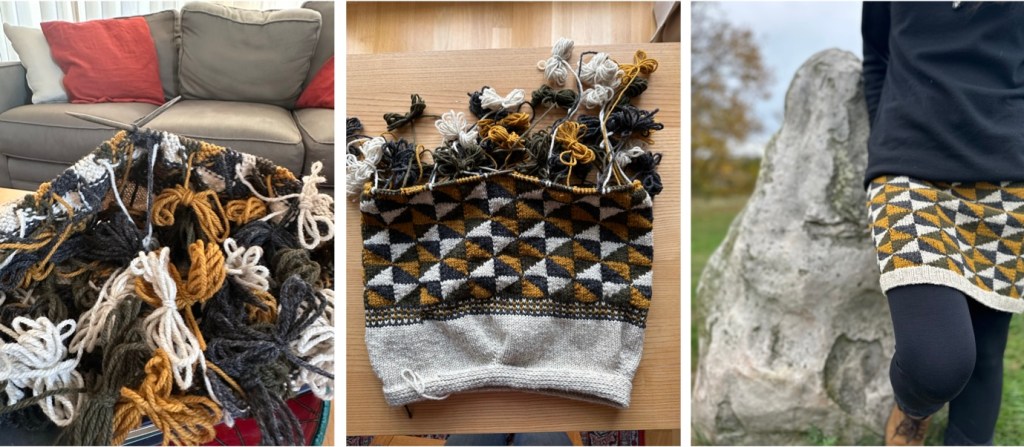
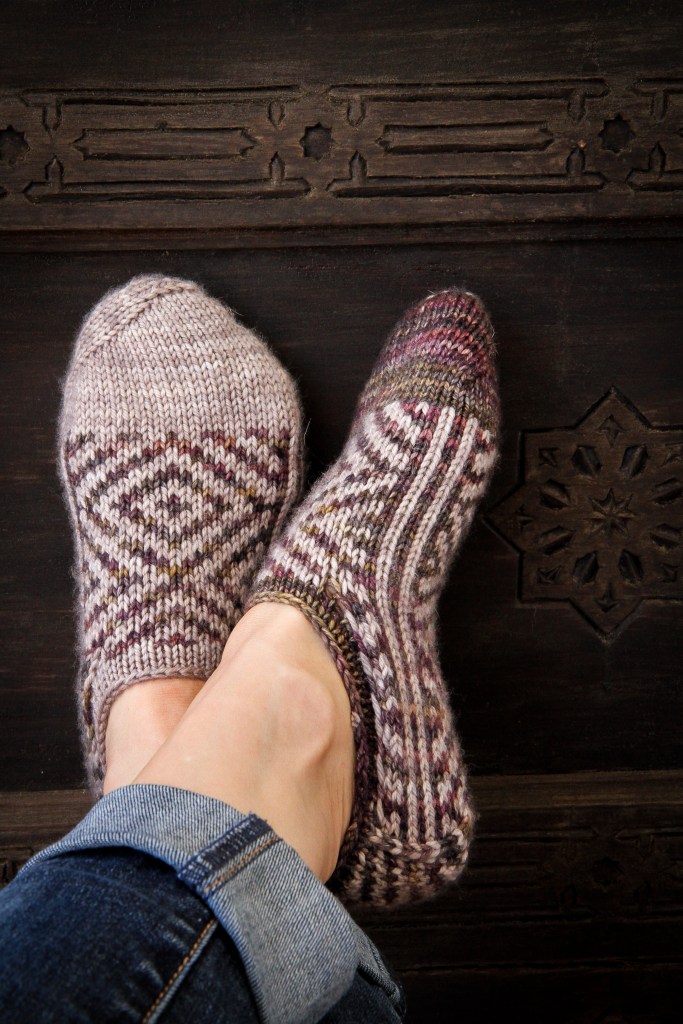
A Middle Atlas motif inspired by leg warmers from the Middle Atlas mountains of Morocco applied to a skirt. The technique is intarsia-in-the-round and was developed as a hypothesis for how this motif may have been executed.

Middle Atlas Knitting and Medieval Egyptian Knitted Fragments

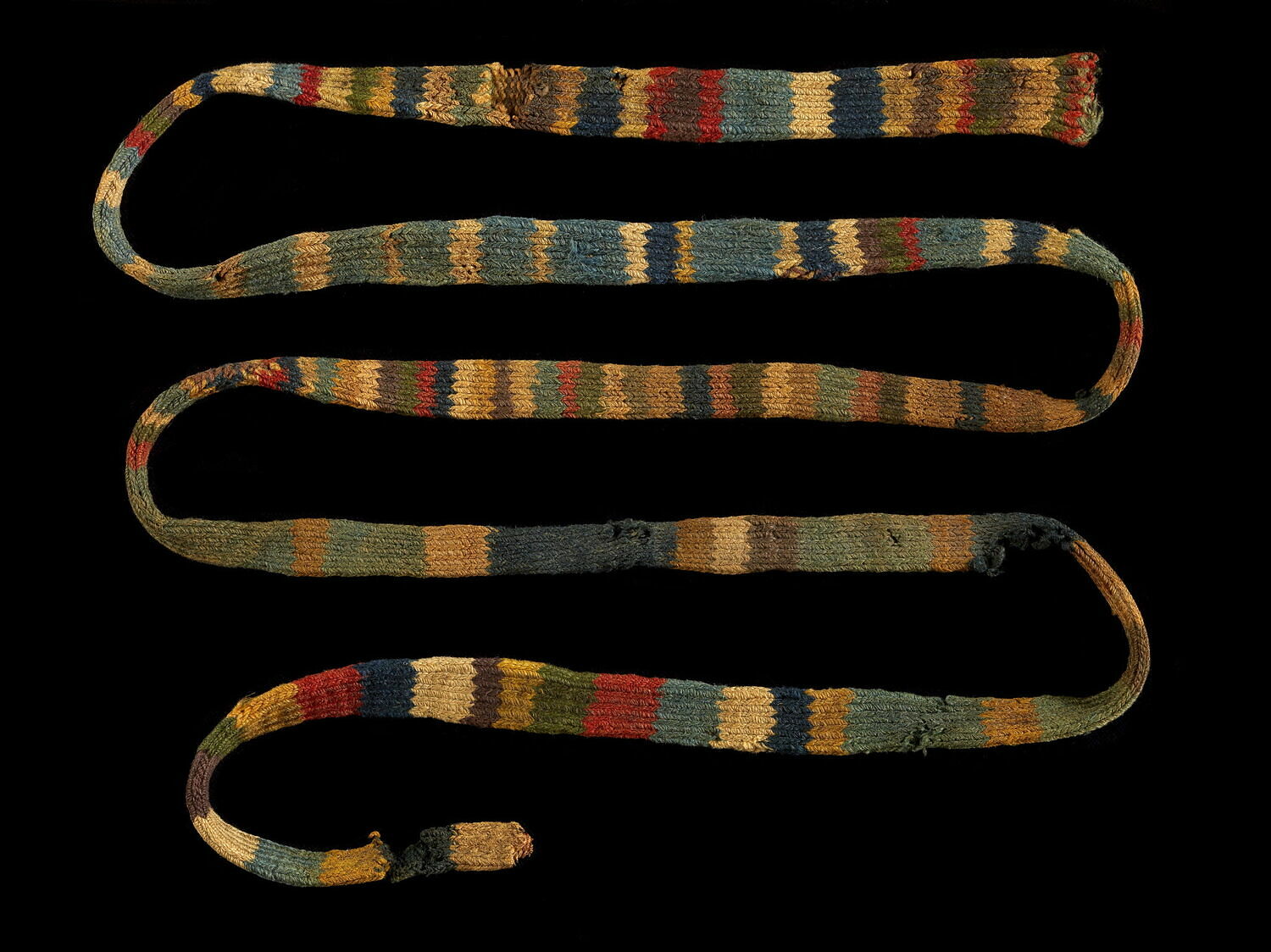
Intriguingly, a design element of Middle Atlas leg warmers echos a design element in medieval Egyptian knitted artifacts. In his seminal book, A History of Hand Knitting, Richard Rutt describes fragments that bear a “design peculiarity” in which the “unit of design is not the single stitch, roughly square (as in Fair Isle knitting), but… a unit of two stitches, one above the other in the same wale” (see p.37 for description and p. 38 for charted design). A similar design element can be seen in Middle Atlas leg warmers at the Musée du Quai Branly (see objects 71.1996.22.3.1-2 and 71.1937.34.3.1-2).

Another interesting parallel is the use of stranded and intarsia-in-the-round design elements in medieval Egyptian knitting. Richard Rutt believed that the use of intarsia in these pieces indicated that they had been knitted flat (p.37). However, the intarsia-in-the-round technique employed by Middle Atlas knitters encourages us to revisit this idea. In fact, intarsia-in-the-round is also used by knitters from western Asian knitting traditions, albeit in a different way (see Priscilla Gibson-Robert’s book, Ethnic Socks and Stockings: A Compendium of Eastern Design and Technique. For possible connections between western Asian and northern African knitting see my post here). In my opinion, both the doubled unit of design in the same wale and the use of intarsia in the round in medieval Egyptian and Middle Atlas knitting are interesting ‘signatures’ that warrant further investigation.

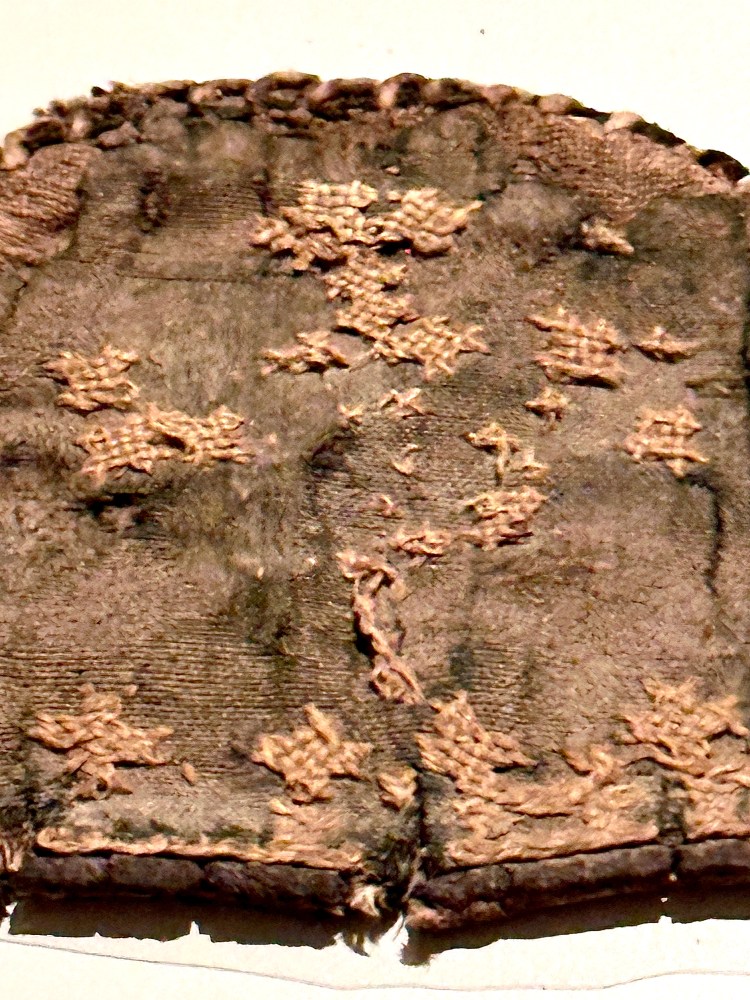
Finally, the Middle Atlas leg warmer motifs are strikingly similar to those on a fragment at the Whitworth Museum in Manchester (inventory number T.1968.438). According to Anne-Marie Decker, the piece was made by nalbinding using an intarsia technique. While she says the provenance is unknown, it is assumed to be from Coptic Egypt. This colorful fragment and the Middle Atlas leg warmers could shed light on the shift from nalbinding to knitting as well as interactions across northern Africa.

Spreading the Word About Middle Atlas Knitting

It would be best to hear and learn from Middle Atlas knitters themselves; however, there appear to be very few, if none at all, left. I believe that this unique and beautiful knitting tradition deserves to be recognized alongside other popular traditions like Fair Isle, Cowichan, and Nordic knitting. Since very little information is available about Moroccan knitting in general, I am making my notes for the Middle Atlas intarsia-in-the-round motif available here in the hopes of spreading the word about Moroccan knitting; encouraging its revival and study; and promoting Moroccan skills and knowledge in knitting history research. These notes first appeared in my Middle Atlas Skirt Pattern, which includes a step-by-step guide to intarsia-in-the-round (with photos). You can purchase it here. As a self-funded, independent researcher with no institutional connections, pattern sales help me cover the costs associated with my work. If you do purchase the pattern, thank you very much for investing in my research on the history and practice of knitting in northern Africa and western Asia. If you don’t want to purchase the pattern but would still like to support my writing, please consider sending me a tip via Ko-fi. Thank you!

Notes

*Written patterns, colonial craft education, and YouTube also have their role to play in the development and practice of knitting. They are very much a part of knitting’s story and illuminate the ways in which people interact and share/spread ideas. They too are worthy of study and are needed for a complete picture of the craft.

The Middle Atlas Skirt Pattern and Intarsia-in-the-Round

When I was doing research for my book, Keepers of the Sheep: Knitting in Morocco’s High Atlas and Beyond, I came across a beautiful pair of leg warmers in the book Berber Costumes of Morocco by Frieda Sorber and Marie-Rose Rabaté. The complex tessellating pattern was intriguing and reminded me of the patterns decorating objects I had seen while living in Niger. The knitter in me wanted to know how the leg warmers had been made, but I was also curious about the knitters themselves and the history and contexts in which the leg warmers had been made and used. Since I was living in Morocco, I immediately set out to find knitters in the Middle Atlas who might be able to help me.

Unfortunately, my trips to the Middle Atlas, where I talked with artisans and residents, were fruitless. No one seemed to know how the leg warmers were made, and some didn’t even know about them. It seemed that this knitting tradition had declined with changes in fashion and eventually disappeared when the last knitters passed sometime in the first half of the 20th century CE. Nevertheless, there could still be people out there who were raised with this knitting tradition and still have memories of it. I just never managed to meet them.

Being too curious for my own good, I couldn’t just let go of these leg warmers. Over the course of a year, I developed a hypothesis for how the leg warmers might have been knit based on many hours of experimental knitting informed by photos of leg warmers (example – inventory no. 71.1996.22.2.1-2) in the Musée du Quai Branly collection in Paris and a photo (inventory no. PP0227604) from their archive depicting a man in the Middle Atlas knitting what are likely leg warmers (use the inventory numbers and search bar on the Musée du Quai Branly collections page).

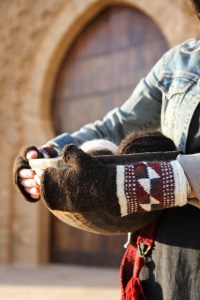
The best way to produce the tessellating pattern proved to be intarsia-in-the-round, which was confirmed by the photo of the man knitting in the Musée du Quai Branly archive as well as photos of the inside of leg warmers at the same museum. Having never knit intarsia before, much less in-the-round, it took me many months to figure out just how to do one line of diamonds in the pattern – never mind trying to get the diamond pattern to repeat over and over again. And so, I developed the gauntlet glove pattern available in the book I wrote, which only requires one line of diamonds.

While I was pleased with having figured out the single row of diamonds, my brain was not satisfied. I really wanted to be able to make the diamond pattern repeat over and over again, as it does in the leg warmers, without creating gaps in my knitting. But, life has a way of distracting you. This project was put on the back burner as COVID-19 hit the world and I was swept up with relocating from Morocco to the USA and then Armenia. Once in Armenia, I hit the ground running doing research for a new book about knitting in Armenia (working title, Knitting at the Crossroads: A Journey with Knitting in Armenia).

Fast forward to last year (2025), and I finally could no longer ignore the itch to revisit Middle Atlas intarsia-in-the-round. I didn’t feel like knitting leg warmers because I knew that I likely wouldn’t finish the second one given my busy schedule and long list of work for my Armenia book. I dislike putting time and effort into something that winds up unfinished and unusable, so I decided to knit a skirt. I reasoned that a tube skirt is similar in shape to a leg warmer and, although it would require more bobbins, I would have a ready-to-wear garment at the end of it and no need to knit a second one (famous last words).

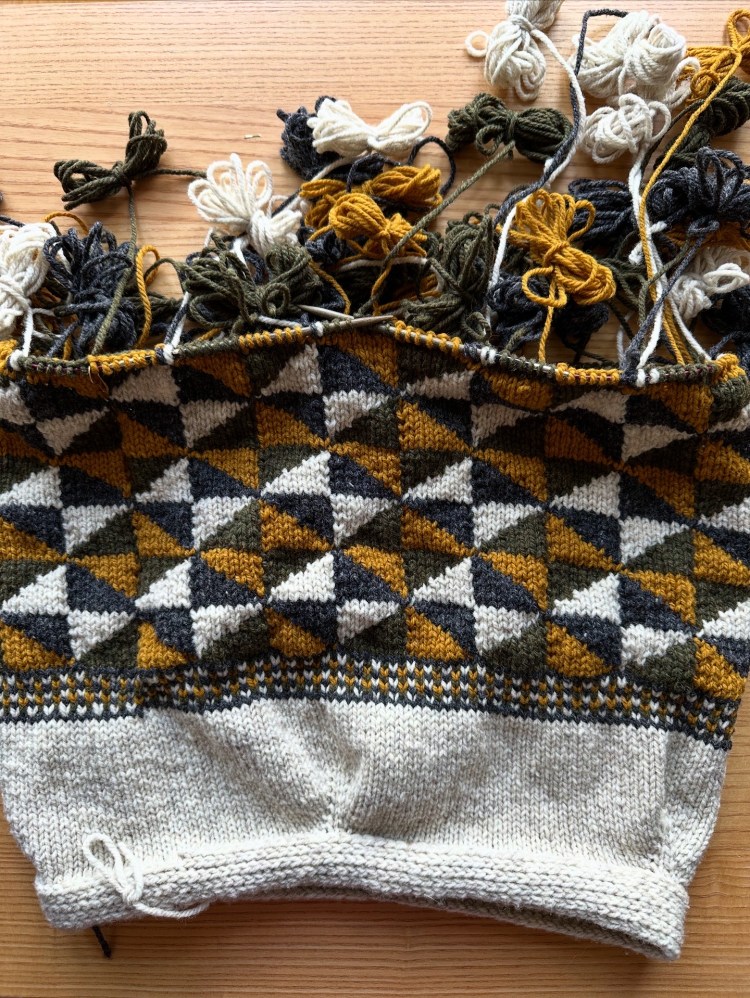
After introducing the bobbins, I was slightly horrified by my decision to apply this technique to anything wider than my leg. My knitting was a mass of yarn that looked as if it would seize up into a giant tangle the minute I moved it. What was I thinking? I would never be able to wrestle this into a completed garment. However, that itch to figure it out was now a full blown flaming rash, so I plodded onwards. I knew that it should work since I had successfully created the gauntlet pattern. I just needed to calm down and be methodical. And so, it began. The first row of diamonds came out as expected, but the second row took several tries to figure out. There were definitely moments when I questioned my sanity, but I eventually figured out how to transition to the second row and the third row. By this point, I had a clear idea of the order of operations. The knitting became easier and easier. Dare I say, it almost became as relaxing as knitting a simple garter stitch scarf? Before I knew it, the skirt was done.

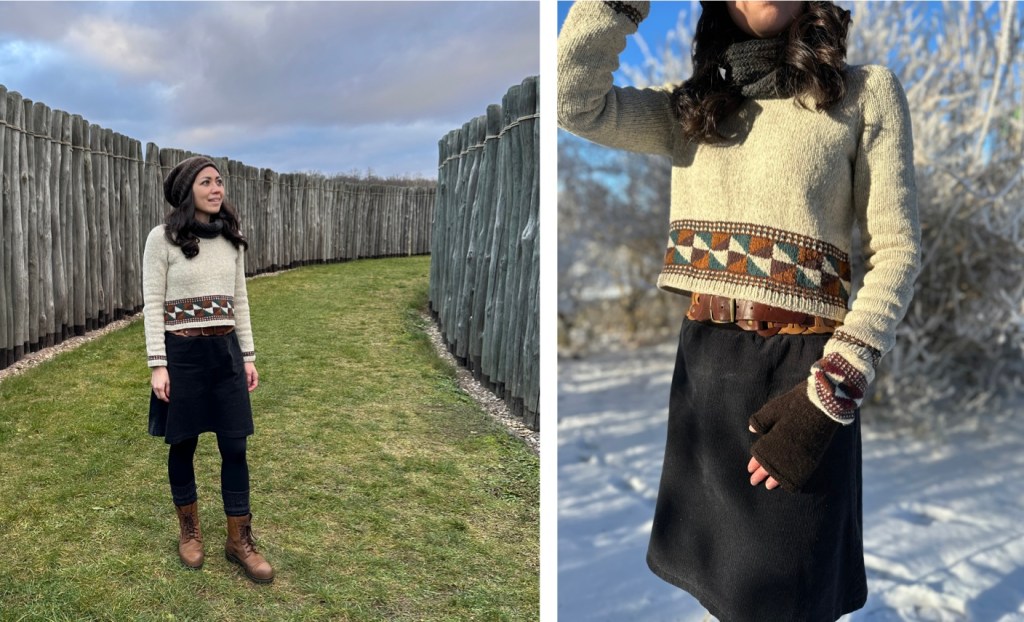
As soon as I bound off my stitches, I wanted to keep working with the motif. I had grand ideas to design a sweater, but I just didn’t have the time, and my reserve of patience was in sore need of refilling. So, I decided to add the motif to the Molly Cocoknits sweater. I really love Julie’s method of knitting sweaters. I am petite-ish, but my shoulders are broad and straight for my frame, which often makes for ill-fitting necklines. However, with the Cocoknits method, I have been able to produce sweaters that fit my shoulders well. Anyway, I opted to shorten the Molly and only increased to a number of stitches that would accommodate the motif and my middle. Although I had thought about doing an all-over design, I chose to do only a line of diamonds at the hem. This left me with lots of leftover yarn so, of course, I immediately cast on for a second skirt (because I needed to test what I had learned to make sure I had really learned it, right?).

Between the first and second skirt, I began developing a written pattern for the skirt and a step-by-step instructional guide for how to do intarsia-in-the-round for this particular motif. Readers of my first book will know that I strive to find a happy medium between oral tradition and written patterns. My grandmother, who taught me to knit when I was 5 years old, does not use written patterns. She might look at the pictures in knitting pattern books for the ideas, but she never follows the instructions. Instead, she knits a gauge swatch and uses calculations and her own experience with knitting to create the sweater she wants. Although I had strayed very far from this style of knitting, and had even become a fairly militant gauge swatch knitter who followed written patterns to the letter, my work with shepherd-knitters in the High Atlas mountains of Morocco re-introduced me to the beauty and freedom of an oral knitting tradition. It blew my mind and did wonders for building my self-confidence as a knitter. I wanted to capture that same feeling in my pattern.

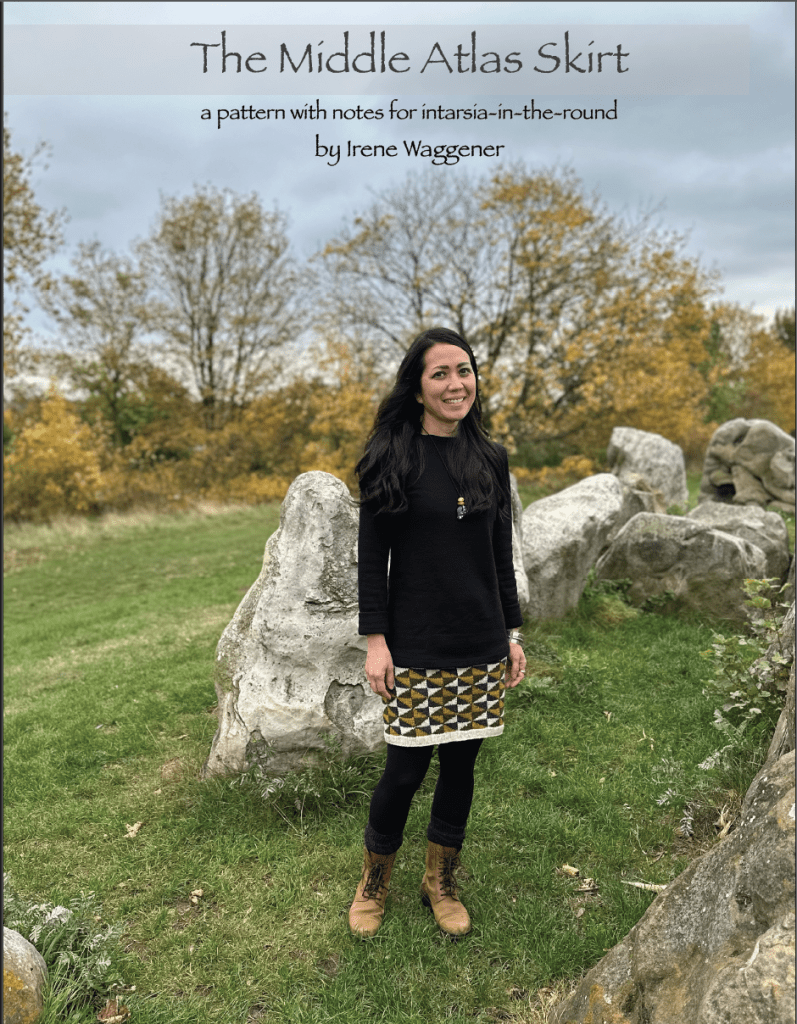
And so, the Middle Atlas Skirt pattern with notes for intarsia-in-the-round was born. Unlike most conventional knitting patterns that require you to get gauge and tell you exactly how many stitches to cast on, increase, etc., this pattern only requires one gauge swatch (using whatever needles and yarn you have on hand) and your waist and hip measurements. A table walks you step-by-step through the calculations necessary to produce a skirt that will fit your body shape. Once those numbers are determined, they are added to the pattern, which has blanks for your specific numbers. While some might groan at the thought of doing math, I have tried my best to walk you through it with clear and simple directions and formatting. The amount of time it takes to knit your swatch, measure your body, and figure out your numbers takes as much time as knitting gauge swatches for a conventional pattern – possibly less if you are like me and waste hours, if not days, trying to get gauge with dozens of little squares of knitting. The beauty of this style of knitting is that you can use any size needles and yarn (although it works best with yarns in the DK and worsted weights). Moreover, since the intarsia-in-the-round motif does not use much of any one color, it is great for yarn stash busting.

If you are interested in giving this skirt and intarsia-in-the-round a try, you can find my pattern on Ravelry (I am working on adding it to my Etsy page and will update here once that’s done). I am always happy to see what you do with my work, so please do tag me on Instagram (@waggens_ho) or send me an email (see the ‘Contact’ button at the top of this web site). As a self-funded, independent researcher, pattern sales help me cover the costs associated with my work. If you do purchase the pattern, thank you very much for investing in my research! If you don’t want to purchase the pattern but would still like to support my writing, please consider sending me a tip via Ko-fi. Thanks!

Up next – Why is understanding Middle Atlas intarsia-in-the-round important?

Updating Knitting History

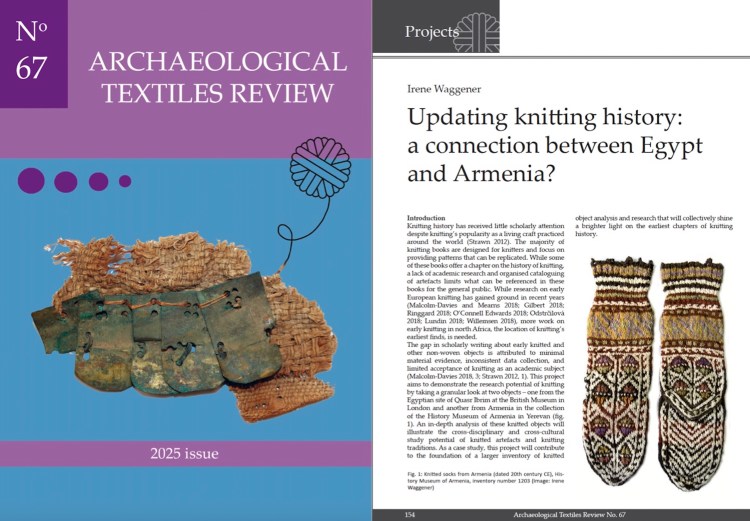
Composite image of Archaeological Textiles Review cover and first page of article

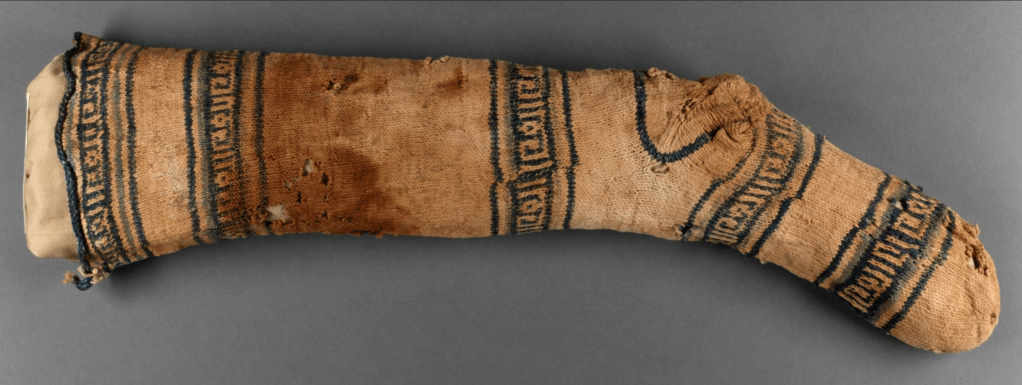
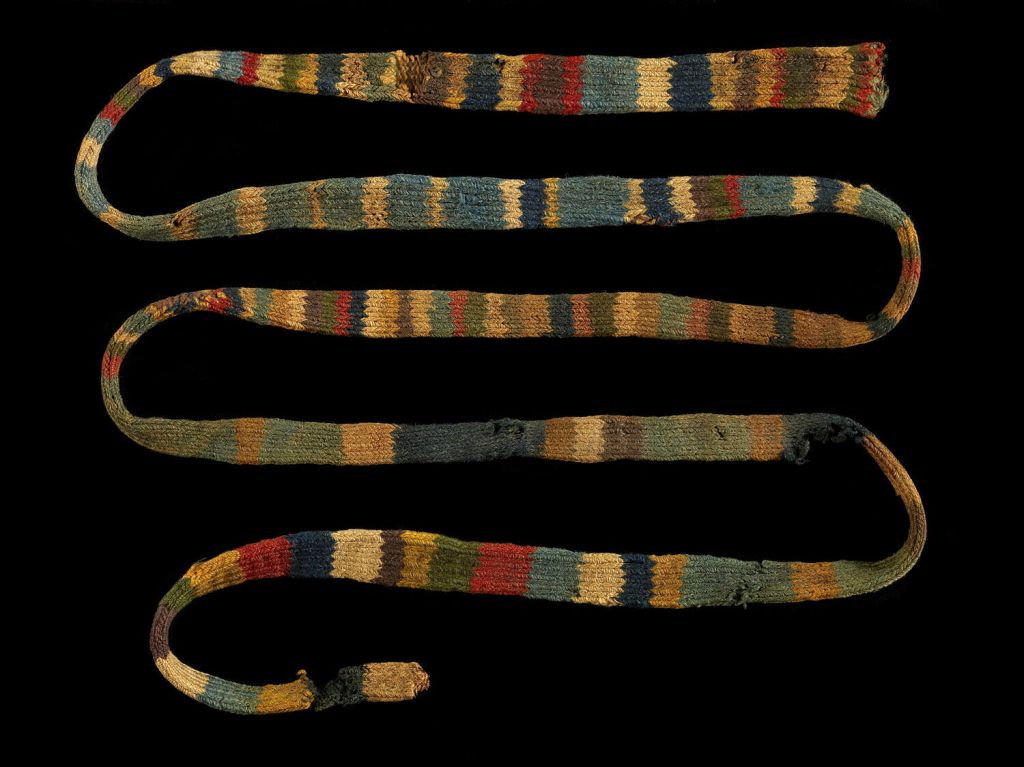
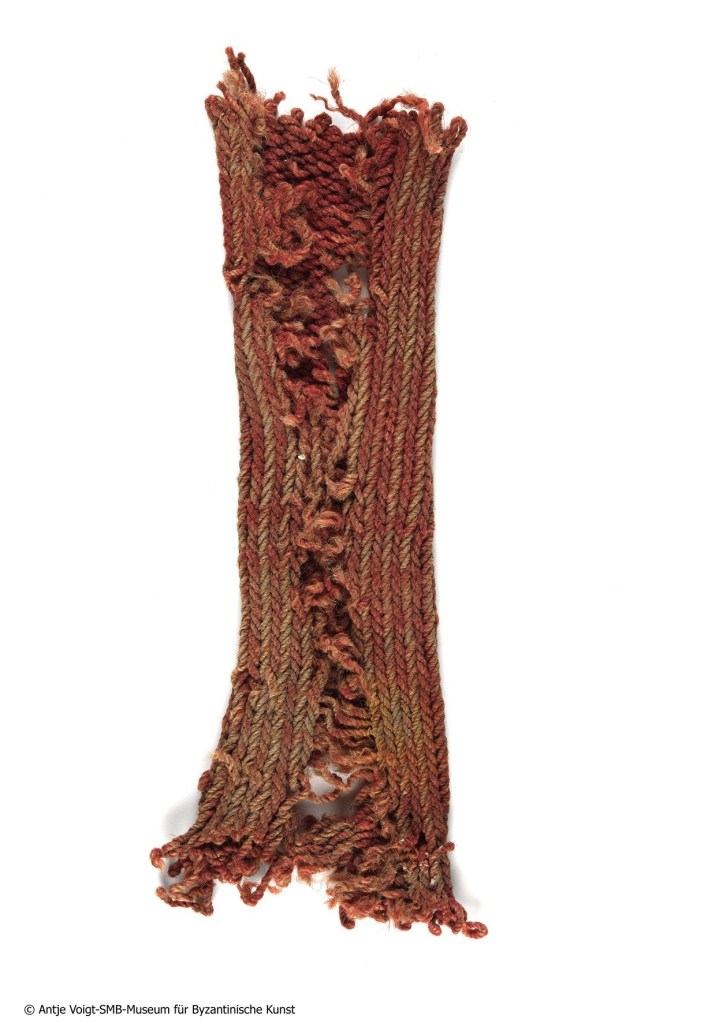
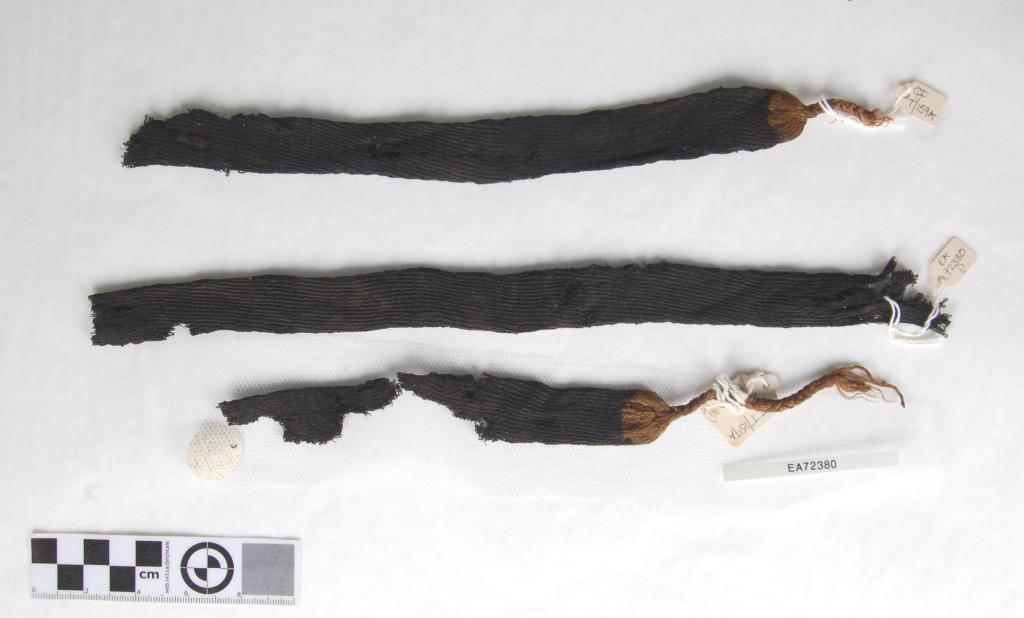
The oldest evidence for knitting, thus far, comes from medieval Egypt. These intriguing pieces, which range from technically simple to very advanced leave knitters and researchers with much to consider: Who knit these objects? How did they use them? How did knitting spread? How do these early knitting traditions relate to knitting practices today?

By analyzing the structure of these knit objects and considering their historical and cultural contexts, we can develop a more nuanced understanding of the story of knitting – and of the medieval world in general. Medieval Egypt was a diverse place that was home to many people from different corners of the world including peoples from around the Mediterranean, Anatolia, the Caucasus, the Arabian peninsula, and Iran. Moreover, it was a cultural hub that attracted merchants, artisans, and thinkers from places far and wide.

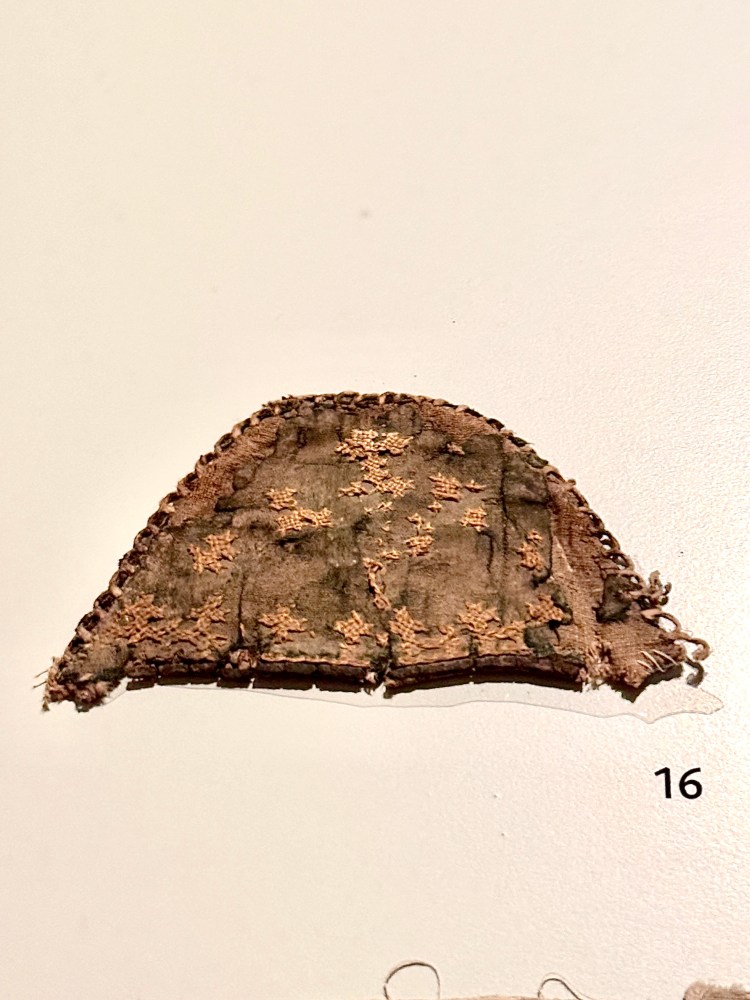
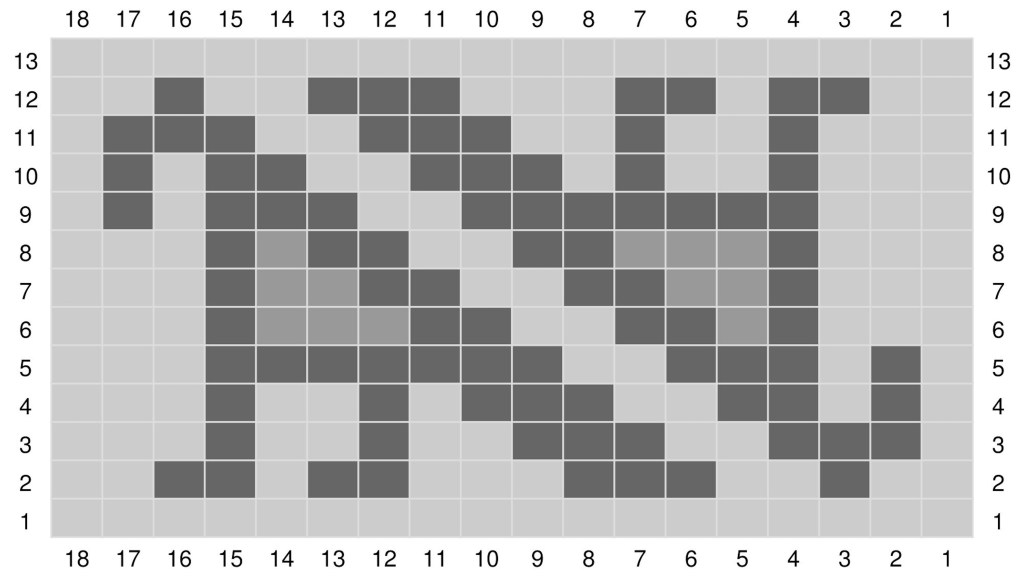
A knit fragment at the British Museum in London (EA72266) likely dating to Egypt’s Fatimid period and a pair of socks at the History Museum of Armenia in Yerevan (inventory number 1203) both bear a geometric bird motif that encourages us to consider the diversity of medieval Egypt and how that world may have shaped the development and practice of knitting. You can read more about my project to untangle the story of this knitted fragment and its motif and what this might tell us about the story of knitting in the latest Archaeological Textiles Review (no. 67, 2025).

Example schema of bird motif found on knitted and woven textiles from medieval Egypt and modern Armenia, Azerbaijan, and Iran. Light grey represents the main color; dark grey the contrast color; and light grey the optional contrast color (image: Irene Waggener)

Check out the full issue here. Download my article below:

Sock-Knitting Techniques from Armenian Knitters: Grafting Without a Tapestry Needle

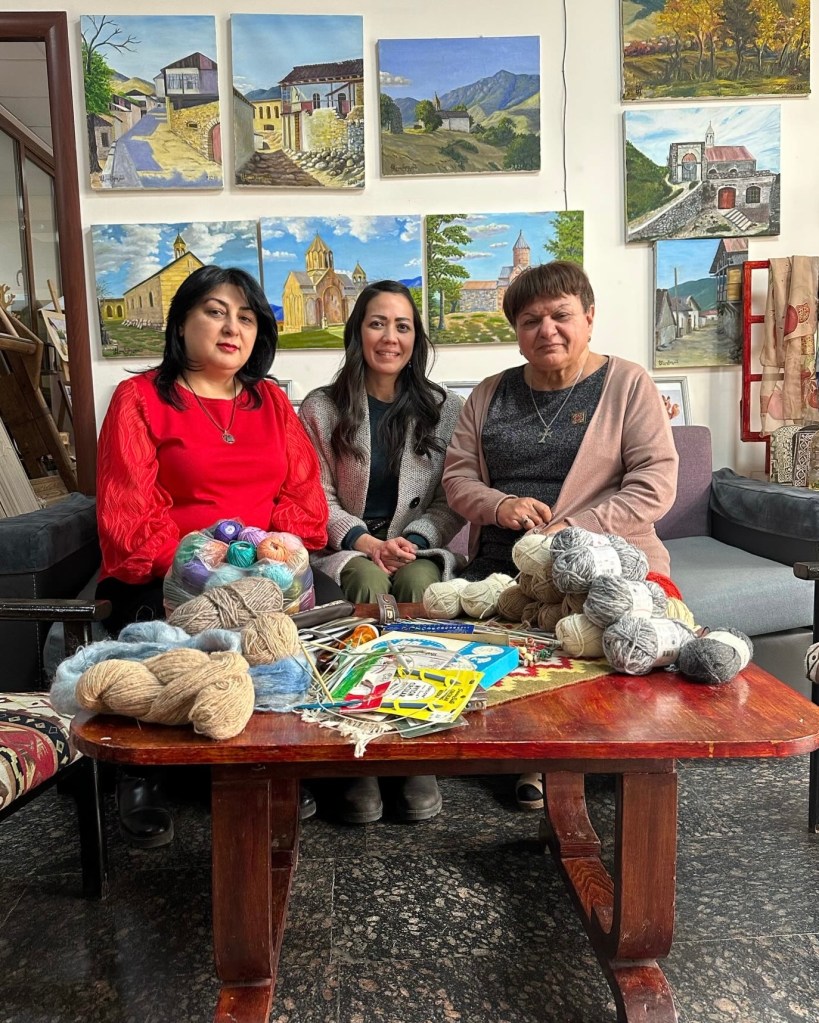
Armine Gasparyan, a knitter from Hadrut, taught me how to graft stitches together without a tapestry needle. She uses this technique to finish inserted sock heels. As with grafting with a tapestry needle, you will need to have an equal number of stitches on each needle in order to carry out the steps correctly. After you have completed the last stitch, you can push the yarn through to the inside of the heel using the tip of your knitting needle, or you can use a crochet hook to pull it through to the inside.

Armine works at the Hadrut Creative Center in Yerevan, Armenia where she teaches knitting, weaving, and other crafts to refugee children from Hadrut as well as their peers from Yerevan. The center was originally based in the town of Hadrut in Nagorno-Karabakh, but it was relocated to Stepanakert after the 44-Day War in 2020. Soon after, a branch was opened in Yerevan and other locations around Armenia to provide a gathering space for refugees from Hadrut to maintain ties with their community, dialect, and culture. Since the exodus of Armenians from Nagorno-Karabakh during the most recent war in 2023, the center’s headquarters in Stepanakert has relocated to Yerevan.

In the past, hand-knit socks were an important part of attire and cultural life for people in Hadrut. Women knit dozens of socks to include in their dowries and for their family members to wear and give as gifts. However, like in other parts of the world, old-style knitting began to decline with the introduction of factory-made clothing and changing fashions. Ira Tamrazyan, the director of the center, noticed that younger women in Hadrut were not knitting the old-style socks that her grandmother used to knit. In order to preserve this style of knitting, she decided to teach a handful of women, who in turn could teach the next generation of knitters through the Hadrut Creative Center’s classes. Armine was one of her students and is now a knitting teacher at the center. Armine welcomes students from around the world who visit the center while on vacation in Yerevan. Please reach out to the center if you are interested in learning directly with Armine and her fellow Hadrut Creative Center teachers in Armenia.

Left to Right: Armine Gasparyan, Irene Waggener, Ira Tamrazyan.

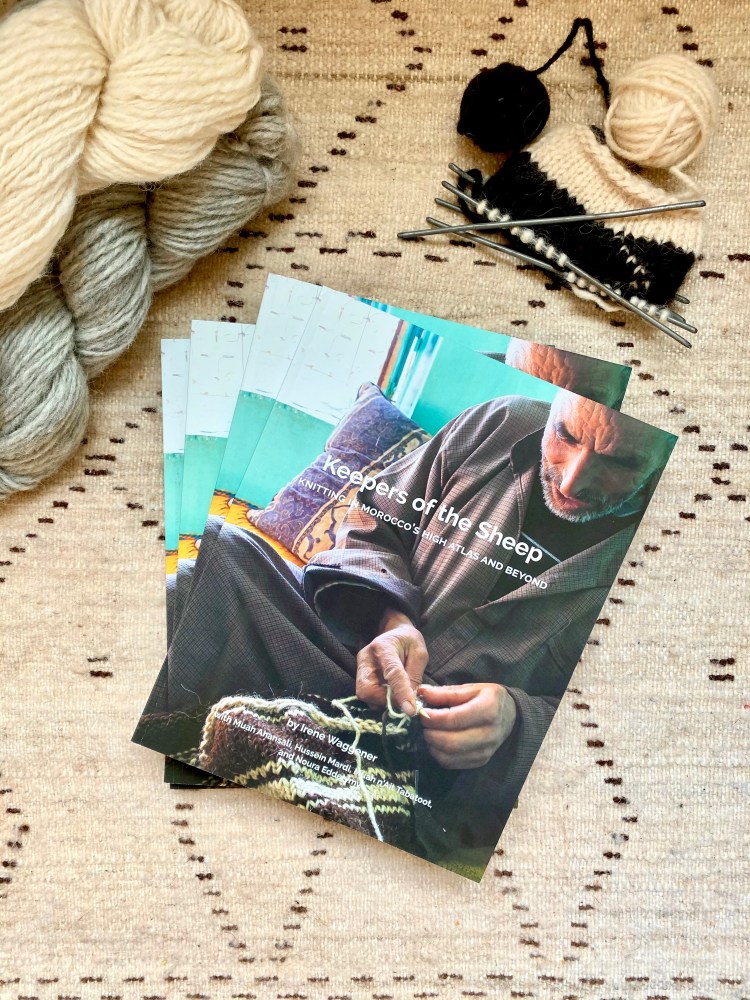
Keepers of the Sheep: Knitting in Morocco’s High Atlas and Beyond

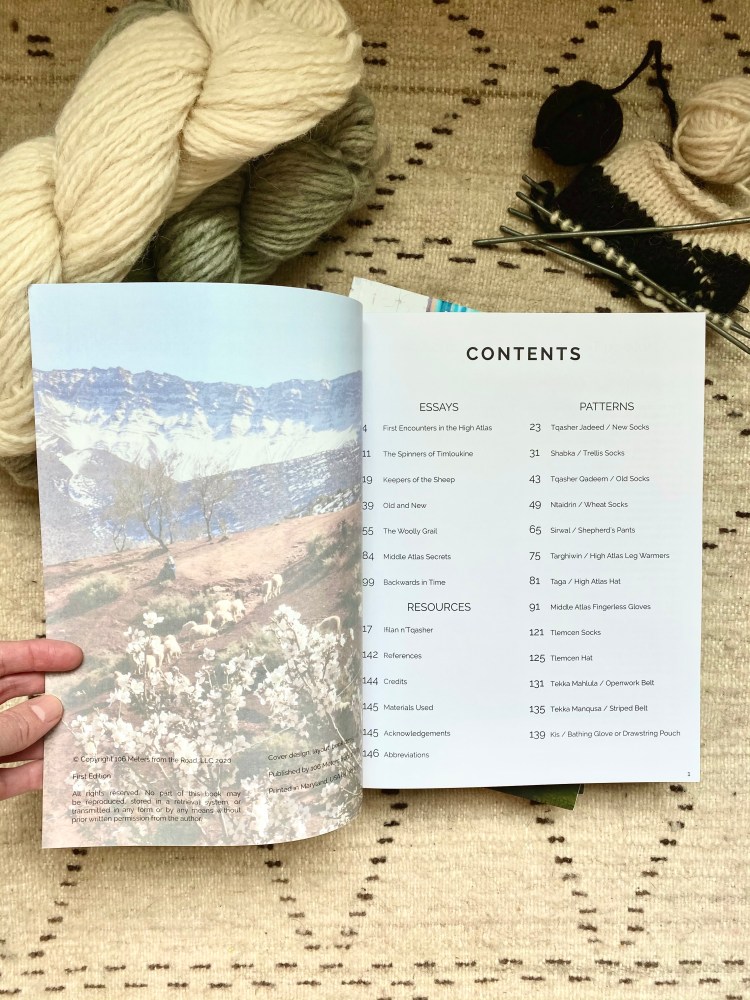
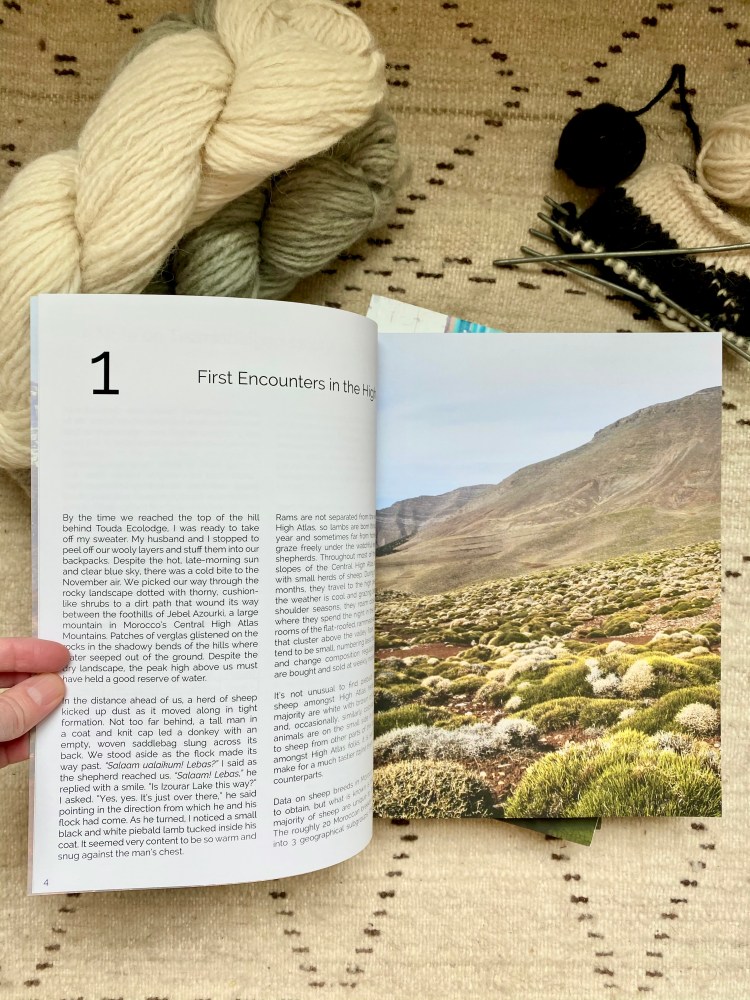
Keepers of the Sheep: Knitting in Morocco’s High Atlas and Beyond documents the knitting tradition of shepherds in Morocco’s High Atlas mountains. It is the culmination of three years of research, interviews, participant observation, and writing. Seven essays and thirteen patterns give the reader a glimpse of life in a High Atlas village and the important role knitting once played there. The book also explores the history of knitting in Morocco taking the reader backwards in time from Morocco, through Algeria, into Spain and Tunisia, and eventually Egypt, where historians believe knitting may have originated. Despite North Africa’s deep connection to knitting, very little has been written about this corner of the knitting world. Keepers of the Sheep: Knitting in Morocco’s High Atlas and Beyond fills this gap by presenting what remains of an age old knitting tradition and examining the available historical and artifactual evidence – some of which has not been shared in knitting books before. Included in the book are patterns from High Atlas shepherds, contemporary designs inspired by the High Atlas, and others recreated from historical accounts and artifacts. This book brings to life a North African knitting tradition that has all but disappeared.

I am extremely grateful to the shepherds with whom I worked and hope this book fulfills their wish to pass on their knowledge to future generations. As requested by the shepherds, a portion of the proceeds from the sale of this book will be donated to their village’s women’s co-operative, Cooperative Ibilou. Without the welcoming support and encouragement of Cooperative Ibilou’s members, I never would have met their husbands, fathers, uncles, and brothers who are the knitters of their village. The cooperative will use the funds for projects that will benefit the entire community.

Find This Book

Buy Directly from the Author

EU: Retrosaria Rosa Pomar and Retrosaria Serafina

UK: Daughter of a Shepherd and Wild and Woolly

USA: Wild Hand

For wholesale enquiries, please contact Irene here.

What People Are Saying

Rosa Pomar, Retrosaria Rosa Pomar, “There are knitting books and knitting books and if I had to choose one very special book from our shop I would choose this one. Maybe it’s because I love the history of knitting as much as knitting itself, maybe because I had the pleasure of meeting (Irene) during her research, maybe because Irene’s book reveals men knitting wool trousers using a new (to me and I bet for you too) way of carrying your yarn when working stripes.”

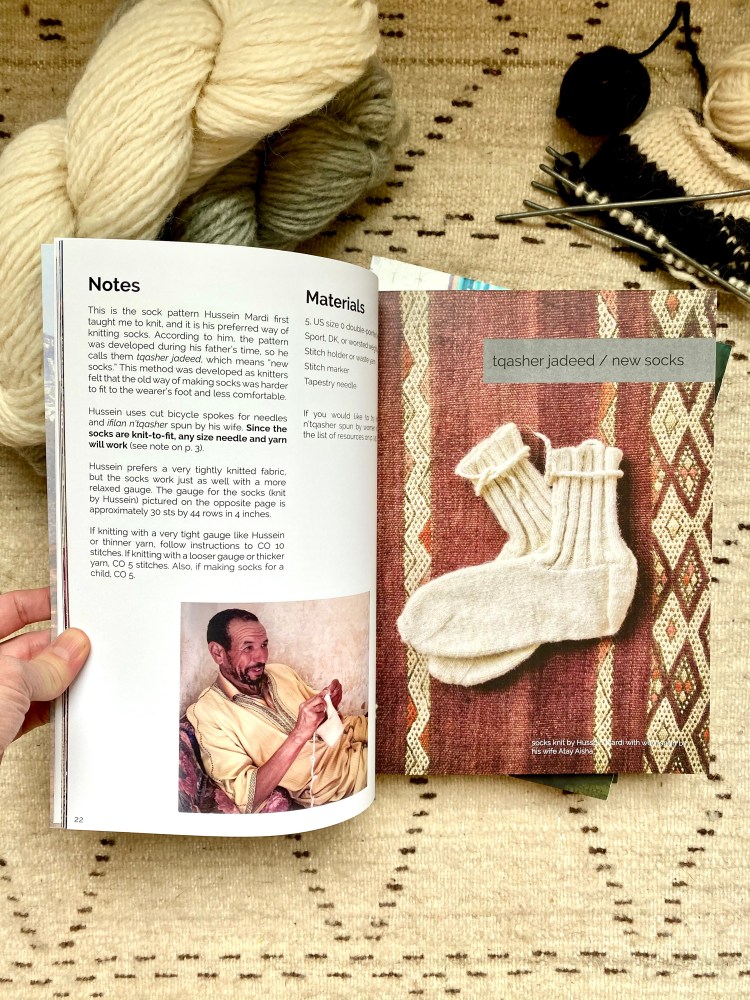
Rachel Atkinson, Daughter of a Shepherd, in reference to Hussein Mardi’s Tqasher Jadeed/New Socks pattern – “The pattern is designed to fit the individual foot and have to say, I think they’re the best fitting socks I’ve ever made!”

Paula Spranger, Retrosaria Serafina, “The book is even better than I thought. It’s so interesting to read and the patterns are wonderful.”

Jenny Dean, author of Wild Colour, “Beautiful and clearly the result of much painstaking research and experimentation. It’s the ideal combination of the practical and informative with plenty of background and historical detail.”

Erin Pirro, Morehouse Farm Merino, “Fantastic narrative of an amazing place and it’s rich wool craft traditions. I’ve gotten to experience just the basics first hand and am thrilled to have Irene take us behind the scenes. I cast on the Shabka/Trellis Socks as soon as the book arrived and am learning some amazing new techniques! It’s so freeing to have the directions result in a project that fits instead of just following and counting, following and hoping. I can’t wait to give a second copy to a dear friend. Thank you Irene – this isn’t just a story, it’s the heritage of our craft.”

Laura-Lee, Etsy Customer, “By any criteria, this book is top-drawer. It’s a wonderful ethnographic study; the photographs are worthy of an award all by themselves; the knitting patterns are interesting and clearly written. It would be of interest to anthropologists, knitters, and anyone who enjoys owning a beautiful book.”

Katherine, Etsy Customer, “Love this book! We live in Morocco at the moment and it is so fun to read the essays and learn about the cultural and historic aspect of the patterns. I have not seen any books like this. The pictures are beautiful. Can’t wait to try out the patterns. Should be a fun gift for anyone that loves textiles and crafting. Awesome job, Irene!”

Emily, Etsy Customer, “Wow. Blown away by this book and the care that went into making it, and how it honors the amazing humans who make up the book. Cannot wait to cast on some socks!! Thank you. This book will be a treasure to reference for generations to come.”

Washing Wool in the High Atlas

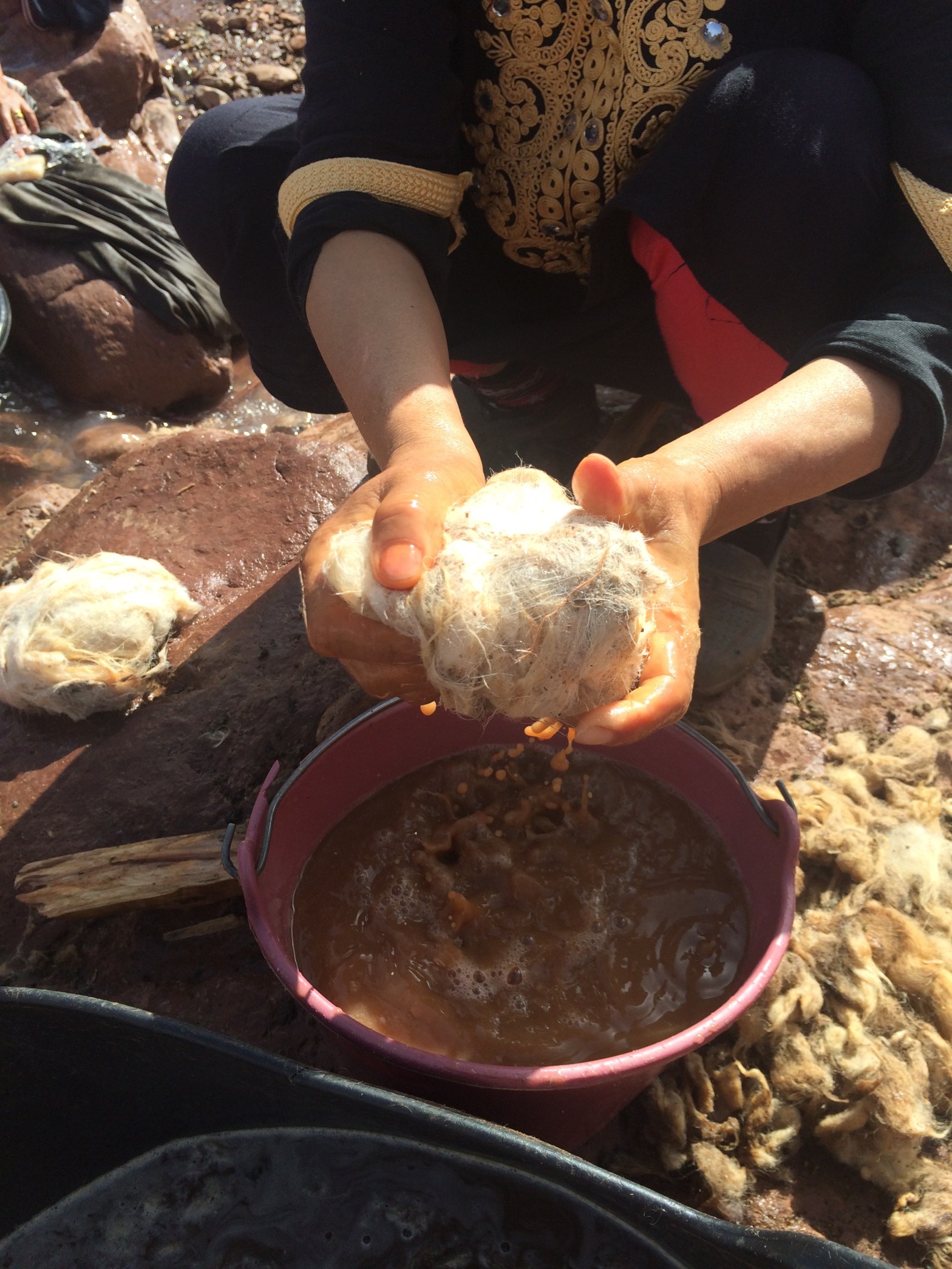
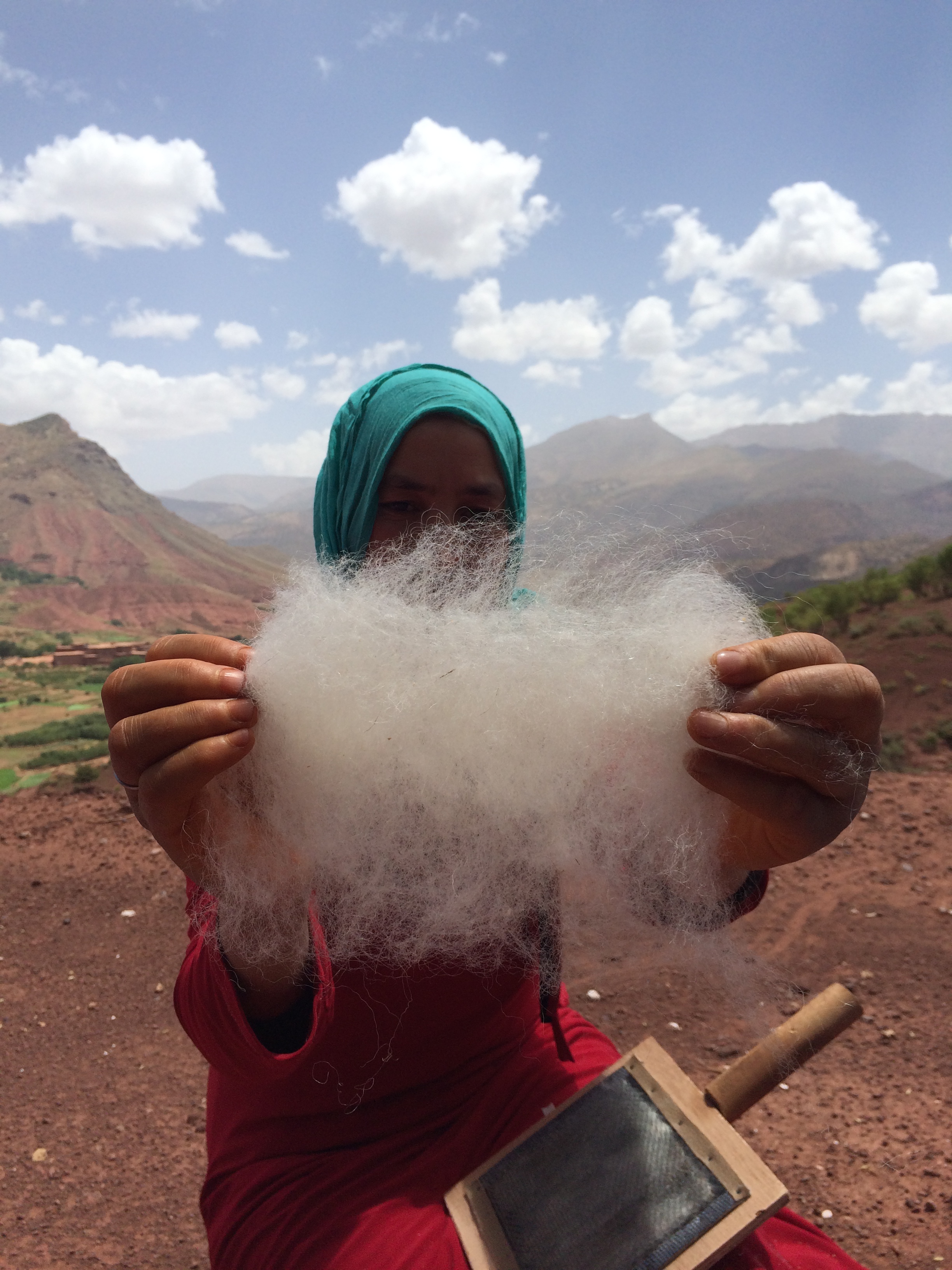
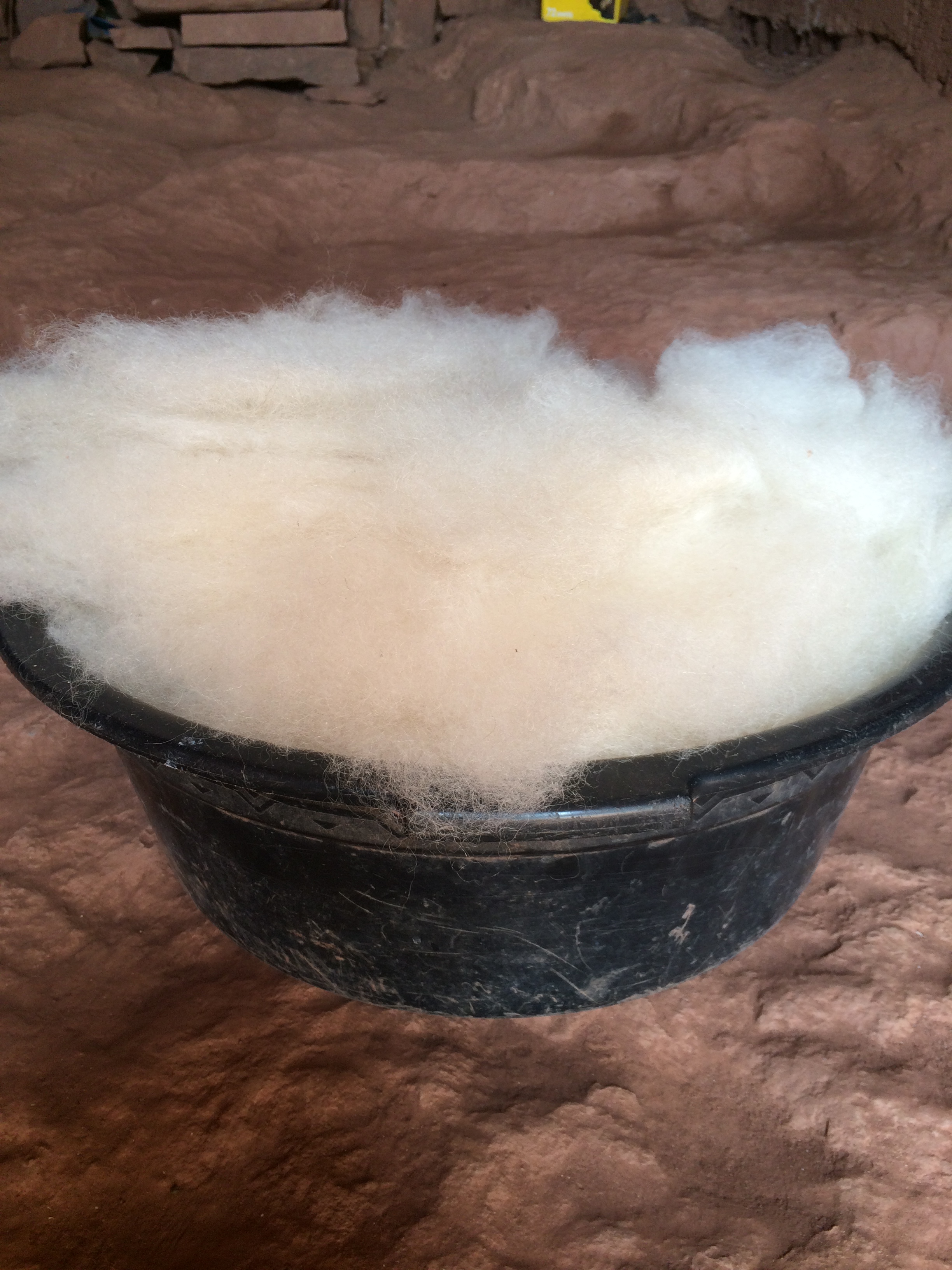
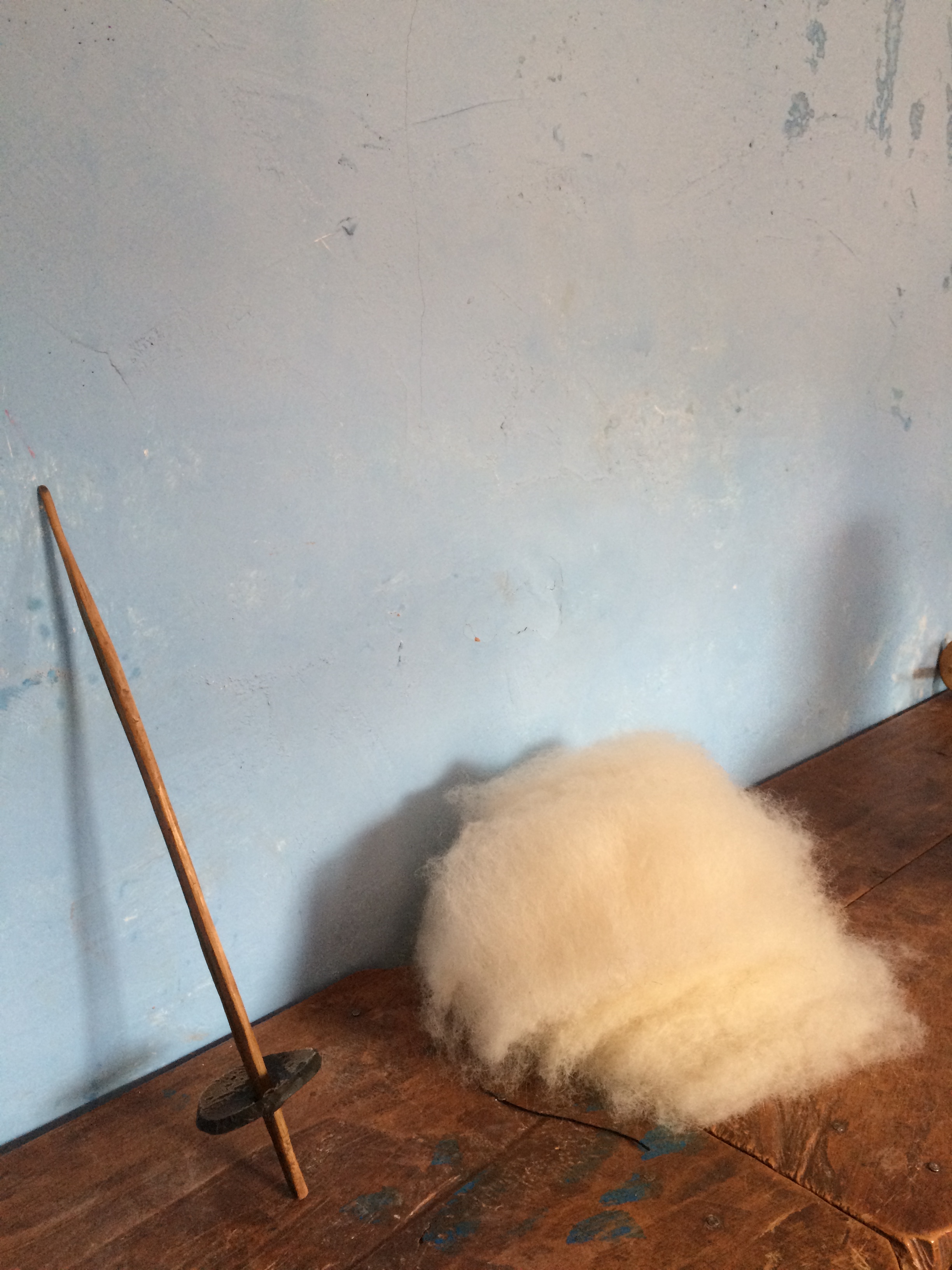
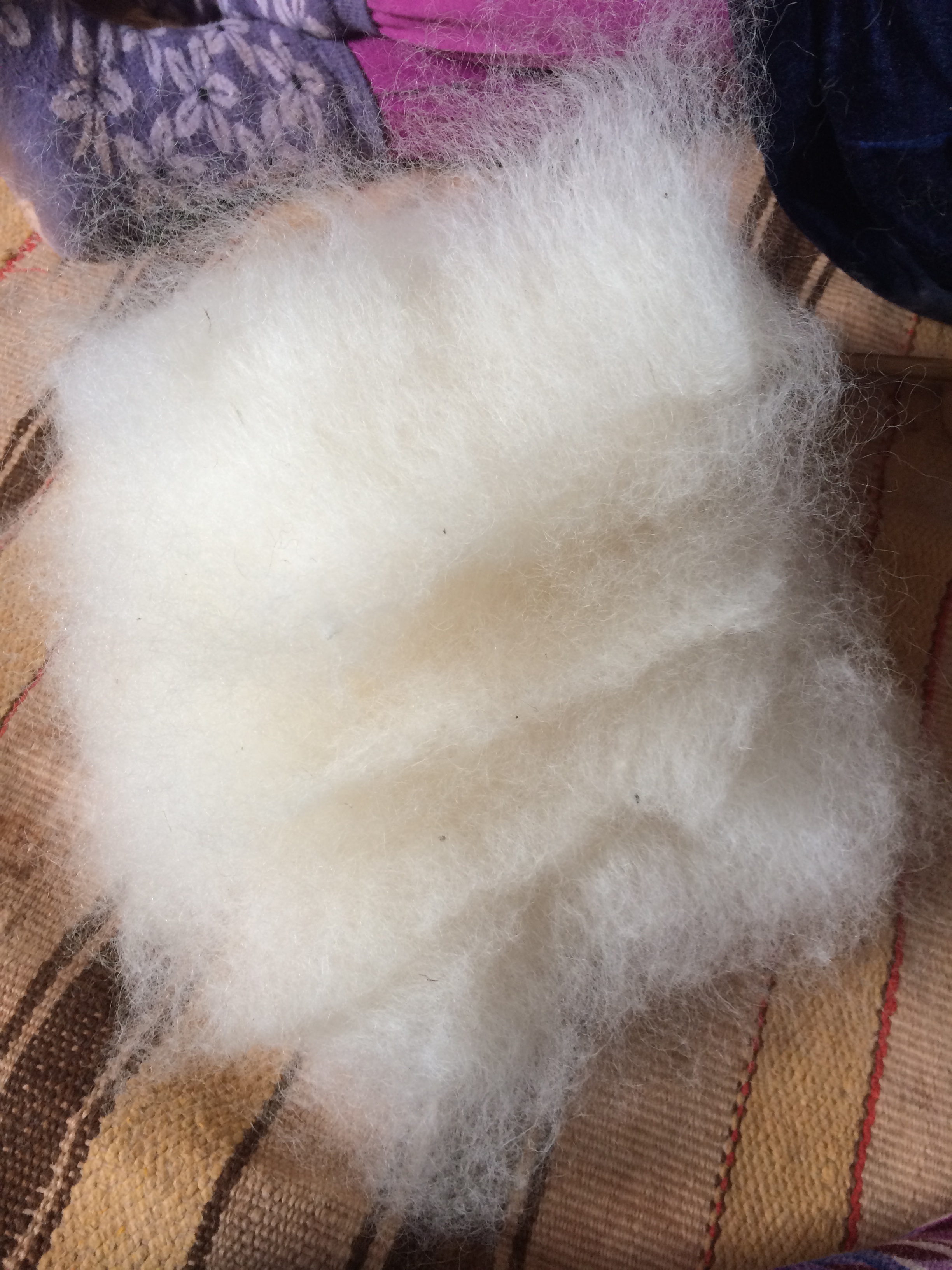
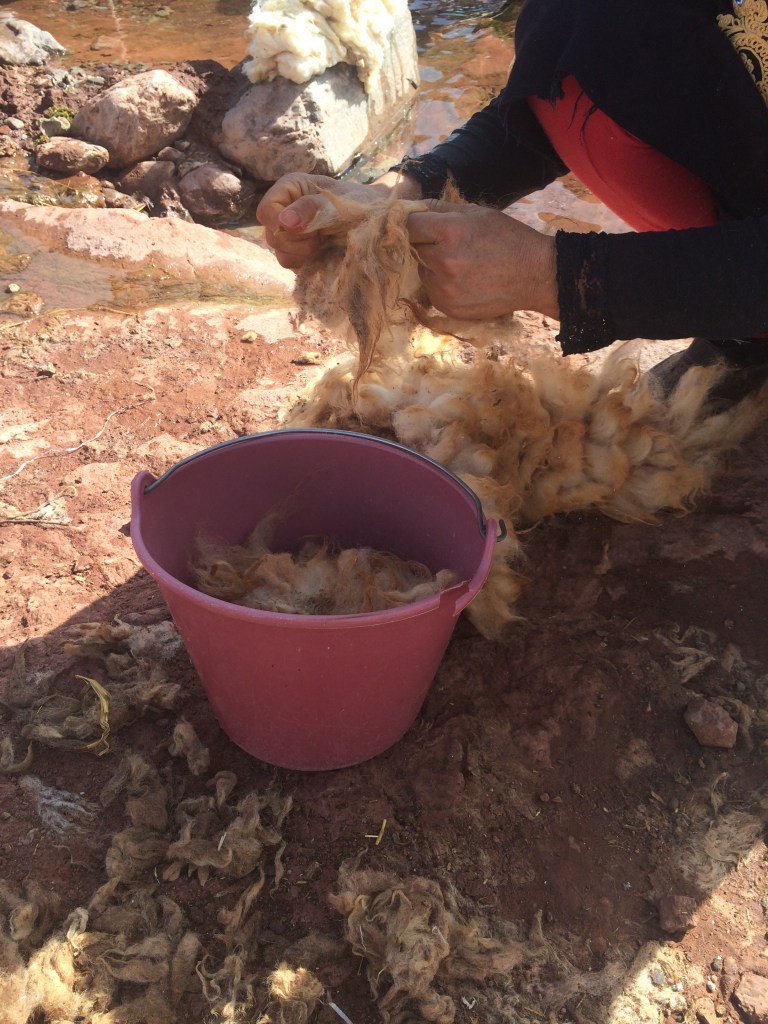
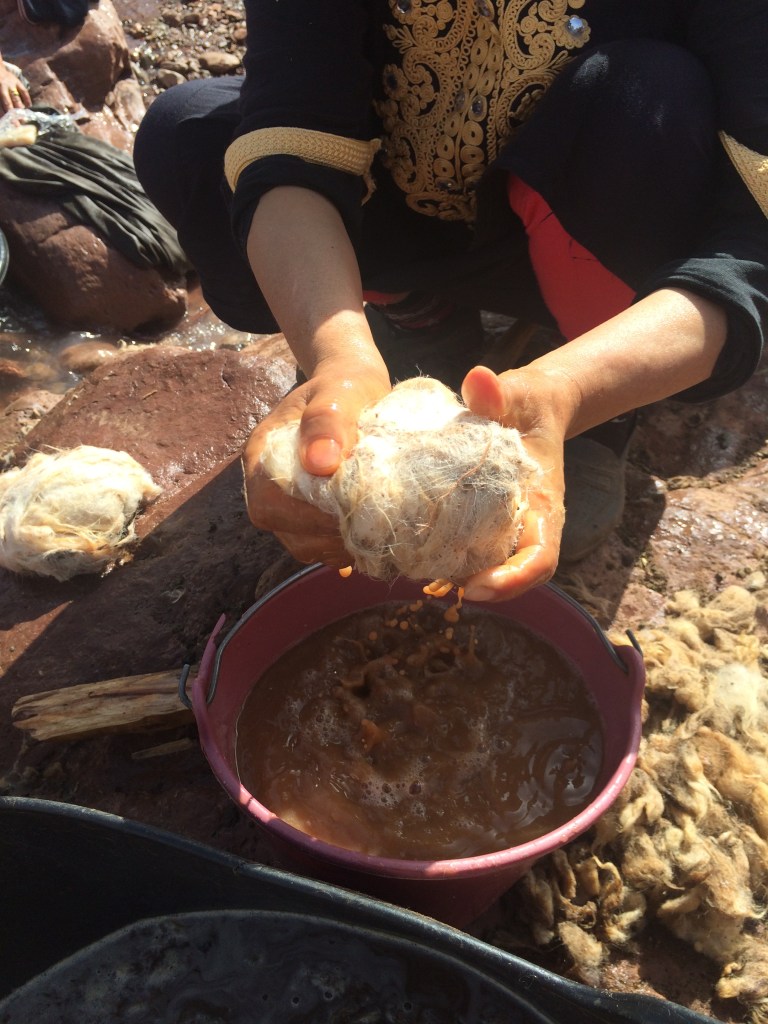
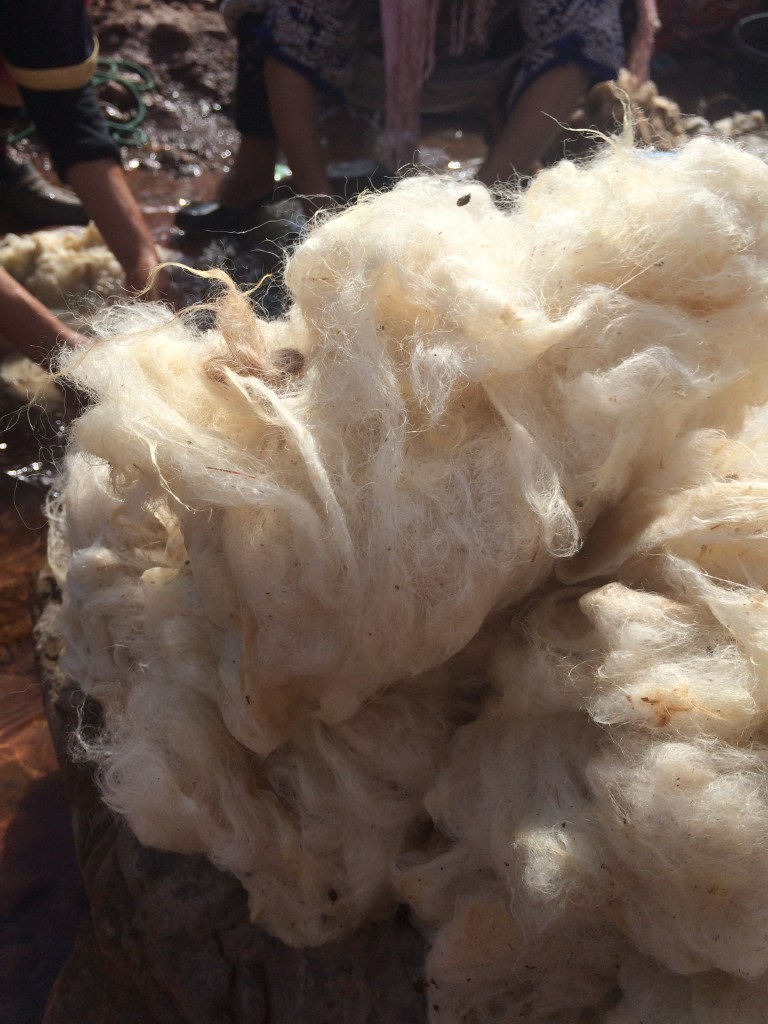
How do Cooperative Ibilou artisans create such fluffy, clean clouds of carded wool for spinning? It all starts with a walk to the river with a bundle of fresh High Atlas sheep wool. You can read more about the washing process and how the wool is spun in my article published in Ply Magazine’s Summer 2020 issue.

Below are some photos and videos that illustrate the process. Please note that High Atlas sheep produce wool that is low in lanolin, so this cold wash method works very well. When I tried this method with some merino wool, which is very high in lanolin, it didn’t work well at all. The lanolin was like velcro – it kept the VM and other debris firmly stuck in the wool.

walking to the river – in the early summer, the river is quite low in some spots

gently opening the locks and placing the wool in a bucket to soak with water

squeezing out the water

beating the soaked wool to break up clumps of dung, dirt, and debris

washing the wool in the flowing water after beating the wool
all of the wool is washed in the river with no soap – the running water pulls unwanted matter away
the washed wool
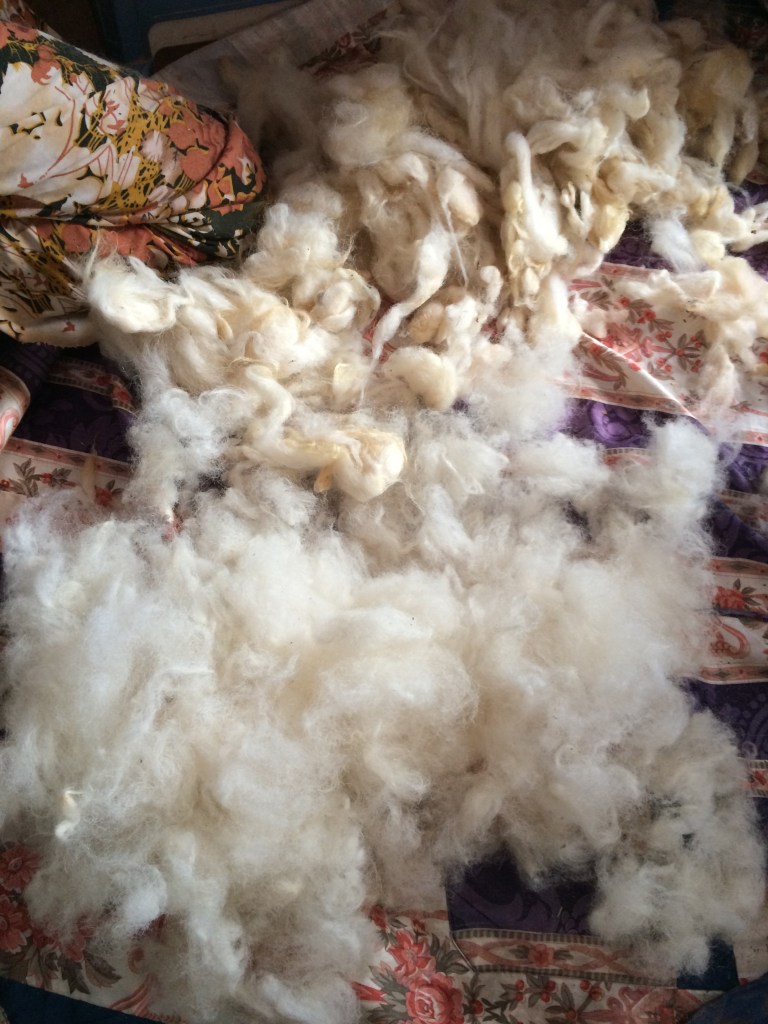
after drying, the wool is fluffed and pulled apart by hand removing any leftover VM
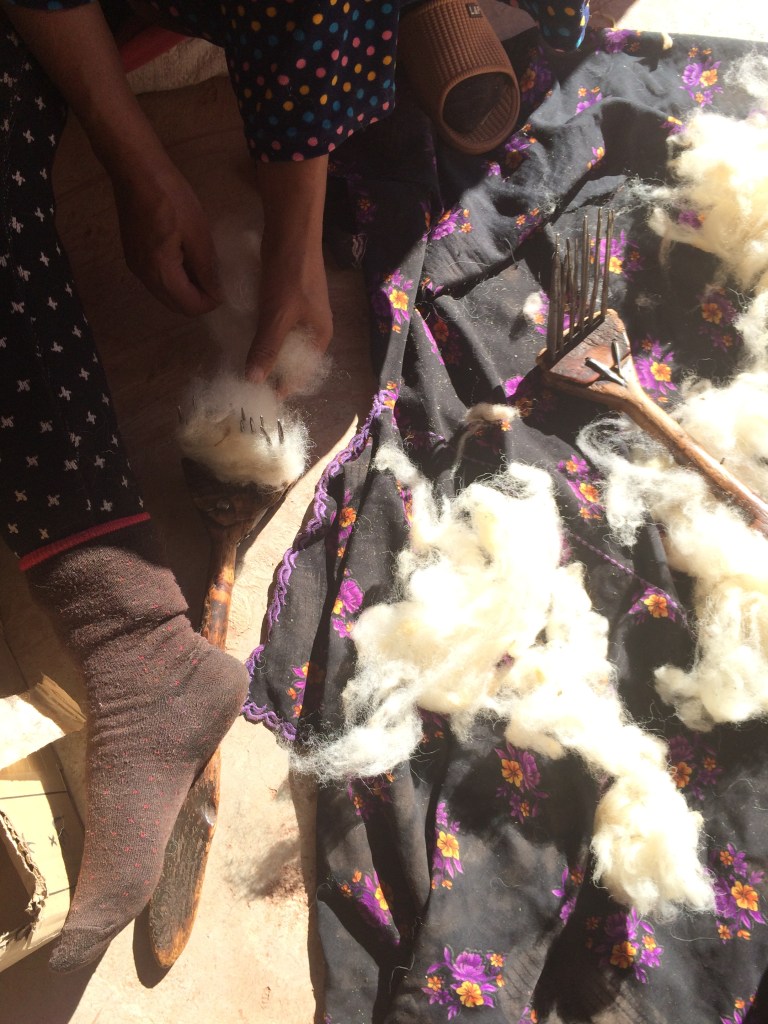
if there is still too much VM, combs are used to take out the excess – if not, the wool is immediately carded

Other posts related to High Atlas spinning:

Spinning in Morocco’s High Atlas

Morocco’s Knitted Pants

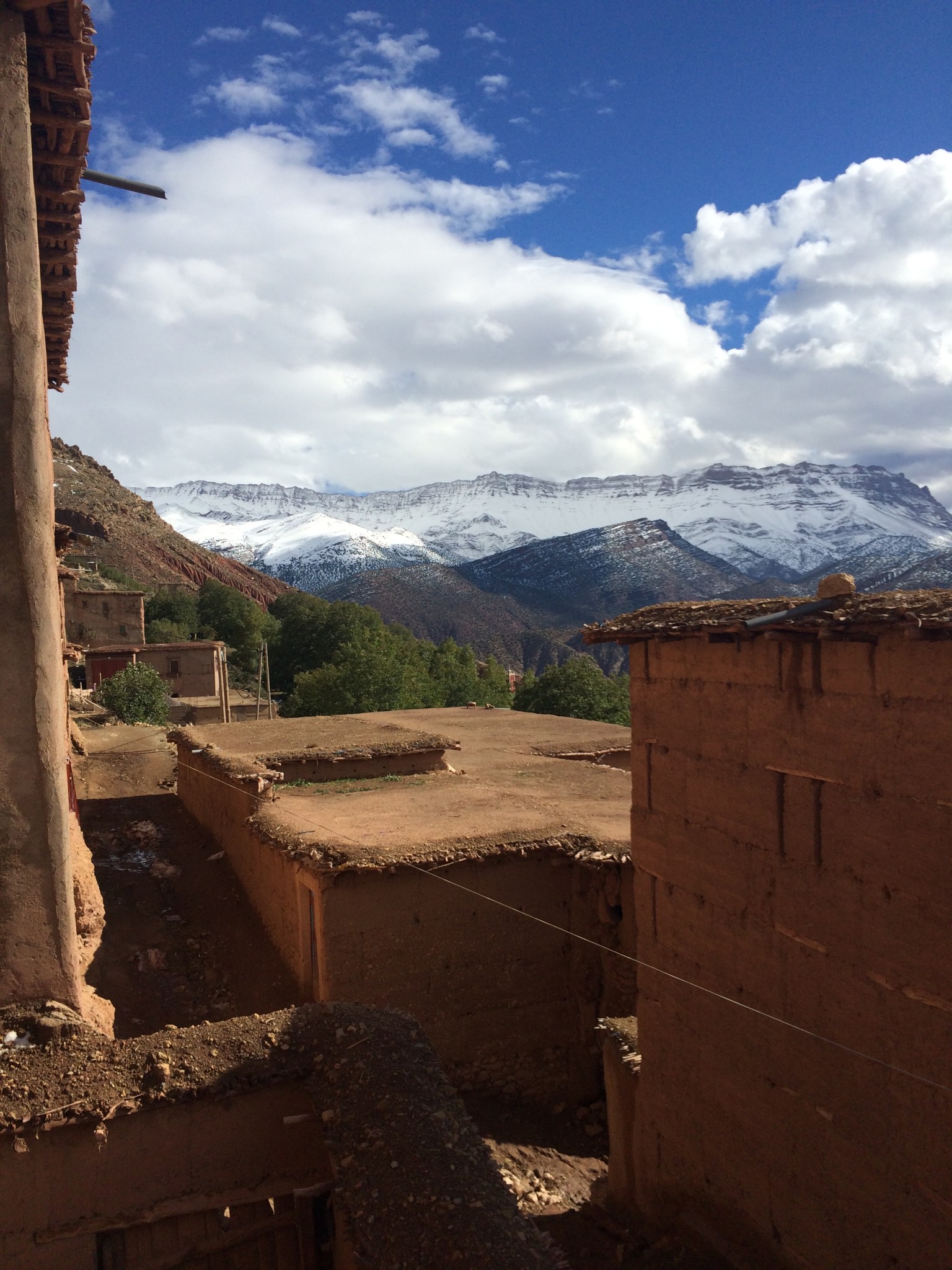
Timloukine_streetsMelting snow dripped from the eaves of the rammed-earth homes. My friend and I carefully picked our way through the slick mud of the narrow path that wound between the multi-storied buildings, trying our best to avoid the bone-chilling drops. Eventually, the path widened to a small square flanked on all sides by dwellings with timber doors. A small gray donkey was parked in front of one home. The saddle blanket and panier draped across its back suggested that its owner would be back momentarily.

A man came ambling through the square from another path on the opposite side. My friend stopped him and they exchanged a few words. The man poked his head through the doorway of one of the homes and shouted something to the inhabitants. A few seconds later an older man stepped out of the shadowy doorway and into the sunlight that warmed the square. He wore a dark brown, heavy, woolen djellaba and a black and white striped knit hat. His eyes were a bluish-gray.

My friend approached him and they exchanged a few words in Shliha, the language spoken by the Amazigh in this area of the High Atlas. The man made an expression of surprise that quickly turned into a smile as he looked at me. I approached them both and asked my friend what was happening. “The needles, do you have them?” I looked at her quizzically and then rummaged through my bag. I pulled out my needle case and took out a set of double-pointed wooden knitting needles. “Will these work?” I asked. “Yes, yes,” she said offering them to the man. He inspected them and then shouted up towards the window of one of the homes. Shortly, a young woman appeared in the doorway with a skein of un-dyed ibilou, a type of handspun, wool yarn used by women to make pile carpets. He untwisted the skein and looped one end over his wrist.

“Moah’s going to show you how he knits pants,” said my friend. “Oh! Right now? Here? In the street?” I asked. She smiled and shrugged her shoulders. “Can I take a video?” I asked. “Of course! No problem,” she responded. Moah began to cast on as I whipped out my phone to record what he was doing. His hands were a bit shaky. I couldn’t tell if it was from the chill in the air, excitement, or nervousness from being watched. He carefully joined the round and began to knit as we all stood in the muddy square. I was quite surprised to see that he was knitting the way I do – inserting the working needle through the front leg of the stitch, which is often associated with the western style of knitting. When Hussein showed me how to knit socks, I noticed that he worked in the eastern style, inserting his working needle into the back leg of the stitch rather than the front.


Suddenly, the young woman appeared again in the doorway and said a few words in Shliha. Moah stopped knitting and extended his hand towards the door. “Let’s go inside.” I followed the woman into the dark entryway and down a short passage that passed a barn entrance before terminating at a hallway with three doors on either side and a window at the end. We were welcomed into a long, narrow room adorned with handmade carpets, a short, round, wooden table, and a TV set at one end. Being a Friday afternoon, the Muslim holy day, a religious program was playing on the television filling the room with the lone voice of a man singing suras from the Koran.

Moah took a seat at the far end of the room and motioned that we should follow him. We both took a seat on either side of him as he continued to knit. The young woman entered again with a tray that had a silver teapot and small glasses arranged under a hand-embroidered cloth. She placed the tray on the table and left. As Moah knitted, we chatted about knitting and the history of the village.

AsamirIghrem10

Moah learned to knit when he was about eighteen years old from my friend’s uncle. The two of them would herd sheep together in the mountains surrounding the village. My friend’s uncle would knit as the sheep grazed, and Moah would watch him, eventually picking up the craft, too. According to Moah, the uncle may have learned to knit from a Jewish man who used to live in the village. Until 1948, there had been a long history of Jews living in the High Atlas and many villages had a Jewish community. My friend said that it was not uncommon for people of different faiths to be friends and work together. However, the Jewish people of the area all immigrated to Israel when it was created, and all that is left are the ruins of the rammed-earth homes where they lived.

IMG_7786

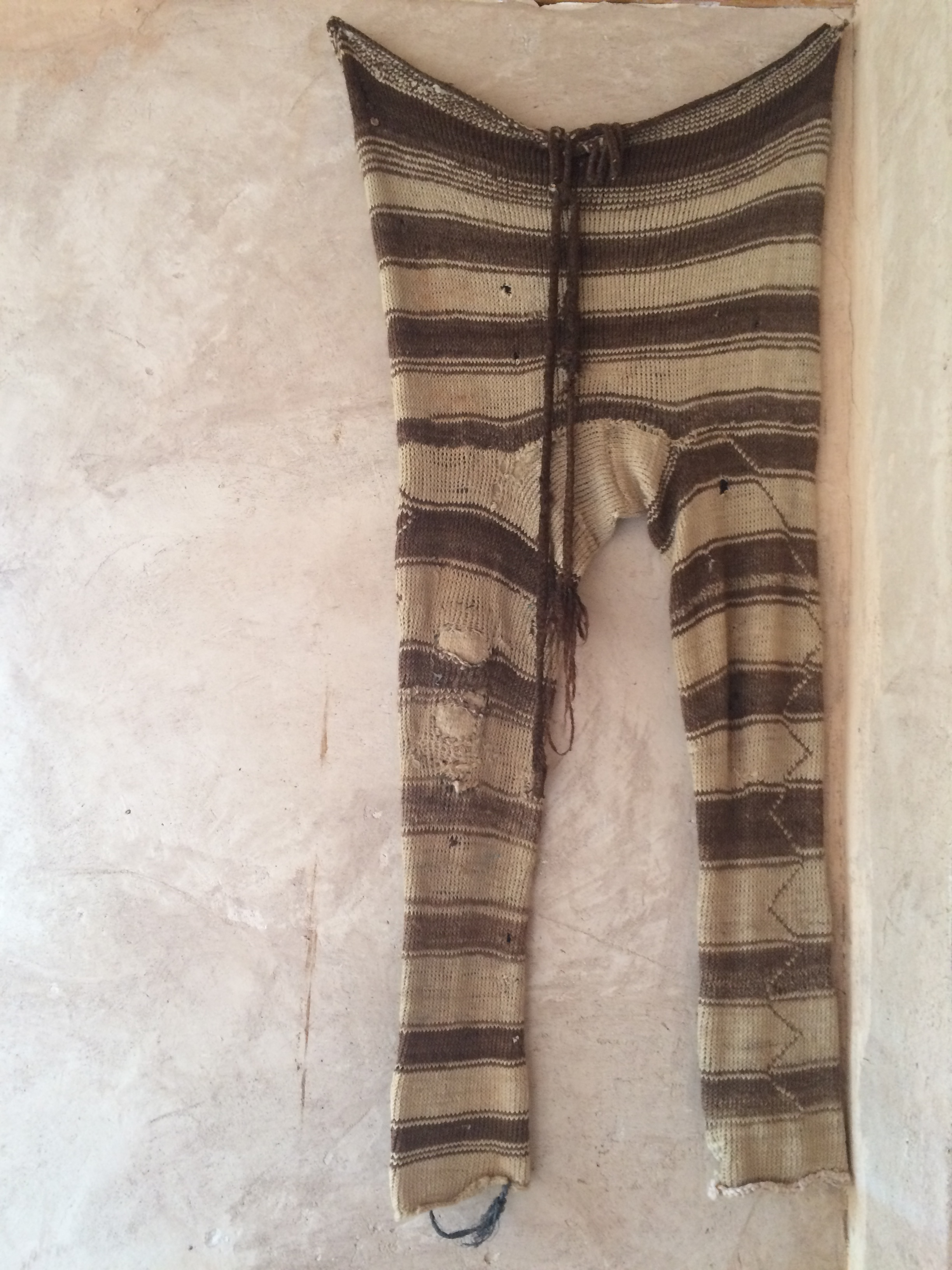
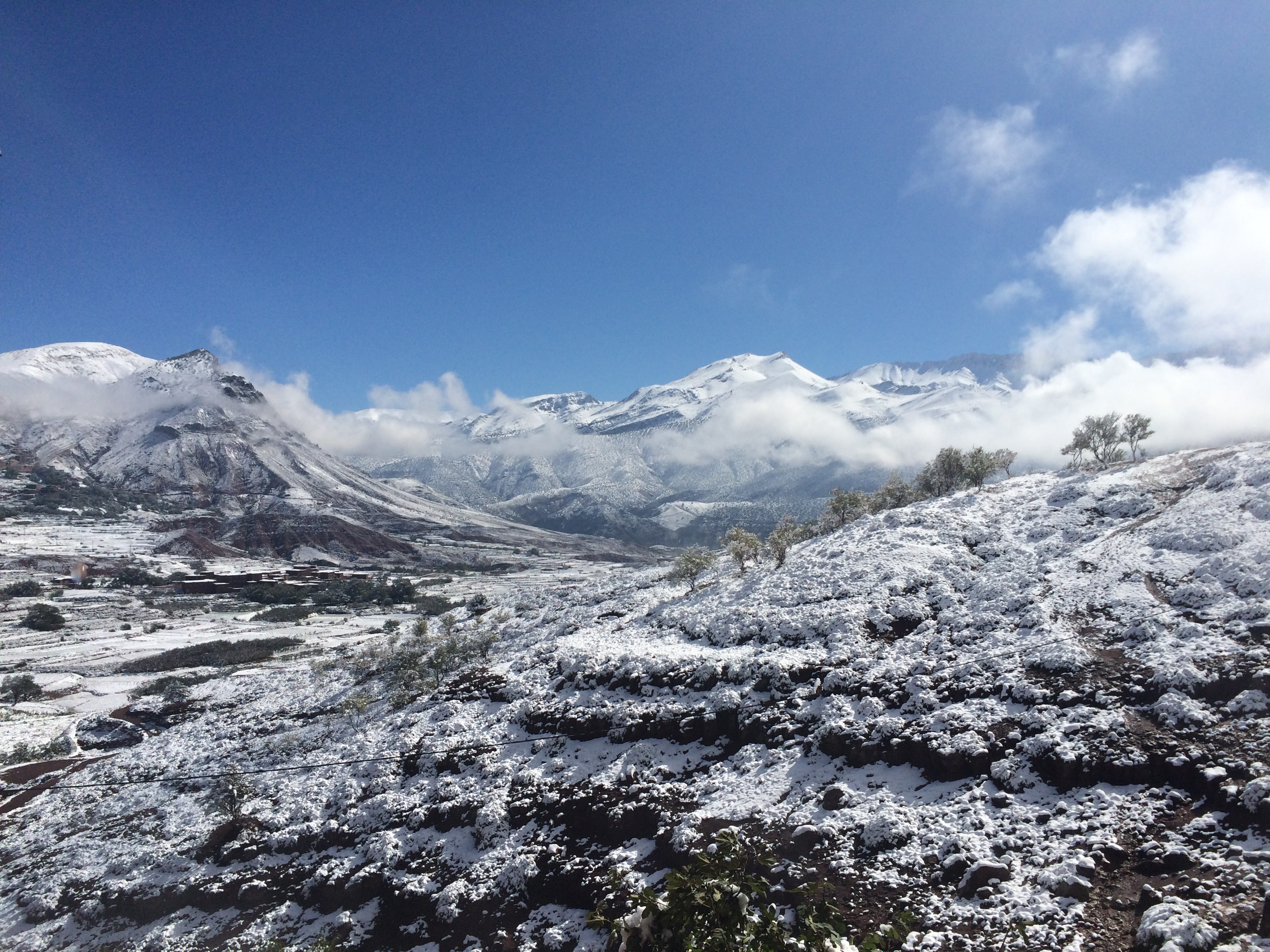
According to Moah, all of the men used to wear knit pants in the wintertime. Being made of wool from their sheep, the pants were very warm and perfect for keeping out the snow and cold. In the High Atlas, snow typically falls between November and March. The highest peaks can be covered with snow almost all year round. When there is heavy snow, the flat-roofed buildings must be cleared so that the roofs don’t collapse. This is typically a man’s job; and in the past, the men would wear knitted pants while they worked. Moah said that you could go into snow waist deep while wearing knit pants and not feel cold. However, the fashion has died out, and the last pair of pants he knit was in 1985 for a fellow villager who paid Moah to make him a pair.

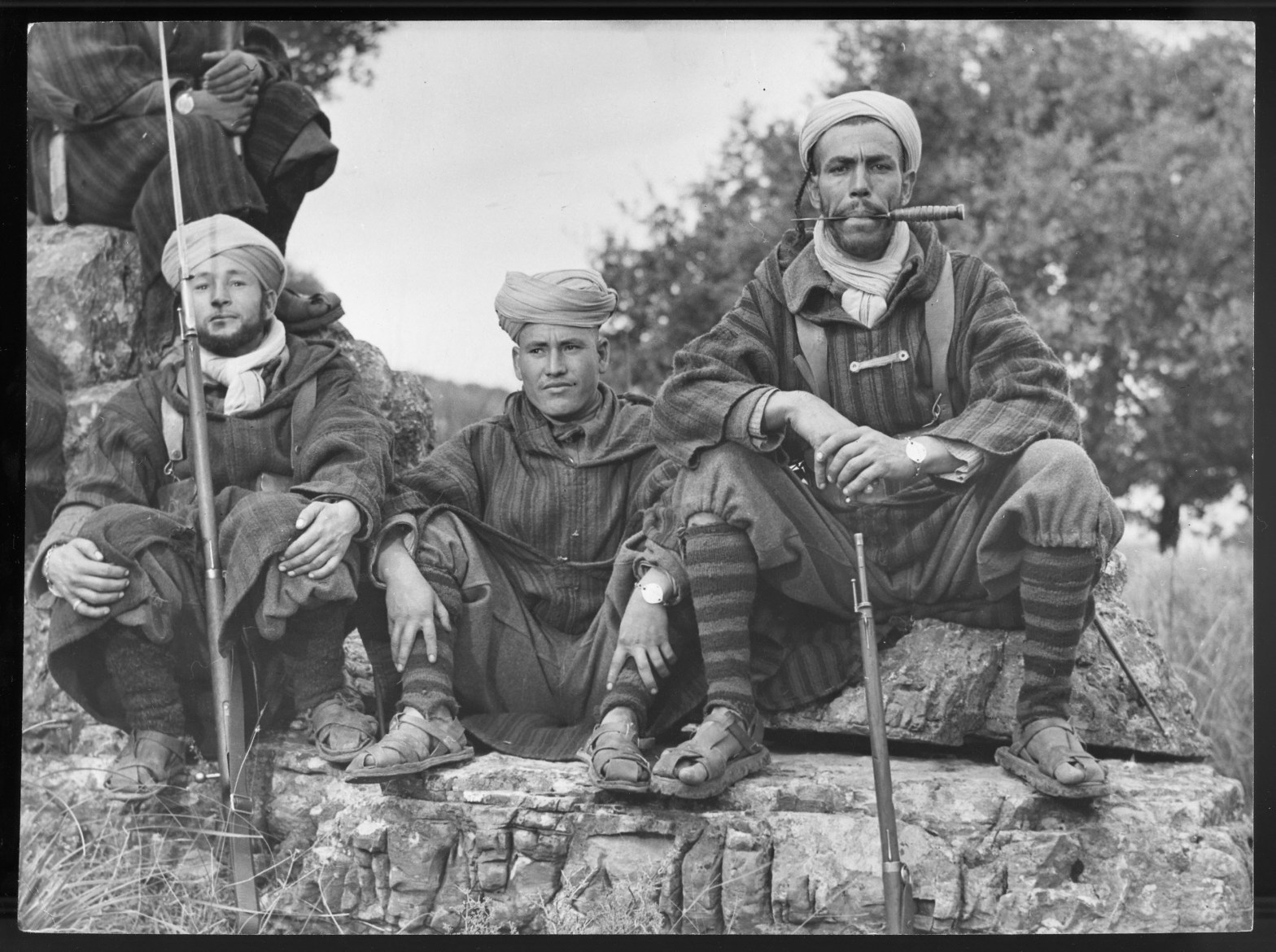
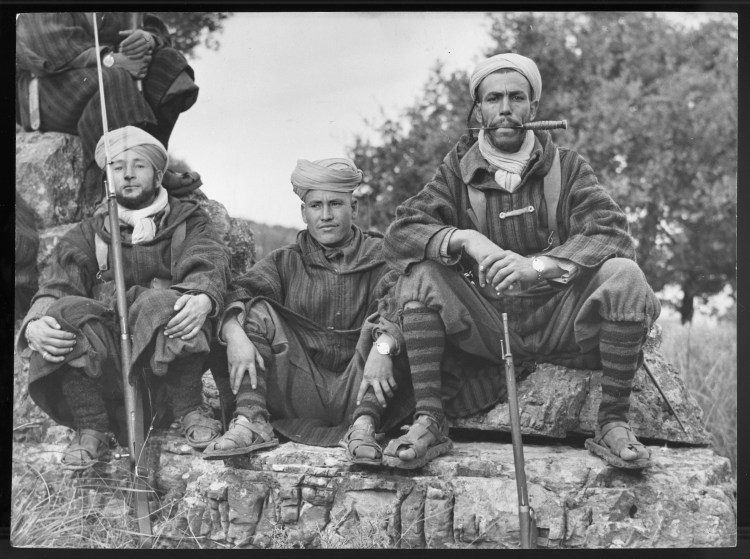
IMG_7451It’s unclear exactly how long people have been knitting in the Atlas Mountains of Morocco. The French artist, Jean Besancenot, produced gouache paintings of Moroccan dress between 1934 and 1939. Two of these depict a woman from the Middle Atlas wearing knitted leg warmers and a man from the High Atlas wearing the pants Moah was showing me how to knit. Besancenot noted that the pants were used by hunters who would spend long hours in the snow while hunting mouflon. He also remarks that the pants must have ancient origins, and that they are depicted on Etruscan vases. However, as far as I know, there currently is no archaeological evidence of these pants or knitting in Morocco. The most we have is the living tradition that exists today, the oral histories of the people from these areas, and any written accounts from historians of the past. What does seem certain is that people have been knitting in the Atlas Mountains for quite some time; and that until quite recently, knitting played an important role in local textile traditions for keeping people warm.

IMG_7799

Men Who Knit: A High Atlas Knitting Tradition in Morocco


IMG_7222

“I learned to knit from my father, and he learned to knit from his father who learned to knit from his father going all the way back before people can remember. As far as I know, people have always knit here.” Hussein holds his skinny, double-pointed needles in his hands as he recounts what he knows of the craft in his High Atlas Mountain village. Although it is hot sitting in the sun on the roof of his rammed earth house, there is a cool breeze that hints at the harsh and snowy winter season that is just around the corner.

A young man emerges from the dark passageway that leads from the house to the roof. He has a pair of cream-colored socks in his hands. He passes them to his father, Hussein, who shows them to me. They are made of a sturdy knit fabric and show signs of use, but they are in excellent condition with no wear in the heels or toes. “A tightly knit fabric is important to keep out the snow and cold. You don’t want any holes between the stitches,” says Hussein as he pokes his finger into the sock fabric to show me how tightly knit it is. “A sock like this will last you many seasons,” he concludes. Several people with whom I spoke in the village confirmed this claim saying that the rugged hand-knit socks do a much better job of keeping their feet warm in winter.

IMG_7131

Not far from us, Hussein’s wife, Atay Aisha, is sitting on a low stool spinning freshly prepared wool. Like many people in the village, Hussein and Atay Aisha have a small herd of sheep that provides their family with wool, meat, and cash when necessary. If they do not have enough of their own wool, Atay Aisha will supplement her stash with raw wool purchased from the local market. She twirls her long spindle on the ground next to her, drafting out a long, thin yarn with her left hand. She is preparing a delicate 2-ply yarn that Hussein will use to knit his socks.

IMG_7112

Hussein grabs a ball of freshly spun yarn from his wife’s spinning box and begins to cast stitches onto one of his needles. He makes his own knitting needles from bicycle spokes, as they are the perfect width for achieving the tight fabric he prefers. According to Hussein, people used to carve knitting needles from a very hard wood found locally, but it appears that no one does this anymore.

I am fascinated watching his fingers manipulate the thin needles and yarn in a way that is so familiar yet foreign to me. It is clear that he has been making socks for many years. Hussein adeptly forms the stitches while he chats with those who have joined us on the sunny roof. I ask his adult sons if they have learned to knit. They smile and shake their heads.

In this village, it is mostly those of the older generation who posses the knowledge and ability to knit and to spin knitting yarn. Of those men who know how to knit, only a handful of them continue to do so as poor eyesight prevents the others from continuing their craft. Although many women both young and old continue to spin for the rugs they weave, very few young women have the level of skill needed to produce finer yarn for knitting. It is clear that as the older generation passes on, so to will the tradition of High Atlas knitting and its related spinning craft.

I am working to document knitting practices in the High Atlas to promote men and women like Hussein and Atay Aisha by making High Atlas knitting patterns available for their community as well as the greater global community. I work with High Atlas knitters to record their practices stitch-by-stitch and then adapt those patterns for a wider audience. Any sale of these patterns is divided so that the High Atlas knitter receives the greater portion of the proceeds. 

If you are interested in contributing to the story of High Atlas Mountain knitting, please consider purchasing Hussein’s High Atlas Mountain Booties, a pattern that evolved from our first knitting sessions. You can purchase it on Ravelry here.

————

I am forever grateful to Hussein for teaching me how to knit socks his way; to his sons for translating from Tashelhit to Darija for me; and to his wife, Atay Aisha, for keeping us well fed. I am also extremely grateful to Noura and her family, especially her mother, for taking care of me and making me feel like part of the family. Tanimert bzef!

Spinning Yarn in Morocco’s High Atlas Tradition

Those who weave in the High Atlas Mountains of Morocco are often proficient spinners, as well. From a young age, girls learn to spin all types of yarn to produce different kinds of textiles for the home. You can read a bit about High Atlas textile usage in this blog post here. However, as more and more people buy ready-made items at local markets and weaving no longer brings in reasonable profits, fewer young women are learning to spin or weave.

On a recent trip to the High Atlas, I spent several days with some spinners to learn about their process and the terms they use for different types of yarn. Note that the names are in the local dialect of Tashelhit – the Amazigh (or Berber) language. The terms used in other regions may be different.

Like spinning in the Middle Atlas Mountains, the High Atlas tradition employs a supported spindle while seated. However, the spindle and technique are quite different. In this High Atlas village, the spindle used is not quite as long or thick as the Middle Atlas spindle. It is also twirled with the right hand rather than rolled against the leg. It reminded me a lot of the techniques demonstrated in some of Rosa Pomar and Tiago Pereira’s La em tempo real videos (warning – these videos are highly addictive and you may lose the greater part of an hour watching them).

In this video, you can see the spinner’s movements as she twirls the spindle and draws out the yarn from wool pulled straight off the carders.

Proficient spinners are able to make a wide range of yarn weights using this technique, but the most common are the following:

Pile Rug Weft: Tilmi

43993666321_2382f4e907_o

When making a pile rug, the weaver separates each knotted row with 4 or more rows of plain weave using Tilmi, a loosely spun yarn about the thickness of a chopstick. The number of plain weave rows between knotted rows plays a role in determining the thickness of the pile. The fewer the rows, the thicker the rug.

Pile Yarn: Ibilou

43993662151_82235aff5c_o

The yarn used to make the knots in a pile rug is called Ibilou. It can be made as a singles or 2-ply and may vary slightly in thickness depending on the weaver’s aesthetic for the rug she is making.

During my time in the mountains, I also encountered a few older women who spin with a small drop spindle and distaff made from a short piece of reed. The women told me that very few people do this today and the young women haven’t learned at all. When spinning this way, the spinner prepares her wool with combs, creating a worsted top that is wound around the reed distaff. In the video below, you can see how finely the spinner is able to spin using this method.

With the small spindle and distaff, the spinner can create the following two types of yarn:

Warp Thread: Id

43087905705_181b6f3466_o

This is a strong, thin yarn used to create the warp for weaving. The wool is worsted prepped and worsted spun. Today, the women rarely spin warp threads for their weaving as it takes an incredible amount of time to prepare enough thread. Cotton and acrylic thread can easily be bought at the local market.

Weft Thread for Cloth: Asousti

43087909815_3d5221e95c_o

This thread is similar to Id, but it is woolen spun and used as the weft thread in cloth for clothing items like djellabas (hooded robe) and agoumez (women’s cape). A couple of the women showed me their handmade djellabas and agoumez made with Id and Asousti. They keep them tucked away in chests or suitcases and only pull them out for special occasions. Many of them were made by great-grandmothers, and none of them were new. These pieces are truly works of art and heirlooms to be treasured for future generations.

One more video. I just couldn’t resist. Make sure you watch until the end for a special treat!


A very big thank you to Noura and her family for welcoming me into their home and sharing so much about life in the High Atlas with me.

I’d also like to thank all of the ladies who were so kind and willing to share their craft with me.

Tanimert bzef!

How the Amazigh Use Their Famous “Berber Rugs”

Berber-style rugs from Morocco are extremely popular around the world. You can find photos of them on Instagram and Pinterest decorating living rooms, bedrooms, and even bathrooms. Danielle Blundell from Apartment Therapy shares her hypothesis for why in this comprehensive piece that also includes a photo of a Citizenry rug made by artisans of the Anou community of cooperatives.
But have you ever wondered how the people who make these rugs use these rugs? There’s a reason why traditional Moroccan pile rugs come in what we might consider odd dimensions for a room. Some are long and narrow and about the size of a person. Others are very long and narrow, but much too wide for a hallway. During my last trip to the mountains, I was lucky to experience first-hand how these textiles fit into Amazigh life.

43993294871_8d06b36bdd_o

Many Amazigh, or Berber, of the High Atlas Mountains still live in traditional-style, rammed earth homes made by the men of the village. The rooms of these buildings are often long and narrow with a door on one end and a window on the other. When the women aren’t tending to the animals, cleaning, or cooking, they spend time spinning or working at their vertical looms to create the textiles that furnish their homes.

The long rooms of the house are often decked out in several layers of long, narrow rugs with thick cushions generously laid out along the walls. I happened to visit in the summertime, so the family I was staying with had laid out flat-weave rugs (white and brown in the photo below) topped with pile rugs, warp-side up.

fullsizeoutput_aee

During the day, people sit on the floor, leaning against the cushions. A low, wooden table might be brought in for tea and snacks when guests arrive.

At night, the room is transformed into a bedroom. First, the cushions are moved to the side and the long pile rug used as a floor covering is doubled over as seen in this picture:

fullsizeoutput_ade

Then, a smaller “bed-sized” pile rug is placed on top:

fullsizeoutput_ad9

Here’s a better look at the design on this beautiful rug that was handmade by the oldest daughter:

fullsizeoutput_ada

I asked her if 2009 was a significant year. She told me, no, it’s just the year the rug was made. Then, another pile rug is added on top:

fullsizeoutput_adb

This one was also made by the same daughter:

fullsizeoutput_adc

And, another:

fullsizeoutput_ae3

This larger one was made by the mother back when her children were small and didn’t help with the weaving:

fullsizeoutput_ae4

Once the sleeper is happy with the thickness of the bed, a pillow and sheet or blanket finishes it off. Since it was fairly warm, we just used thin sheets to keep us comfortable as we slept.

fullsizeoutput_ae5

I spent an entire week sleeping very comfortably on my pile of thick Berber carpets. It reminded me a lot of spending the night at my Japanese great-grandmother’s house in Yokohama, Japan where we slept on futons on the floor.

Today, Amazigh weavers produce carpets to fit international taste and style. This has caused some trouble as we often want rugs that are large enough to fit in our rather square living rooms. But, the weavers are eager to please their customers and have come up with ingenious ways of getting longer loom pieces into their homes.

Life is also changing in High Atlas villages, and not everyone continues to sleep on homemade textiles. Just as certain clothing items have gone out of fashion, replaced by cheaper alternatives and more modern styles, the use of pile rugs for bedding may not survive into the future. I have a feeling that I was lucky indeed to have spent time with a family who still produces traditional rugs for home use.