The question of knitting’s origins became a fascination for me when I was in my early twenties, but the limited information available at the time left me feeling unsatisfied. To be sure, the earliest chapters of knitting history are murky and obscure, making it very difficult to confidently say anything about the craft’s origins. Nevertheless, it struck me as odd that so little was known about knitting in the lands from where its earliest evidence has been found – specifically, northern Africa. How was it that the oldest pieces of knitting came from Egypt and yet very little had been written about knitting in Egypt and the surrounding region? What happened to that tradition? Why did it disappear*?
Like many, I had to be content daydreaming about these questions since all I knew was what was published in knitting books, which often reported the same research and examples. This, of course, wasn’t any fault of the authors since they were themselves constrained by the available evidence and very little new research. This changed for me, however, when I moved to Morocco where I learned about an indigenous knitting tradition that persists (although barely) in corners of the High Atlas mountains – areas where people kept knitting because they had to in order to survive harsh, cold winters with limited access to fast fashion clothing. Maybe knitting in North African hadn’t disappeared? Perhaps, this remnant knitting tradition in the High Atlas was related to the North African knitting traditions that gave us the earliest evidence for knitting to-date?
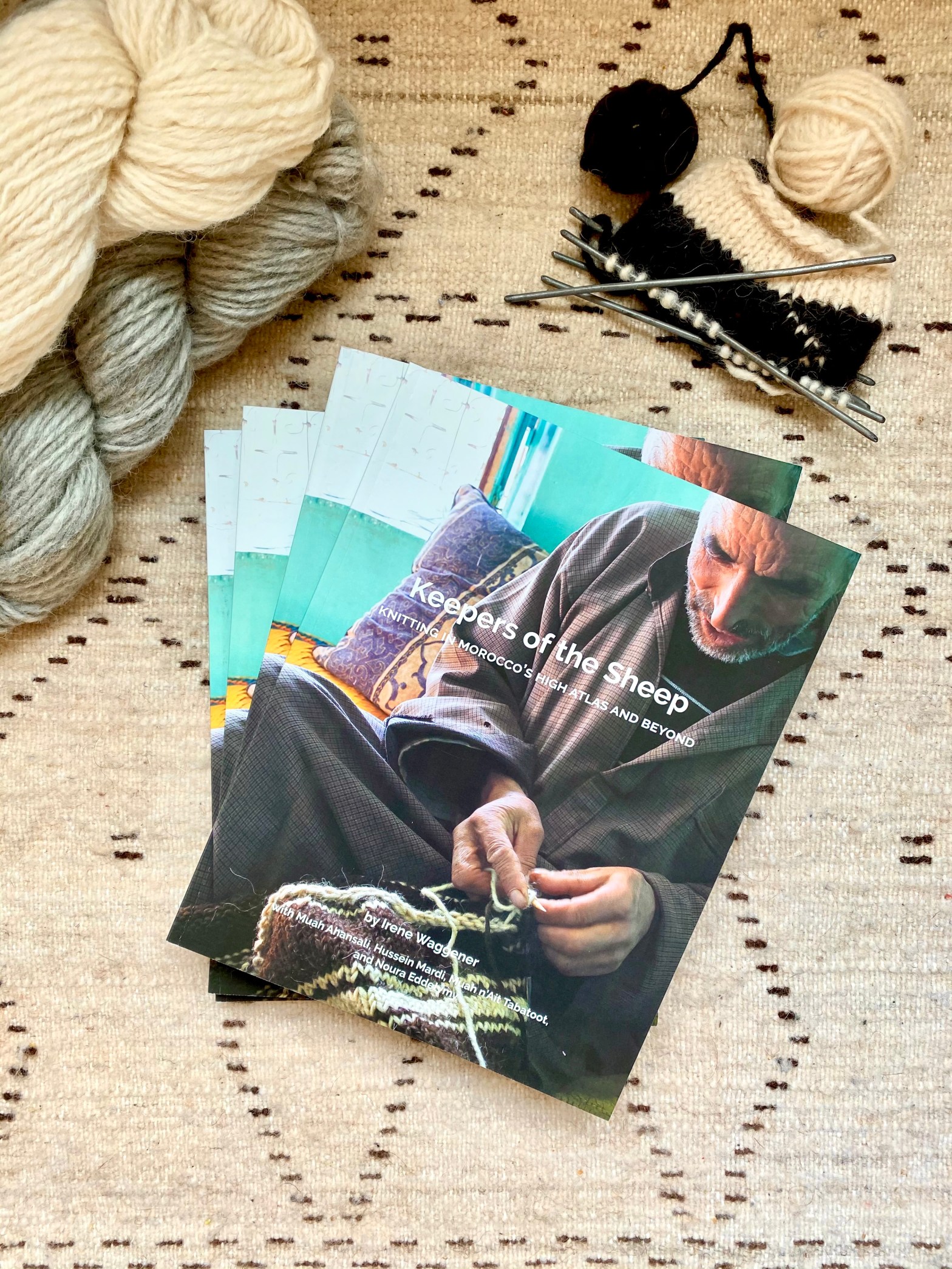
With the agreement of shepherd-knitters I met in the Aït Boulli valley, I started documenting their knitting patterns. Simultaneously, I attempted to connect this living tradition to evidence from Egypt by working backwards in time as far as the available historical, linguistic, and archaeological material would allow. This work resulted in the book, Keepers of the Sheep: Knitting in Morocco’s High Atlas and Beyond, which I wrote in collaboration with Muah Ahansali, Hussein Mardi, Muah n’Aït Tabatoot, and Nora Eddelymy.
It pleases me greatly that the book has been so well received by fellow knitters and textile enthusiasts who are just as interested as I am in the history of knitting. The knitters and community members with whom I worked in Morocco are also deeply touched by the interest in Moroccan knitting that the book has helped to generate. Thank you so very much to everyone who has supported our work by purchasing a copy of the book, sharing about it, or even just reaching out with kind words and encouragement. The goal of everyone who contributed to the book has always been to spread the word about knitting in North Africa in order to encourage more research on North African knitting and the inclusion of North African perspectives and knowledge in textile research.
Since the book has sold out, many people have reached out to me about whether or not I will do another print run. I am currently saving funds to publish an updated second edition in the (near-ish) future. This second edition will include further research, new photos, and new patterns. In the meantime, I am making available the e-book version of Keepers of the Sheep: Knitting in Morocco’s High Atlas and Beyond. You can purchase a copy from my Etsy or Ravelry shops. Because my work is self-funded, my portion of the proceeds from the sale of this e-book version will be used to produce the second edition.
Just as for the physical copies of the book, a portion of the proceeds from the sale of this e-book is donated to the women’s cooperative, Cooperative Ibilou, as requested by the shepherd-knitters who contributed their patterns. The cooperative uses these funds for community development projects that benefit everyone in the village.
*NOTE: I use the word disappear from my own perspective on the subject as an American educated in the United States and limited by the information available to me. There were/are people in northern Africa who possess knitting knowledge but whose voices haven’t reached global knitting and academic communities. It is my hope that this book contributes to bringing forward these perspectives.

